
The popular advice is to perfect the first thirty seconds of a sales call. That advice is incomplete. A polished opener can earn attention, but it won't close a deal if the rep misses the buyer's hesitation, answers the wrong objection, or rushes into a product pitch before understanding the business problem.
A useful sales meeting script works less like a speech and more like a set of decisions. It gives the rep a stable sequence, then leaves room to respond to what the buyer says. The strongest scripts are modular, time-boxed, and easy to score in roleplay. They help managers evaluate whether a candidate can control a conversation, listen actively, diagnose concern, and secure a meaningful next step.
Why Most Sales Meeting Scripts Fail Before Discovery Even Starts
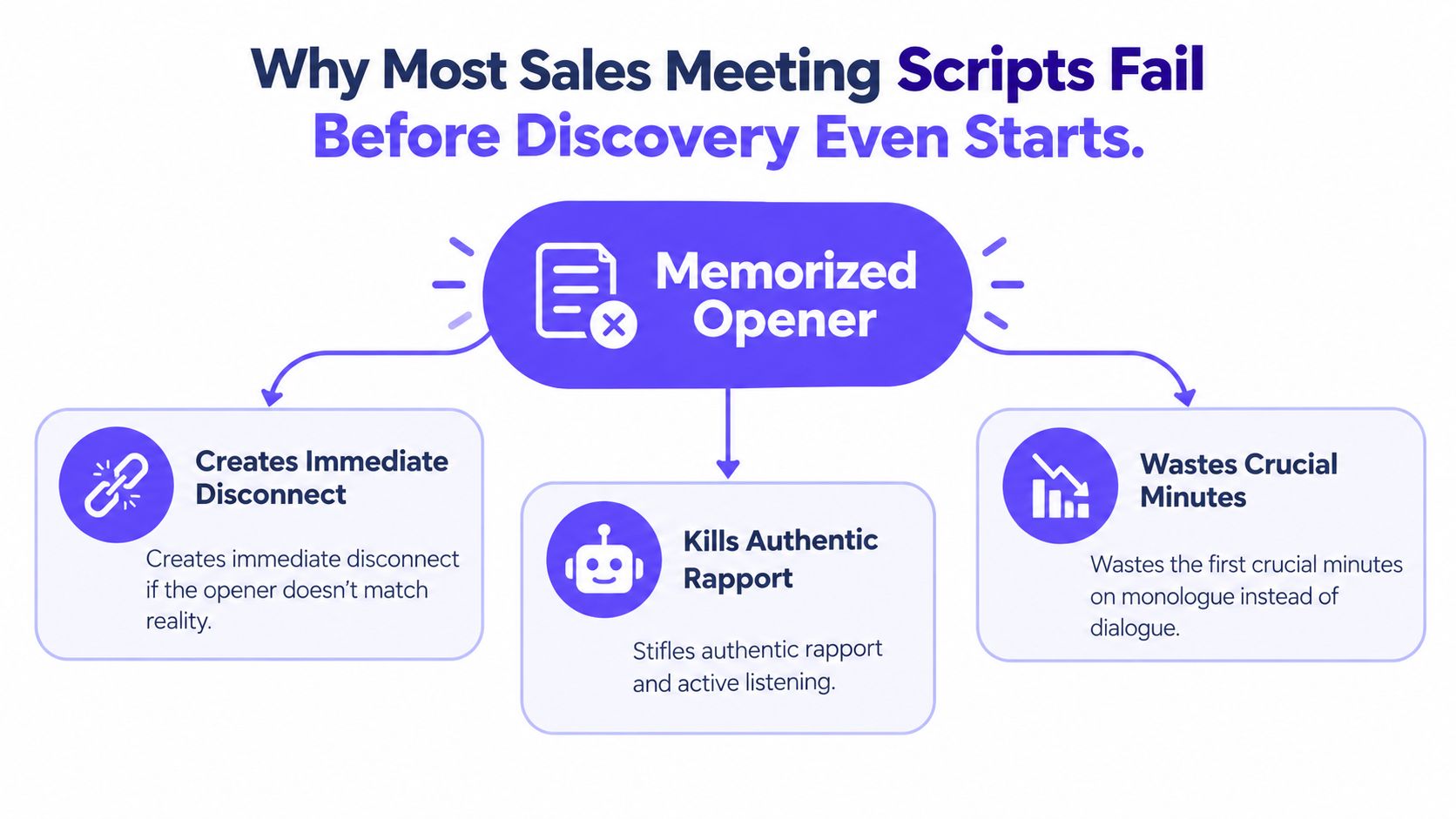
A rep can deliver an elegant opener and still lose the meeting immediately afterward. The failure usually starts when training rewards performance instead of responsiveness. Reps memorize wording, tone, and transitions, but they don't learn what to do when the buyer sounds rushed, skeptical, vague, or unexpectedly interested.
Three patterns appear repeatedly in weak calls:
- Theater instead of diagnosis: The rep performs a prepared introduction without checking whether the buyer's situation matches the premise.
- A monologue instead of a modular script: Word-for-word recitation leaves no practical branch for a dismissive answer or an unplanned concern.
- No recovery path: Once the opener misses, the rep either keeps pushing or abandons structure entirely.
The correction isn't another clever opening line. The correction is a script built from labeled blocks, such as opener, agenda, discovery, objection handling, and close. Each block should have a purpose, a transition condition, and observable behaviors that a manager can score.
A modern framework structures a 30-minute B2B discovery call into five timed phases: 0–2 minutes for an upfront contract, 2–10 minutes for situational questions, 10–22 minutes for pain and impact discovery, 22–26 minutes for objections, and 26–30 minutes for next steps, as outlined by B2B Sales Training's sales call structure framework. That framework also recommends a 43% speaking and 57% listening benchmark and cites Gong data showing 76% of top performers conduct pre-call research compared with 42% of average reps, which makes preparation and listening behaviors suitable for objective assessment.
Practical rule: Score the rep's response to the buyer's first unexpected answer, not just the quality of the prepared opener.
Changing the opener without changing the underlying operating system won't solve the problem. A candidate who can memorize a script may sound prepared, while a candidate who can adapt the script demonstrates the selling behavior that discovery requires.
The 30-Minute Sales Meeting Structure That Holds Up Across Deals
A durable structure gives every rep the same spine while allowing the content to change by persona, industry, and deal stage. The following four blocks translate the more detailed five-phase framework into a practical meeting agenda.
The opener uses 3 minutes to establish a contract
The purpose is shared context, not persuasion. The rep should identify the reason for the meeting, confirm the buyer's priorities, set the agenda, and make the conversation easy to redirect.
A useful transition sounds like: “If that works, a few questions should clarify whether this is relevant. Then the buyer can decide whether a deeper conversation makes sense.” The rep should move forward only after receiving a clear verbal agreement.
Discovery uses 15 minutes to expose the business situation
The purpose is diagnosis. Early questions should clarify the current process, stakeholders, tools, and trigger. Later questions should connect the problem to operational consequences, risk, internal pressure, or missed objectives.
The rep shouldn't treat the entire discovery block as a checklist. A strong answer earns a follow-up question. A shallow answer requires a narrower prompt. The transition into objections can be direct: “Based on what the buyer described, what concerns would need to be addressed before evaluating a change?”
Objection handling uses 7 minutes to test commitment
The purpose is clarity, not rebuttal speed. Objections should be surfaced before the final minute so the rep has time to understand what sits underneath the stated concern.
If the meeting is shortened to 20 minutes, the rep should protect the upfront contract, the most important pain question, and the next-step commitment. In a 45-minute meeting, extra time belongs to stakeholder alignment and decision process, not an unplanned feature tour.
The close uses 5 minutes to secure a real commitment
The purpose is forward motion. A next step should include an owner, an action, and a reason the action matters. “Let's talk soon” isn't a close. A concrete agreement might involve a technical review, an internal stakeholder, or a defined evaluation task.
Teams that need to connect meeting activity with attribution can use SourceLoop meeting attribution as a resource for tracking how meetings relate to revenue activity. The script itself should still stand on observable behavior. A recording should make it possible to answer one question for every block: what did the buyer agree to do next?
Opening Lines and Agenda Setting That Buy You the Rest of the Call
The opener should buy permission to diagnose, not force the rep to deliver a miniature pitch. The exact words can change, but the sequence should remain stable: acknowledge the buyer's context, anchor the purpose, and ask for agreement on the conversation.
A short cold-call version
For a cold interaction, the rep needs a compact reason for calling and a low-friction question:
“This is [name] from [company]. The reason for the call is [specific business issue]. Is that something the buyer is currently responsible for?”
If the buyer says they don't have time, the rep shouldn't launch into proof points. A better response is: “Understood. Is the issue irrelevant, or is now a difficult time?” That question separates a lack of fit from a timing problem.
A warm meeting version
For a scheduled meeting, the rep can use a longer agenda:
“The purpose of today's conversation is to understand how the buyer currently handles [process], where that creates friction, and whether a change is worth evaluating. Could the buyer share the most important outcome for this meeting before the conversation starts?”
The checkpoint should come before discovery:
“If the discussion shows a fit, the rep can outline a possible next step. If it doesn't, the buyer can say so. Does that work?”
Each line has a job. The acknowledgment shows attention. The anchor names a business outcome. The ask creates a mutual contract. Reps should pause after the ask and wait for a verbal yes.
| Scenario | Acknowledge | Anchor | Ask / Checkpoint |
|---|---|---|---|
| Cold call | “The buyer may be between priorities.” | “The call concerns [business issue].” | “Is that relevant to the buyer's role?” |
| Warm discovery | “The meeting is scheduled to discuss [topic].” | “The aim is to understand process, impact, and fit.” | “Would that be a useful agenda?” |
| Skeptical buyer | “The buyer may have evaluated similar options.” | “The discussion will test whether the situation is materially different.” | “Is it reasonable to explore that first?” |
Managers can score three behaviors during roleplay. Did the rep pause for agreement? Did the rep name the buyer's likely goal before pitching? Did the rep set a checkpoint for the end of discovery? These behaviors matter more than whether every phrase sounds polished. For more guidance on preserving buyer control while keeping a meeting focused, the call control techniques guide provides a useful companion resource.
Discovery Question Stacks by Persona and Deal Stage
Discovery questions should match the buyer's decision state and reveal what the buyer believes, fears, and needs to justify internally. Early-stage conversations establish context. Mid-stage conversations test pain and impact. Late-stage conversations examine process, risk, stakeholders, and approval criteria.
| Persona | Early Stage Focus | Mid Stage Focus | Late Stage Focus |
|---|---|---|---|
| Technical champion | Current architecture and workflow | Failure points, effort, and integration impact | Technical validation and internal advocacy |
| Operations leader | Process ownership and daily friction | Business disruption and priority | Implementation effort and operational risk |
| Economic buyer | Strategic objective and investment context | Financial or organizational consequence | Decision criteria, sponsorship, and approval path |
Technical champion in a mid-market SaaS deal
Start with the current workflow:
- “How does the team handle this process today?”
- “Which systems exchange data during that process?”
- “Where does the current approach create manual work or risk?”
Then test ownership and consequence: “When that issue occurs, who has to intervene?” followed by “What does that intervention delay?” A useful answer identifies a workflow, owner, consequence, or internal priority. “It's inefficient” describes discomfort, not yet a buying case.
Ask the implication question only after the technical issue is clear: “If the current process remains unchanged, what becomes harder for the team or the business?” The buyer's response shows whether the champion sees a local inconvenience or a problem worth sponsoring internally.
Time-poor operations leader in an SMB purchase
Keep the questions tied to daily execution:
- “Which part of the process consumes the most management attention?”
- “What happens when the process breaks or falls behind?”
- “What would improve first if the team solved that problem?”
A narrow stack works better here. An operations leader with limited time does not need an inventory of every frustration. The rep needs to identify the operational problem that creates enough urgency for action, then confirm whether the buyer has authority or a clear path to involve the right person.
Economic buyer at an enterprise account
Late-stage discovery should connect the initiative to business priorities and decision mechanics:
- “Which company objective is connected to this initiative?”
- “What consequence follows if the objective remains unmet?”
- “Who must be confident in the decision, and what evidence will each stakeholder require?”
The pause matters as much as the wording. After each question, stay silent for roughly three seconds, avoid rescuing the buyer, and use the answer to select the next layer. Candidates should roleplay these pauses and be scored on whether they let the buyer finish, identify the underlying concern, and choose a relevant follow-up.
A candidate should be scored on question depth, not question count. Managers can rate whether the rep moved from context to impact, connected the issue to the buyer's priorities, and tested what would make action safe. A long list of surface prompts can sound polished while leaving the buyer's actual state of mind untouched. Reps should learn the sequence through roleplay, then adapt it to the answer instead of memorizing every line.
Objection Handling as a Diagnostic Skill Not a Rebuttal
An objection rarely tells you the whole story. It may signal weak urgency, a poor fit, or a competing priority. The rep's job is to identify the buyer's state of mind before choosing a response. A polished rebuttal delivered against the wrong diagnosis usually makes the conversation less credible.
Use three categories to organize the script:
- Brush-off: The buyer is trying to end an interaction that feels unclear or low-value.
- Fit: The buyer doubts that the solution matches a requirement, environment, or workflow.
- Timing: The buyer sees relevance but cannot prioritize action now.
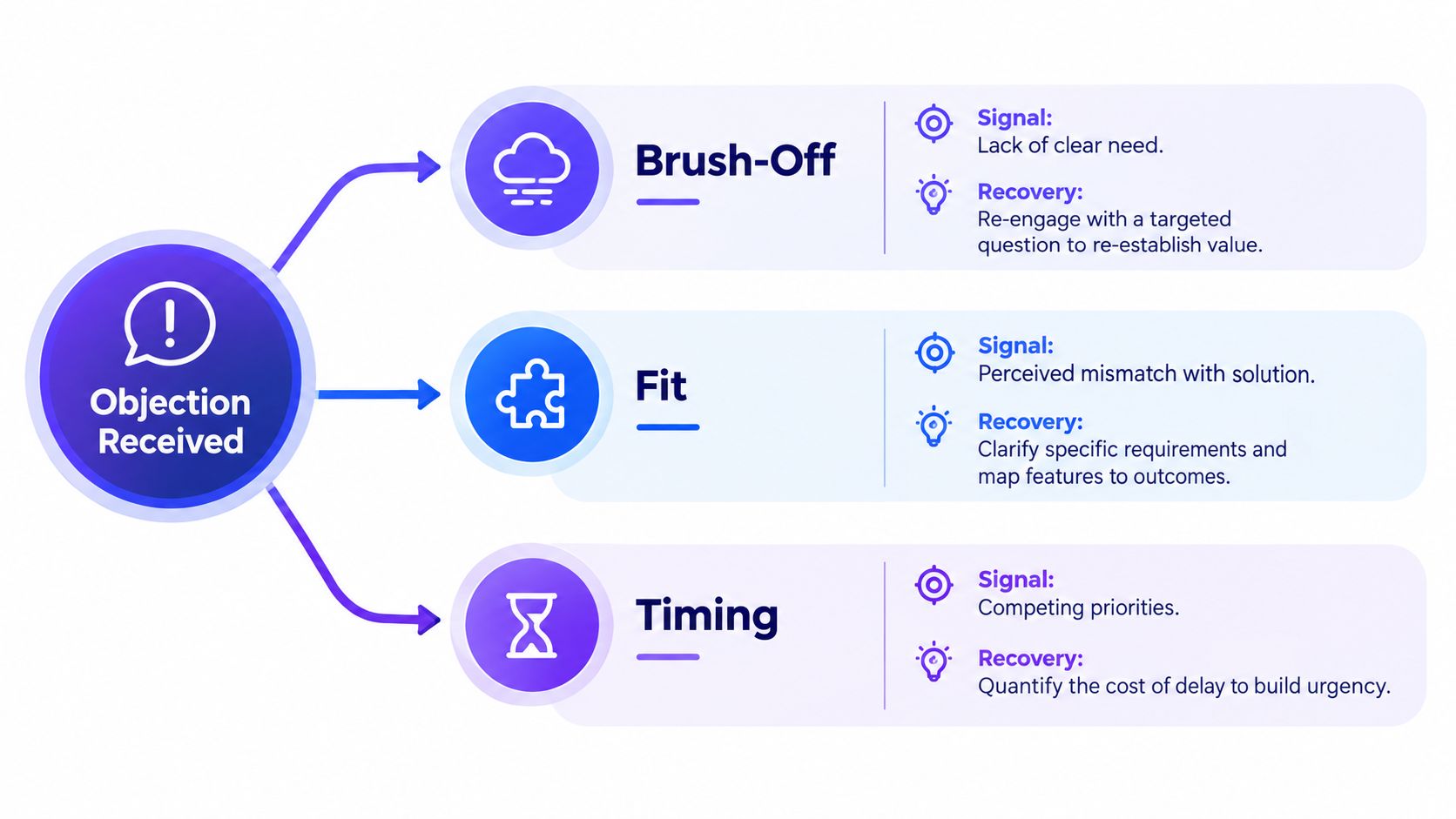
The analysis in B2B Sales Training's objection script analysis supports a practical sequence: acknowledge the concern, clarify what sits behind it, then respond conditionally. Candidates should roleplay each branch and receive scores for diagnosis, listening, and response selection. Memorizing the wording is less useful than recognizing which branch the buyer has entered.
“Send me some information”
- Acknowledge: “That makes sense. You may want to review this independently.”
- Diagnose: “What would the information need to clarify for it to be useful?”
- If the issue is relevance: “I can send a short summary focused on that workflow, then confirm whether it answers the question.”
- If the issue is timing: “Let's agree on when you will review it and schedule a brief decision conversation.”
The score should reflect whether the rep uncovered a review criterion, not whether the rep sent material quickly.
“We already use a competitor”
- Acknowledge: “That existing investment is important context.”
- Diagnose: “What does the current solution handle well, and where does it still leave friction?”
- If the gap is fit: “Focus the conversation on that requirement rather than proposing a full replacement.”
- If there is no meaningful gap: “Acknowledge that a change may not be justified and leave the door open.”
“It is too expensive”
- Acknowledge: “The budget needs to make sense against the expected business outcome.”
- Diagnose: “Is the concern the total investment, the timing of spend, or uncertainty about the return?”
- If the issue is uncertainty: “Define the evidence the buyer needs to evaluate value.”
- If the issue is budget timing: “Identify the planning cycle and the conditions for reconsideration.”
“Now is not the right time”
- Acknowledge: “You may have a valid competing priority.”
- Diagnose: “What would need to change for this problem to become active?”
- If the trigger is known: “Agree on the event that should restart the conversation.”
- If the trigger is unclear: “Ask whether the problem is important enough to monitor.”
A rebuttal-first rep treats the buyer's words as resistance. A diagnostic rep treats them as incomplete information and tests the missing detail. Teams can use overcome objections with LiveDocument alongside the objection handling training framework to structure practice. Score each candidate on whether they acknowledged the concern, asked a relevant diagnostic question, allowed the answer to finish, and selected a conditional response. That standard reveals whether the script works under pressure, rather than merely sounding polished in rehearsal.
Adapting the Same Script for Cold, Mid-Market, and Enterprise Calls
A single modular script should travel across selling contexts, but the time budget and close must change. Reps shouldn't memorize separate monologues for every segment. They should preserve the block sequence and swap the depth, language, and commitment level.
| Call Context | Keep | Cut | Add |
|---|---|---|---|
| SDR cold call | Reason for calling and one diagnostic question | Long agenda and product explanation | Permission to continue or a meeting ask |
| Mid-market discovery | Agenda, focused discovery, objection diagnosis | Broad stakeholder mapping | Clear next step with the primary decision maker |
| Enterprise meeting | Agenda and diagnostic questioning | Premature hard close | Stakeholder map, individual priorities, and process confirmation |
SDR cold call
The opening should be brief. A practical version is: “This is [name] from [company]. The reason for the call is [issue]. Is that relevant to the buyer's role?” If interest is absent, the rep should cut the value explanation rather than force the full meeting script into the interaction.
Cold calls are typically 2–3 minutes long and should be treated as meeting-booking interactions rather than product demonstrations, according to the sales call structure guidance from Prospeo. That source also states that a prospect gets only 93 seconds of actual conversation on average in a 30-minute discovery setting, reinforcing the need to move quickly from context into qualification.
Mid-market discovery
The rep can spend more time on current process, impact, and alternatives. The close should confirm a specific action by the end of the scheduled meeting, ideally with the person who owns the decision or the next stage.
Enterprise multi-stakeholder meeting
Enterprise calls require a softer commitment. The rep should ask what each attendee needs to validate, how the buying process works, and which internal groups need to participate. “Would the buyer like to move forward?” is often premature. “What process should the team follow to determine whether this deserves a formal evaluation?” is more useful.
Teams refining adjacent outbound motions can use a practical cold email for sales guide to keep messaging consistent across channels. The principle remains the same: preserve structure, then adapt the branch.
Practicing the Script With Roleplay and AI Simulations That Score It
A script becomes useful only when reps practice the behaviors it requires. A 30-minute roleplay should resemble a real call, not a friendly rehearsal where the buyer agrees with every prompt.
A repeatable human roleplay protocol
The manager assigns a persona and shares only the buyer brief. The brief should include the company context, role, current process, pains, objections, competitors, and technology environment. The rep receives the scenario, prepares independently, and follows the same time boxes used in live discovery.
The partner should not volunteer every detail. The buyer reveals information only when the rep asks a relevant question or earns deeper access through a useful follow-up. This design tests whether the rep can recognize a vague answer and respond without returning to the prepared script.
Four behaviors deserve explicit scores:
- Pause ratio: Does the rep leave enough space after important questions and objections?
- Question depth: Does the rep move from context to cause, impact, and implication?
- Diagnosis before rebuttal: Does the rep clarify the concern before offering a response?
- Next-step commitment: Does the rep secure an owner, action, and reason for continuation?
Formal and ongoing training matters because independent industry summaries report that 70% of trained representatives hit quarterly quotas versus 45% without ongoing training, alongside a cited 20% higher win rate and 353% return on training spend, as compiled by ZipDo's sales training statistics summary. The same summary cites that 84% of training content is forgotten within three months without reinforcement, so a single workshop shouldn't be treated as enablement.
Where AI simulations add value
AI simulations can generate buyer variants that a human partner may not consistently reproduce. One scenario can become a skeptical champion, a rushed operator, or an economic buyer who agrees with the problem but resists commitment. The system can record the call, transcribe it, and score the same criteria across candidates or reps.
| Practice Dimension | Human Roleplay | AI Simulation |
|---|---|---|
| Buyer realism | Nuanced interpersonal reactions | Consistent persona behavior at scale |
| Variation | Limited by partner availability | Multiple roles, objections, and deal stages |
| Coaching | Rich verbal feedback | Repeatable transcript and rubric scoring |
| Standardization | Can vary by manager | Same scenario and criteria for every participant |
| Adaptability | Strong for complex judgment | Strong for repeated deliberate practice |
Sales role-play guidance can help managers structure the exercise around observable actions rather than personality. An AI assessment platform such as Overvue lets candidates and reps practice simulated conversations with AI buyers, with calls recorded and scored against criteria including objection handling, call control, responsiveness, and next-step execution.
A practical first-quarter cadence combines scheduled human roleplay with repeated AI practice. Managers should review score changes by script block, such as discovery depth or objection diagnosis, rather than label an entire call “good” or “bad.” That approach turns the sales meeting script into a measurable training asset and gives each rep a specific behavior to improve before the next live conversation.
Overvue provides AI sales roleplay for candidate assessment and team training, using standardized buyer scenarios, recorded conversations, and objective scoring across selling criteria. Sales leaders can use the platform to compare candidates consistently or give new reps a safe place to practice objections, call control, and next-step execution. Visit Overvue to build a repeatable evaluation and training process around the sales meeting script.