
A sales training program can be busy and still fail to change how reps sell. Attendance, course completion, and product knowledge don't prove that a seller can uncover business pain, respond to a price objection, or secure a credible next step in a live buyer conversation. Kirkpatrick's four-level model, first published in 1959, established a more useful evaluation sequence across reaction, learning, behavior, and results, and later sales training research reinforced the need to measure workplace application rather than classroom satisfaction alone (sales training evaluation background).
The strongest sales training topics therefore describe observable selling behavior. New hires need foundational modules that build basic execution. Active sellers need practice for the stages where deals stall. Senior account executives, enterprise teams, and customer success professionals need advanced skills for complex buying groups, competition, negotiation, and expansion.
Each topic below connects four decisions: what capability to develop, which role and deal stage it serves, what practice to run, and how managers can measure application. The most effective programs also use one ICP-based roleplay standard across hiring, onboarding, and continuous coaching, so the same expectations guide candidate assessment and rep development.
1. Objection Handling and Rebuttal Techniques
Objection handling develops a seller's ability to distinguish a genuine concern from a vague delay, acknowledge the buyer's position, and respond without becoming defensive. It matters most for SDRs handling first-contact resistance, AEs working through mid-funnel concerns, and senior sellers managing price, timing, risk, competition, or internal approval.
A useful exercise starts with the company's actual ICP. A manager can create buyer personas for a finance leader, operations executive, technical evaluator, and economic buyer, then assign each persona a different concern. A rep shouldn't memorize a rigid script. The rep should practice clarifying the objection, confirming its meaning, connecting the response to the buyer's stated priorities, and asking whether the concern has been resolved.
Objection handling training can support repeatable AI roleplay built around realistic buyer situations. Recorded customer calls should supply the scenario library, while top performers can help refine responses that sound credible rather than rehearsed.
Practical rule: A rebuttal isn't successful because it sounds persuasive. It succeeds when the buyer gives new information, agrees to a useful action, or identifies the remaining barrier.
Managers should score four behaviors:
- Diagnosis: Did the rep explore what sits behind the objection?
- Empathy: Did the rep recognize the buyer's concern without conceding prematurely?
- Relevance: Did the response connect to the ICP's business context?
- Progression: Did the rep test resolution and establish a next step?
Daily scenario rotation builds recall, but call review shows whether the behavior transfers to real opportunities. Pipeline outcomes can then reveal which objections repeatedly stall deals and deserve deeper practice.
2. Discovery and Needs Analysis
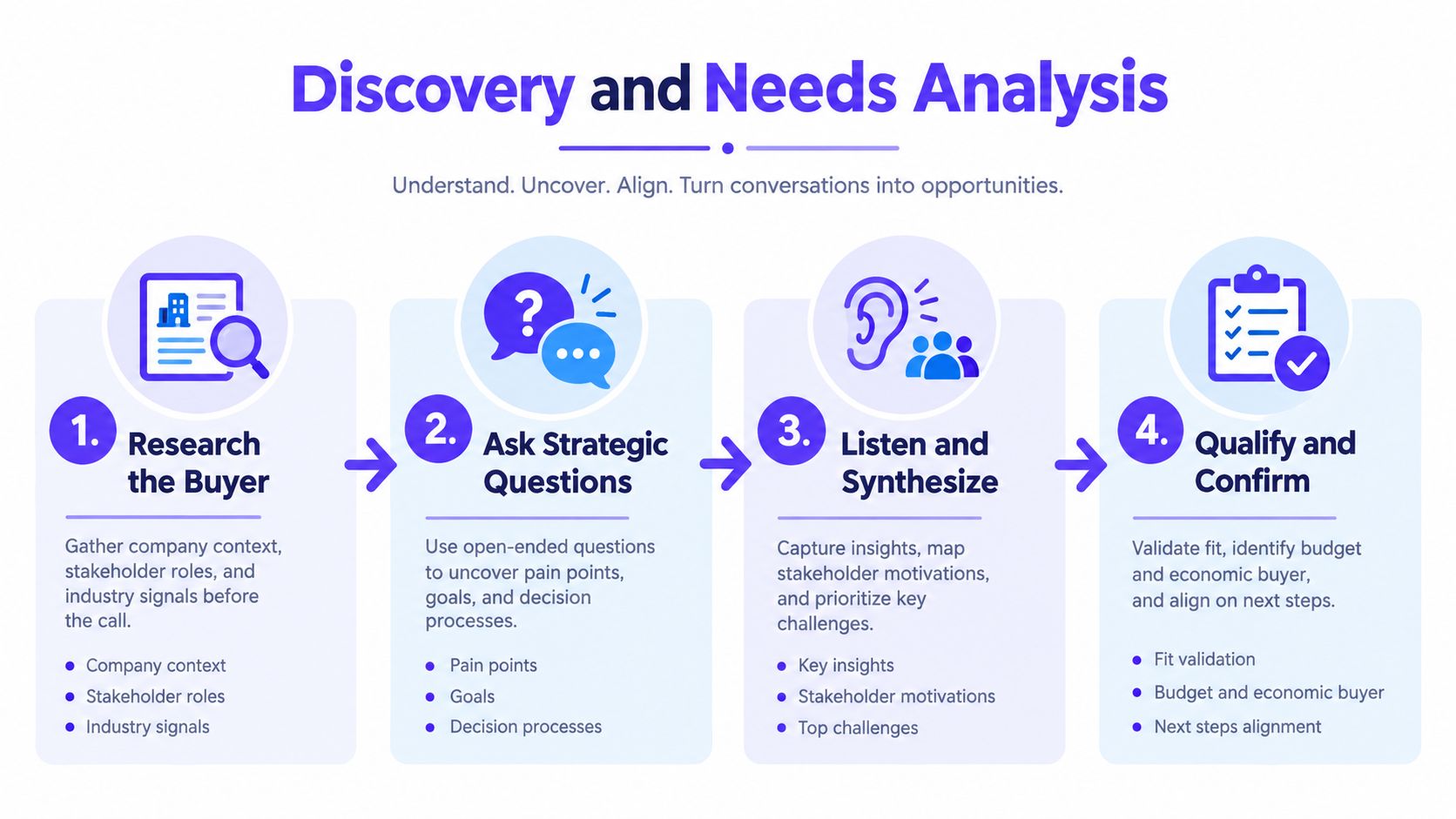
Discovery is where a seller earns the right to position a solution. The capability includes asking open questions, probing vague answers, listening for business impact, identifying stakeholders, and turning scattered comments into a shared view of the problem. It serves new SDRs and AEs during early conversations, while enterprise sellers need additional practice with multi-threaded discovery across departments.
A discovery roleplay should reflect a real account, not a generic “interested prospect.” The buyer persona needs a business context, current process, pain, desired outcome, decision process, and reason for considering change. The rep should leave the conversation knowing what the buyer wants to improve, why it matters, who else is involved, and what evidence would justify a decision.
Managers can compare novice and advanced performance through the same rubric. A new hire might need to demonstrate question sequencing and accurate summarization. An experienced AE should surface consequences, quantify priorities where the buyer can support them, and test the decision path without turning the call into an interrogation.
A practical discovery practice loop
- Prepare: Build role-specific question maps for each ICP segment.
- Practice: Use AI personas that reveal information only when the rep asks relevant follow-up questions.
- Review: Compare transcripts from strong and weak discovery calls.
- Apply: Require every live discovery call to end with a documented problem statement and mutual next action.
Completion isn't enough. Managers should inspect whether CRM notes capture the buyer's language, identified stakeholders, business drivers, and decision criteria. Call quality reviews can also track whether reps ask thoughtful follow-ups instead of moving quickly into a demo.
3. Prospecting, Outreach, and Pipeline Generation
Prospecting training develops the ability to select worthwhile accounts, research relevant triggers, write specific messages, and create conversations across email, phone, and professional networks. It primarily serves SDRs and BDRs, but full-cycle reps also need it when they own pipeline creation or enter a new territory.
The role and skill level should determine the exercise. A new SDR can research an ICP account and write an opening message for one buyer role. A seasoned outbound rep can design a coordinated sequence for several stakeholders, explain the relevance of each touch, and adapt the message after a response. Tools such as LinkedIn Sales Navigator, ZoomInfo, Apollo, and SalesLoft can support execution, but technology doesn't replace judgment about account fit or message relevance.
A manager can run a prospecting lab around one target account. Each rep identifies the likely business problem, selects a credible reason to contact the buyer, drafts a concise opener, and practices the first phone exchange. AI roleplay can introduce common interruptions, skepticism, or requests for information before a meeting is accepted.
The measurement system should separate activity from quality:
- Account selection: Does the prospect fit the defined ICP?
- Message relevance: Does the opener reflect the buyer's role and likely priorities?
- Conversation skill: Can the rep respond naturally to resistance?
- Pipeline quality: Do resulting meetings meet the agreed qualification standard?
The sales training software market was estimated at USD 2.68 billion in 2024 and is projected to reach USD 6.11 billion by 2030, with a projected 15.1% CAGR from 2025 to 2030 (sales training software market data). That growth points to demand for scalable practice, but managers should still judge platforms by whether reps improve live prospecting behavior.
4. Active Listening and Emotional Intelligence
Active listening is a performance skill, not a personality trait. Sellers must notice what the buyer says, what the buyer avoids, changes in confidence or urgency, and the difference between a surface complaint and a strategic concern. Emotional intelligence helps a rep adjust tone, acknowledge uncertainty, and preserve trust when the conversation becomes difficult.
This topic serves every customer-facing role, but the practice should change by stage. New hires can rehearse paraphrasing and follow-up questions in discovery. Mid-funnel AEs can practice responding when a champion becomes hesitant. Enterprise sellers can work through meetings where one stakeholder supports the project and another resists it.
A manager can use call recordings to assess whether the rep interrupts, jumps to recommendations, or misses a meaningful cue. The review should focus on observable behaviors rather than personality judgments. Useful evidence includes accurate summaries, relevant follow-up questions, pauses after important statements, and language that confirms the buyer's perspective.
Active and passive listening guidance can complement peer review and AI simulations. A simulated buyer can change tone or introduce ambiguity, forcing the rep to respond to the conversation rather than wait for a scripted keyword.

Buyers don't need a seller to agree with every concern. They need evidence that the seller understood it accurately.
Managers can score listening through transcript-based reviews, buyer summaries, peer feedback, and the quality of the next question. The result should guide the next practice assignment, not produce a rating.
5. Value Proposition and Solution Positioning
Value positioning teaches sellers to connect a solution to the buyer's priorities, consequences, and desired business outcome. It prevents product tours from replacing commercial conversations. SDRs need a concise relevance statement, new AEs need persona-specific positioning, and senior sellers need to build a business case for several stakeholders with different definitions of value.
A strong exercise uses one product and several ICP personas. The operations leader may care about process consistency, the finance leader about risk and efficiency, and the executive sponsor about strategic impact. Each rep should deliver a short explanation that starts with the buyer's situation, connects the solution to a meaningful change, and makes clear why the proposed approach is preferable to doing nothing.
Managers should challenge unsupported claims. If a rep says a solution will save time, the buyer should be asked how that time is currently spent and what decision depends on the improvement. If a rep mentions return on investment, the rep should explain the assumptions and identify what the buyer would need to validate.
What managers should inspect
- Persona fit: Does the message match the stakeholder's responsibilities?
- Outcome clarity: Does the buyer understand what changes?
- Differentiation: Does the rep explain why this approach matters?
- Credibility: Are claims grounded in known customer evidence or validated assumptions?
- Adaptation: Can the rep revise the message after new discovery information?
AI roleplay works well here because the same positioning can be tested against different buyer contexts. Real call recordings reveal whether reps preserve that clarity when a buyer interrupts, asks about features, or requests a demo before discussing impact.
6. Qualification and Pipeline Management
Qualification training protects seller time and improves the accuracy of pipeline decisions. It develops the judgment to assess fit, urgency, business impact, stakeholders, decision criteria, and the path to approval. AEs, sales managers, and revenue operations leaders need this capability most, while SDRs need a simpler version focused on whether a meeting deserves progression.
A qualification framework only helps when stages have observable exit criteria. “Good conversation” isn't a stage requirement. A better standard might require a confirmed business problem, an identified decision process, a credible timeline, and agreement about the next evaluation step. The exact criteria should reflect the company's sales motion and ICP.
Managers can use weekly reviews to separate active opportunities from hopeful records. A rep should explain what is known, what remains unverified, who supplied the information, and what action will close the gap. Disqualification practice matters too. A respectful conversation that identifies poor fit is more valuable than keeping every prospect in the forecast.
MEDDIC versus BANT comparison can help leaders choose language that fits their deal complexity, but the framework shouldn't become a form-filling exercise. Reps need to understand why each qualification element changes resource allocation or forecast confidence.
A practical scorecard can assess:
- Fit: Does the account match the ICP and use case?
- Pain: Is the problem material enough to support action?
- Power: Are the relevant decision-makers and influencers known?
- Process: Is the buying path understood?
- Progress: Has the buyer made a reciprocal commitment?
Measurement should connect rubric-based proficiency to CRM behavior, including accurate stage movement, documented evidence, and timely removal of stalled deals.
7. Competitive Positioning and Win/Loss Strategy
Competitive training prepares sellers to create preference when buyers compare vendors, internal projects, or the status quo. The skill isn't reciting a battle card. It involves identifying the buyer's decision criteria, understanding how alternatives satisfy them, and changing the comparison when the current frame favors a competitor.
This topic is most useful for mid-to-senior AEs, enterprise sellers, solution consultants, and account teams operating in crowded categories. New hires can learn basic competitor facts, but experienced reps should practice live conversations where the buyer praises a rival's feature, cites an incumbent relationship, or asks for a discount to match another proposal.
A useful scenario begins with the buyer's stated alternative. The rep must ask what the buyer values about that option, test whether the benefit is decisive, and then position the company's strengths against the actual evaluation criteria. That approach is safer than attacking a competitor or repeating claims the buyer can't verify.
Build competitive practice from evidence
- Win and loss themes: Review why buyers selected or rejected alternatives.
- Battle-card discipline: Keep competitor guidance short, current, and tied to buyer outcomes.
- Third-option framing: Help reps introduce a different way to evaluate the problem.
- Reference matching: Connect prospects with relevant customer experiences only when the reference is appropriate.
- Manager calibration: Score the same competitive scenario across roles and experience levels.
Quarterly reviews can update the scenario set after product changes, market shifts, or recurring customer feedback. The measurement should focus on differentiation quality, discovery depth, accuracy, and the rep's ability to preserve trust under pressure.
8. Call Control, Next Steps, and Close Execution
Call control doesn't mean dominating the buyer. It means creating enough structure for the conversation to produce a decision, a useful discovery outcome, or a clearly defined next action. New SDRs need agenda-setting and time management. AEs need control across discovery, demos, and evaluation meetings. Senior sellers need to coordinate multiple stakeholders and secure commitments that survive internal handoffs.
A practical drill starts with a meeting objective, a time boundary, and a desired outcome. The rep opens by confirming the agenda, redirects tangents without dismissing them, checks alignment before moving forward, and closes by naming owners, dates, dependencies, and the buyer's approval path. The manager should then inspect whether the next step advances the deal or merely schedules another conversation.
Multi-stakeholder roleplay exposes weaknesses that solo practice misses. One buyer may want technical detail, another may challenge the business case, and a third may remain silent. The rep must acknowledge each perspective while keeping the group focused on a decision process.
A calendar invitation isn't a next step. A next step names the action, owner, evidence, and decision point.
Managers can score agenda clarity, relevance of transitions, stakeholder inclusion, commitment quality, and CRM documentation. Call recordings should be reviewed for moments when the rep lost control, rushed the close, or accepted a vague promise. Daily challenges can reinforce bridging language, summary statements, and commitment checks without forcing reps into identical talk tracks.
9. Remote and Virtual Selling Skills
Remote selling requires more than knowing how to turn on a camera. Reps must create engagement through video, phone, email, shared screens, and asynchronous updates while managing the limits of digital attention. SDRs need concise video and phone openers. AEs need virtual discovery and demo facilitation. Enterprise teams need methods for coordinating distributed buying groups.
The best exercise recreates the technical and conversational pressure of a real meeting. A rep should open with a clear purpose, confirm the participants' priorities, use screen sharing only when it adds value, invite questions, and recover smoothly when technology fails. The practice should include a buyer who stays quiet, multitasks, or asks for materials instead of committing to a discussion.
Managers should assess the buyer's experience, not the rep's camera setup alone. Useful criteria include pacing, visual clarity, purposeful use of demonstrations, participation from remote stakeholders, and the quality of asynchronous follow-up.
Combine synchronous and asynchronous practice
- Video meeting: Practice agenda-setting, discovery, and stakeholder engagement.
- Phone call: Train vocal clarity, concise questioning, and objection response without visual cues.
- Async message: Write a follow-up that summarizes value and proposes a specific action.
- Screen-share rehearsal: Demonstrate only the workflow connected to the buyer's stated problem.
- Recovery scenario: Continue productively after a connection, audio, or access issue.
The global market projection for sales training software suggests demand for digital and scalable formats, but a platform won't fix passive virtual delivery. Managers should blend live facilitation, recorded review, and repeated simulation so remote skills become part of normal selling behavior.
10. Customer Success and Account Expansion Selling
Expansion selling develops the ability to protect customer value after the initial deal, identify new use cases, and earn the right to discuss additional scope. It serves customer success managers, account managers, renewal owners, and AEs responsible for land-and-expand motions. The relevant stage begins after implementation, but the behavior starts during the original sale when the team defines success and adoption conditions.
A strong training scenario gives the rep an existing customer with a specific outcome, an unresolved adoption issue, and a possible expansion signal. The rep must review progress, ask about changing priorities, identify stakeholders affected by the next use case, and distinguish a genuine customer need from an opportunistic upsell.
Managers can use account plans, customer reviews, adoption evidence, and mutual success plans to assess execution. The rep should be able to explain what value the customer has received, what remains incomplete, and why an additional solution or user group would support the customer's stated goals.
Practice the conversation before the renewal window
QBR simulations can include an executive sponsor who wants business impact, an operational user who reports friction, and a procurement stakeholder who asks about commercial terms. The rep needs to preserve trust while coordinating the account team and identifying the appropriate next action.
Useful measures include the quality of success-plan documentation, stakeholder coverage, risk identification, follow-up discipline, and the evidence supporting an expansion recommendation. Training should also include reference development, customer advisory participation, and collaboration between sales, success, product, and delivery teams. Expansion is sustainable only when the customer's outcome remains central to the commercial conversation.
11. Advanced Value Positioning for Expansion and Executive Conversations
Expansion positioning requires account judgment, not a second introductory pitch. Senior AEs, account executives handling complex renewals, customer success leaders, and specialists presenting to executive sponsors must connect incremental spend to a customer's current business case, internal politics, and evidence of progress.
This module belongs late in the learning path, after discovery and qualification practice. Reps should first learn to identify who benefits from broader adoption, who controls the decision, and what approval risks could delay it. Otherwise, the conversation becomes a polished presentation that ignores the account's actual constraints.
Use a standardized ICP-based roleplay with an existing customer, a defined expansion trigger, and different stakeholder priorities. The rep must position one solution for an operational user, a department leader, and an executive sponsor. The user may care about workflow friction, the leader about consistency across teams, and the executive about whether the investment supports a broader priority. The rep should distinguish verified customer evidence from assumptions and ask each stakeholder to validate the proposed value.
Managers can score whether the rep:
- Builds from known evidence: The message uses verified account context and separates outcomes already achieved from expected results.
- Justifies incremental spend: The rep links broader adoption to a stated business priority and explains the cost of inaction.
- Handles internal politics: The conversation addresses competing stakeholders, ownership, and approval risk.
- Avoids feature dumping: Product detail supports the expansion case rather than replacing it.
- Secures alignment: The meeting ends with an agreed evaluation, stakeholder action, or success measure.
AI simulations can vary account history, buyer seniority, and expansion trigger while keeping the same rubric. That connects hiring assessments, onboarding practice, and continuous coaching, while giving managers comparable evidence across roles and skill levels.
11-Point Sales Training Topics Comparison
| Topic | 🔄 Implementation Complexity | ⚡ Resource Requirements | 📊 Expected Outcomes | 💡 Ideal Use Cases | ⭐ Key Advantages |
|---|---|---|---|---|---|
| Objection Handling and Rebuttal Techniques | Medium, requires iterative refinement and roleplay | Moderate, coach time, call review, AI practice | Higher close rates; fewer stalls | Competitive deals; negotiation-heavy conversations | Repeatable rebuttal frameworks; increased rep confidence |
| Discovery and Needs Analysis | Medium–High, requires disciplined questioning & synthesis | Moderate, training, call recording, analysis tools | Better qualification; faster progression; lower churn | Early-stage qualification; complex B2B deals | Deeper customer fit; stronger positioning |
| Prospecting, Outreach, and Pipeline Generation | Medium, process-driven cadences and testing | High, data tools, automation, SDR time | Predictable pipeline; scalable outreach | SDR/BDR teams and demand gen | Scalable, repeatable pipeline; faster ramp for reps |
| Active Listening and Emotional Intelligence | High, long-term behavioral change | Low–Moderate, coaching, call review, practice | Stronger relationships; improved retention | Relationship selling and CSM work | Builds trust, reduces defensive responses |
| Value Proposition and Solution Positioning | Medium, needs product & market alignment | Moderate, market research, case studies, enablement | Larger deals; less price sensitivity | Competitive or enterprise positioning | Clear differentiation; improved win rates |
| Qualification and Pipeline Management | Medium, framework adoption and governance | Moderate, CRM discipline, scorecards, reviews | Better forecast accuracy; fewer dead deals | Pipeline hygiene and forecast-driven orgs | Predictable pipeline; efficient resource allocation |
| Competitive Positioning and Win/Loss Strategy | Medium, continuous intel and analysis | Moderate, research, win/loss programs | Higher win rates vs. key competitors | Competitive deal situations | Stronger pricing discipline; targeted rebuttals |
| Call Control, Next Steps, and Close Execution | Medium, nuance in timing and stakeholder management | Low–Moderate, templates, roleplay, CRM follow-up | Faster deal velocity; clearer accountability | Closing calls; multi-stakeholder meetings | Reduces scope creep; increases next-step conversion |
| Remote and Virtual Selling Skills | Low–Medium, tech & presentation adaptation | Moderate, video tools, async content, training | Broader market reach; reduced travel cost | Distributed buyers; virtual-first sales | Scalable, recorded coaching; cost-efficient engagement |
| Customer Success and Account Expansion Selling | High, cross-functional alignment and long-term focus | Moderate, CSM resources, success metrics, integrations | Increased LTV; predictable renewals and expansion | Post-sale growth and renewal scenarios | Drives expansion revenue; improves churn metrics |
| Value Proposition and Solution Positioning (duplicate) | Medium, needs product & market alignment | Moderate, market research, case studies, enablement | Larger deals; less price sensitivity | Competitive or enterprise positioning | Clear differentiation; improved win rates |
Turn Topics Into a Role-Based Training Path
A list of sales training topics becomes useful only when sales leaders turn it into a sequence of observable behaviors. New hires shouldn't receive the same curriculum as enterprise closers, and customer success managers shouldn't be measured against outbound SDR criteria. Role, deal stage, and proficiency should determine both the practice scenario and the standard for passing it.
A foundational path for new sellers can begin with prospecting, active listening, discovery, value positioning, and objection handling. These modules establish the behaviors that shape early buyer conversations. Reps should practice with ICP-based personas, receive a consistent score, and repeat the scenario after targeted feedback. Product knowledge can support the exercise, but it shouldn't replace evidence that the rep can apply the knowledge conversationally.
Once reps handle basic conversations reliably, managers can add qualification, pipeline management, call control, next-step execution, and close preparation. These skills belong in live deal reviews as well as simulations. A rep who can describe qualification criteria in a course may still fail to challenge a weak opportunity, document missing evidence, or secure a reciprocal commitment. Training should therefore inspect CRM behavior, call quality, and stage progression alongside completion or certification.
Advanced and role-specific development can then focus on competitive positioning, remote selling, expansion, executive value communication, and AI-assisted selling. AI deserves treatment as a selling capability, not only a software lesson. Recent coverage identifies digital selling as the least addressed area in sales training, with 48% of sales leaders saying it is underaddressed, while reps spend about 70% of their week on tasks AI could automate (sales training topics and AI-assisted selling coverage). The practical question is which behaviors should remain human-led, which tasks can be delegated, and how managers will assess judgment, accuracy, buyer trust, and responsible use.
Training frequency also matters. One source reports that 39% of reps consider coaching too generic, 50% want coaching focused on skill development rather than pipeline reviews, and enterprise training often relies on roughly four coaching touchpoints per year (sales training best practices for 2026). These figures point to a design problem, not a need for endless content. Practice loops, feedback quality, and manager consistency should receive more attention than another disconnected module.
A practical implementation sequence looks like this:
- Define role criteria: Write what an SDR, AE, enterprise seller, account manager, and customer success manager must demonstrate at each stage.
- Run baseline roleplays: Use the same ICP details, buyer roles, objections, and scoring rubric across candidates or current reps.
- Assign targeted practice: Match each gap to a scenario, such as price resistance, weak discovery, competitive pressure, or vague next steps.
- Inspect transfer: Review call recordings, CRM evidence, qualification quality, and buyer commitments.
- Reinforce continuously: Use manager coaching, daily challenges, call feedback, and updated scenarios as the market changes.
The measurement framework should move from leading indicators to behavior and then business outcomes. Completion, certification pass rate, and rubric-based proficiency show early readiness. CRM behavior and call quality show whether reps apply the skill. Pipeline created, stage conversion, win rate, cycle time, and forecast accuracy provide the later business view (sales training effectiveness measurement framework).
A structured employee learning plan can help leaders document role expectations, practice assignments, ownership, and review points, as outlined in this HR management training plan guide. Overvue is one relevant option for connecting the system. It can simulate live conversations with AI buyers modeled on a company's ICP, score behaviors such as objection handling, call control, responsiveness, and next-step execution, and reuse standardized scenarios across hiring, onboarding, and ongoing coaching. Daily challenges, recorded calls, team analytics, and multilingual assessment support can extend the practice loop for distributed teams.
Sales leaders should start with one role and one business problem rather than launch every module at once. Define the observable standard, run baseline simulations, assign focused practice, and review the same criteria in real calls and pipeline meetings. That process turns sales training topics into a role-based operating system for better hiring, faster readiness, and more consistent execution.
Overvue helps sales teams assess candidates and train reps through realistic AI buyer simulations built from their ICP, including buyer roles, pains, objections, competitors, and deal stages. Visit Overvue to explore standardized scoring, recorded practice, daily challenges, and shared hiring-to-onboarding scenarios.