
A renewals call goes sideways fast when one customer's invoice is double a similar customer's, and the only explanation is usage. Sales wants a concession, finance wants a root cause, and the buyer wants a cap before they sign again. That is the reality pushing the usage based pricing model onto more desks, not vendor hype.
The model is no longer confined to infrastructure or API products. OpenView's 2023 survey found 61% of SaaS companies had adopted some form of usage-based pricing, up from 45% in 2021 and 34% in 2020, while Stripe's summary showed growth from 27% in 2018 to 46% in 2022 (TechCrunch's summary of the OpenView data). For operators, that shift matters because buyers now expect pricing that moves with demand, especially in products where activity rises and falls with hiring, training, or compute load.
Why Usage Based Pricing Is Suddenly Everywhere
A sales leader sees it first in the renewal. One customer used the product lightly for months, then a hiring push or a big deployment sent consumption higher, and suddenly that account pays far more than a similar logo on a flat plan. Finance sees the same pattern and asks the uncomfortable question, whether the current package still matches the way customers create value.
That is why the usage based pricing model has moved from a niche billing tactic into mainstream SaaS. OpenView's 2023 survey showed adoption at 61% of SaaS companies, while Stripe's adoption summary showed a rise from 27% in 2018 to 46% in 2022 (TechCrunch). The important detail is not just adoption. It is that usage pricing is no longer an experiment reserved for infrastructure vendors.
What changed in the commercial conversation
The biggest change is buyer expectation. Procurement teams now compare fixed subscriptions against metered capacity, especially in software where demand is uneven and tied to activity, not headcount. That is why a billing review now belongs in the same conversation as product packaging, rev-rec, and customer success.
The other shift is model shape. In OpenView's same study, only 15% of companies ran a largely pure pay-as-you-go model, while 46% used a hybrid model combining subscription and usage charges (TechCrunch). Pure metering is visible, but hybrid is what most teams ship.
For teams evaluating tooling around that shift, it helps to review rev-rec automation platforms before any pricing change goes live. Pricing can be the elegant part. Billing operations are where the work shows up.
Practical rule: if a customer can explain their value in terms of activity, volume, or capacity consumed, usage pricing probably belongs in the pricing conversation.
How the Model Actually Works
A usage based pricing model works a lot like a utility bill. A meter records each billable event, an aggregator totals those events over the billing period, a rate is applied, and the customer gets a report before the invoice lands. The structure is simple on paper, but the meter choice decides whether the whole thing feels fair or feels arbitrary.
The best meters are the ones customers can understand without a decoding call. API calls, compute hours, data volume, transactions, active users, and assessment minutes are common because they tie cleanly to product activity. A meter that feels too abstract, or too disconnected from customer value, quickly becomes a billing dispute in disguise.
The four pieces that have to work together
A good model needs four parts.
- Meter. This is the billable event, such as a call, token, transaction, or minute.
- Unit price. This is the rate applied to each unit, or to units inside a tier or volume band.
- Billing period. This is the time window where usage is summed, usually monthly.
- Reporting layer. This is the customer-facing view that shows what happened before the invoice does.
The meter is the design decision that matters most. M3ter's guidance is blunt on this point, the meter needs to correlate tightly with both customer value and cost-to-serve, because weak metric design creates pricing drift and makes bills feel unfair (M3ter). That's the right test. If the customer can feel the value and the vendor can measure the cost, the meter has a chance.
Bottom line: a meter should match the way the customer experiences value, not the way the billing team finds the data easiest to collect.
A useful way to see the trade-off is that the model is not really about counting. It is about choosing the right unit of value, then making that unit visible, predictable, and auditable.
Usage Based vs Subscription and Per Seat Pricing
Usage pricing gets compared to subscriptions and per-seat licensing because those are the models it displaces most often. The right choice depends on what the buyer can forecast, what the vendor can measure, and how much friction the sales team can tolerate before the deal closes.
| Criterion | Usage Based | Subscription | Per Seat |
|---|---|---|---|
| Revenue predictability | Lower without controls | High | High |
| Customer fairness | Strong when usage tracks value | Can feel blunt for light users | Can overcharge teams with uneven adoption |
| Sales cycle length | Can be shorter when entry is low | Often straightforward | Often tied to headcount debates |
| Expansion mechanics | Natural when customer usage grows | Needs upsell or renewal motion | Grows when more seats are added |
| Implementation overhead | Higher metering and reporting burden | Lower | Moderate |
Usage pricing wins when demand is volatile and the buyer wants to start small. That is why products tied to hiring volume, training cycles, or assessment activity often fit better here than in a seat model. Overvue's public pricing page is a useful example of how a flexible plan can align capacity with changing hiring load, which makes it relevant to teams dealing with spiky demand (Overvue pricing).
Where each model actually belongs
Usage based fits products with real variable consumption, meaningful marginal cost, and customers who can monitor spend.
Subscription fits stable usage, simple budgeting, and buyers who want one number on the invoice.
Per seat fits collaboration software or workflow tools where value scales mostly with the number of people using the system.
The strongest case against pure usage pricing is not philosophical. It is operational. Finance teams often want a fixed number, procurement wants a ceiling, and sellers want a deal that does not require a spreadsheet to defend every month. That is why usage pricing often works best when the product naturally exposes consumption and the buyer can govern it without friction.
Strengths, Risks, and the Hybrid Middle Ground
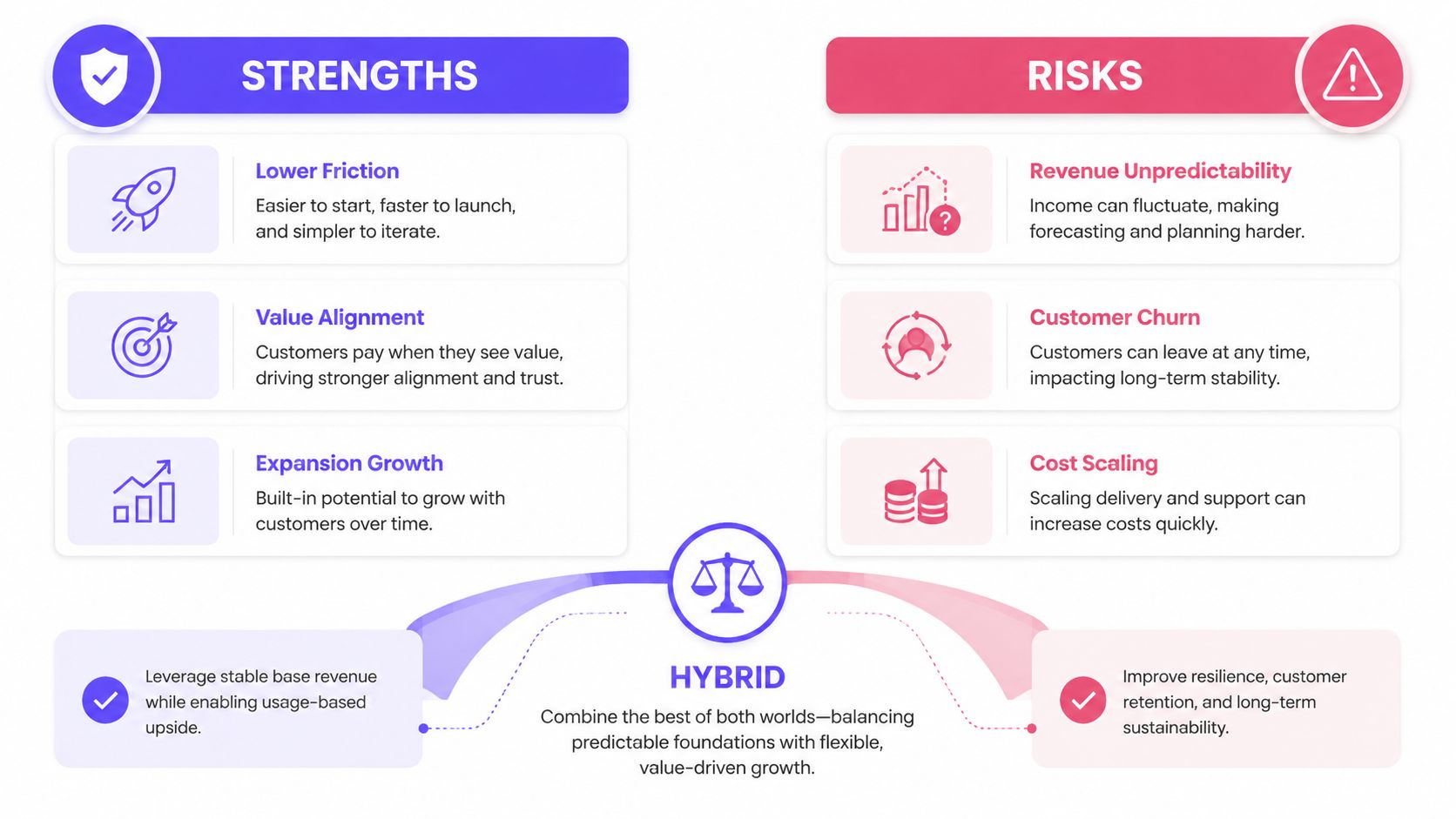
Pure usage pricing has real strengths, and it also has obvious failure modes. The strength is that customers can start with low commitment, pay in proportion to use, and expand spend as the product creates more value. The failure mode is just as obvious. Spikes create bill shock, forecasting gets harder, and the seller inherits more metering and billing complexity.
Why buyers like it until the invoice arrives
Buyers like usage pricing because it lowers the entry bar. They do not need to justify a big fixed commitment before the product proves itself. They also like the fairness argument, because light users do not subsidize heavy ones.
The trouble starts when usage spikes are invisible. Stigg's guidance points out that customers need monitoring, alerting, reporting, and spending controls built into the product, not bolted on later, because the procurement objection is unpredictability (Stigg). If a buyer cannot answer how the bill will behave next month, the sales cycle can stall right there.
Why hybrids dominate real-world deployments
The hybrid base-plus-usage structure solves the part that pure metering leaves exposed. A committed base gives finance a floor, while the usage layer preserves upside and fairness when demand rises. OpenView's 2023 data showed 46% of SaaS companies using a hybrid model, far more than the 15% on largely pure pay-as-you-go (TechCrunch).
That lines up with operator reality. Pure usage pricing sounds clean in a deck. Hybrid is usually easier to sell, easier to forecast, and easier to defend in a renewal meeting.
A second reason hybrid wins is internal. Sales comp is simpler when there is a floor. Finance can recognize a committed amount with more confidence. Customer success can still point to value growth when usage climbs. That is why the middle ground is not a compromise in a weak sense. It is usually the more durable design.
Implementing Usage Based Billing Without Surprises
Shipping usage pricing without losing trust requires more than a meter and an invoice. The product team needs clean event instrumentation, the finance team needs a billing stack that can reconcile usage, and the customer needs enough visibility to avoid a surprise. If any one of those pieces is missing, support gets buried in disputes.
The implementation checklist that keeps deals alive
Start with the canonical meter. The product must define one billable event, or one primary family of events, and own that definition across product, sales, and finance. If the meter changes every quarter, the model will never feel stable.
Then instrument usage events inside the product. Each event should be recorded reliably, deduplicated, and tied to the right account or workspace. After that, integrate the usage stream into billing and entitlements, so invoices, caps, alerts, and access controls all agree on the same source of truth.
A few practical controls matter more than most admit.
- Usage dashboard. Give customers a live view of what they've consumed.
- Alerts. Warn them before usage crosses a threshold they care about.
- Caps or limits. Let finance set a hard guardrail when certainty matters more than flexibility.
- Tiered or volume curves. Use pricing bands where heavy use deserves a lower unit rate or a committed package.
For teams mapping this into packaging, Overvue pricing is a concrete reference point because it shows usage-based capacity controls alongside the commercial plan. That is the kind of structure buyers can approve.
Why spend controls are not optional
The contrarian truth is simple. Buyers love flexibility in theory, then block the deal in practice when they cannot forecast the bill. That's why spend controls are not a nice extra, they are the objection handler.
If finance cannot predict the downside, the product team will spend the next quarter explaining invoices instead of expanding accounts.
Usage pricing works best when the customer can see the meter, see the trend, and stop the bleed before it becomes a procurement issue. Without that, the model turns from flexible to risky very quickly.
Forecasting and Revenue Recognition Considerations
Usage pricing changes finance work from fixed-number planning to probabilistic planning. The revenue line stops behaving like a clean subscription schedule and starts behaving like consumption, which means the forecast needs ranges, not a single point estimate. That is a better model for reality, but it is less comfortable for teams used to deterministic bookings math.
How to build a forecast that a board can tolerate
The cleanest approach is a three-layer forecast.
- Committed minimum. Model the contracted floor first, because that is the most defensible number.
- Modeled usage. Add expected consumption based on current product behavior, historical trends, and known customer seasonality.
- Upside scenario. Separate the expansion case so the board can see what happens if usage spikes.
That structure gives the seller a range and gives the buyer's CFO something to budget against. It also keeps RevOps from over-promising on a month when consumption looks strong only because a few accounts are running hot.
What changes in revenue recognition
When invoicing happens after consumption, recognition can lag the product event itself. That means finance has to think carefully about earned revenue, invoicing timing, and how usage accruals flow through the books. In practice, usage-based businesses need tighter coordination between product telemetry, billing, and accounting than subscription-only businesses do.
The metric story changes too. A plain subscription MRR view is not enough when consumption drives the top line. Finance teams usually need a usage-adjusted view that separates committed recurring revenue from variable revenue, otherwise the board gets a distorted picture of retention and expansion.
A strong forecast is honest about uncertainty. It does not pretend usage is fixed. It shows the base, the expected band, and the upside, then explains what operational levers can move the number. That is a much better conversation than pretending every invoice will behave like a seat license.
Case Patterns Across Software Categories
The cleanest examples of usage pricing are not all the same. Different software categories use the meter in different ways, but the logic is consistent. The meter should mirror the value driver, not the convenience of the billing system.
Infrastructure tools meter pure consumption
The classic pattern is infrastructure software where every call, transaction, or gigabyte can be counted. That model works because the vendor's marginal cost rises with use, and the buyer already thinks in terms of volume. When a team scales traffic or compute, it expects the bill to move with it.
AI tools usually need a floor
AI products often work better with a hybrid structure. The base fee covers baseline access, support, or platform overhead, while metered tokens or calls capture variable inference cost. That structure protects margins without making every customer start from zero.
Hiring and training platforms need flexible capacity
Assessment and training products have a different pattern. Demand spikes with hiring campaigns, onboarding waves, and training cycles, then falls back when headcount work slows. That makes metered capacity useful because it avoids overpaying in slow months and avoids locking out usage during a hiring push.
Overvue is a useful example of this category because its product centers on sales assessments and training simulations, and its pricing page shows usage-based capacity with rollover of unused hours while a subscription remains active (Overvue for enablement teams). That combination matches the buying pattern in talent-heavy software, where customers want flexibility without losing committed value.
What matters across all three patterns is the same thing. The meter has to map to the customer's lived demand pattern. If it does not, the pricing model stops being a commercial advantage and starts being a support problem.
When to Choose This Model and What to Ask Next
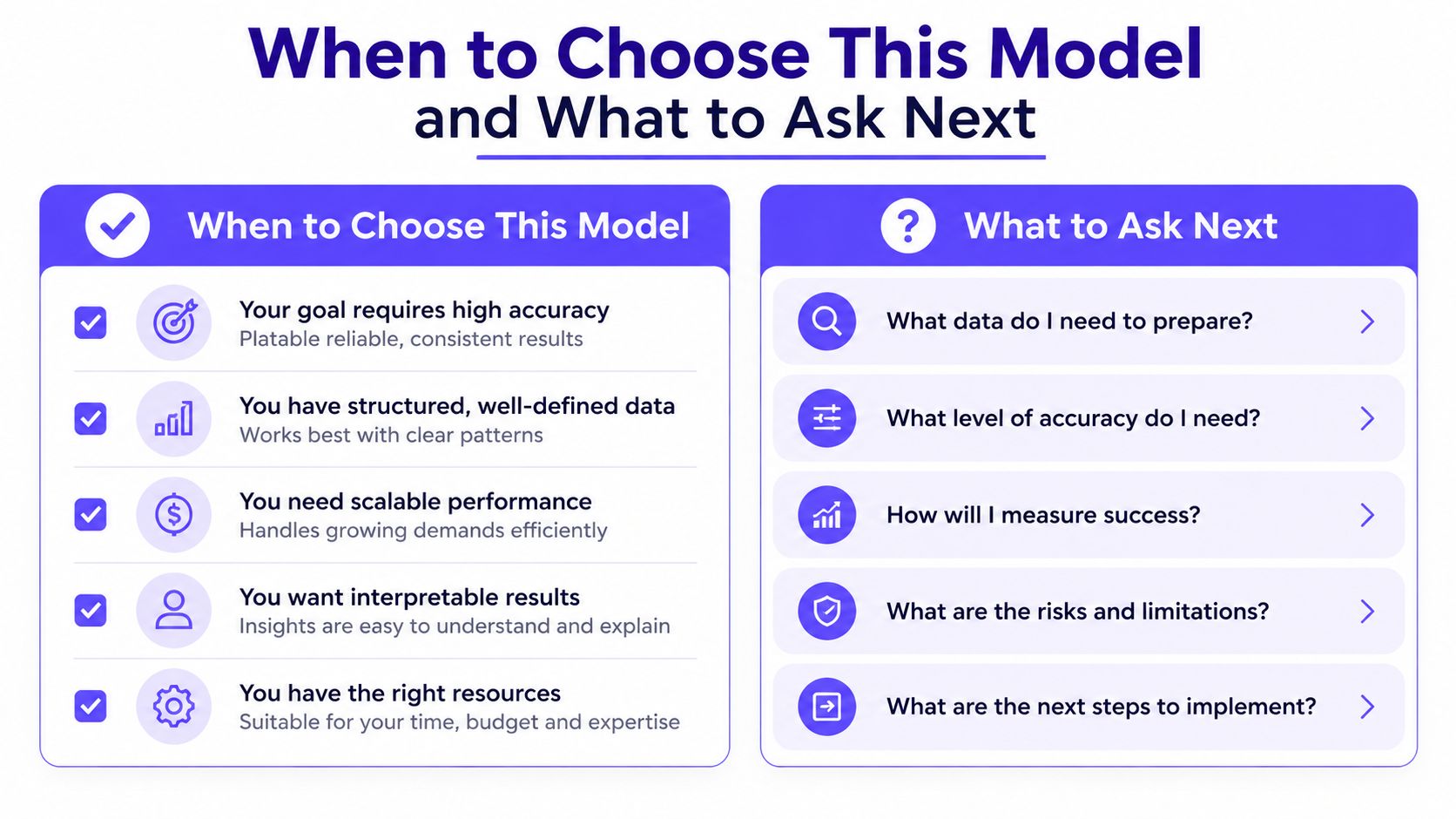
The decision is not whether usage pricing sounds modern. The decision is whether the business can defend it operationally.
The four questions that should decide it
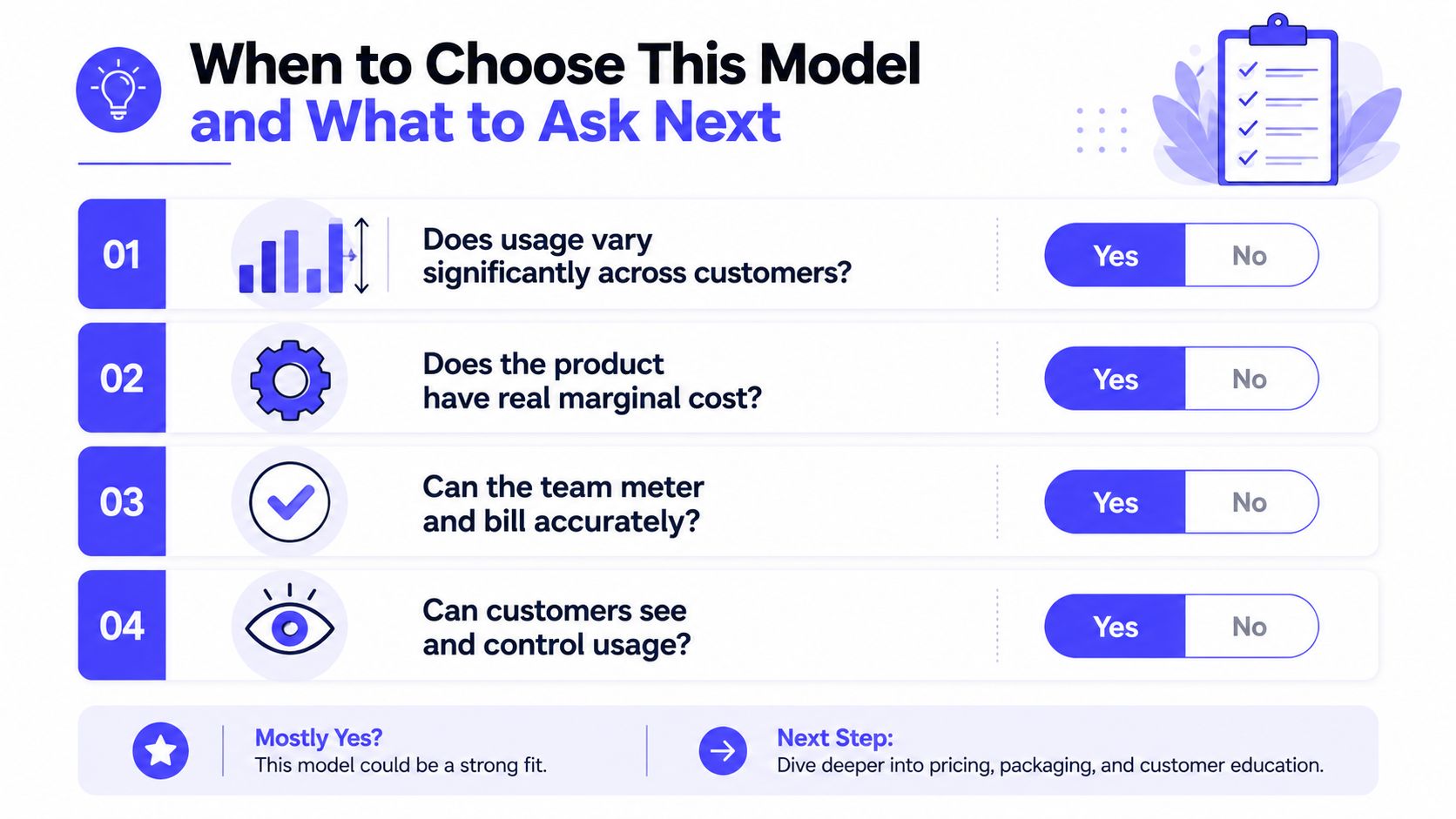
- Does usage vary significantly across customers? If the difference between light and heavy users is real, usage pricing can capture that spread better than a flat seat plan.
- Does the product have real marginal cost? Compute, bandwidth, storage, and AI inference are the usual signals that the bill should move with consumption.
- Can the team meter and bill accurately? If not, the risk lands on support, finance, and trust.
- Can customers see and govern their spend? If buyers cannot monitor usage, the model will trigger objections before it triggers expansion.
The FAQ operators keep asking
How is bill shock prevented? By putting usage visibility, alerts, and caps directly into the product flow. If customers discover the number only on the invoice, the design is wrong.
How should sales comp work? Keep a committed floor in the package if possible, then pay reps on contracted value plus expansion. Pure open-ended consumption is harder to comp cleanly.
What contract structure works best? A hybrid contract with a minimum and a usage layer usually gives both sides what they need.
How does migration avoid churn? Existing subscription customers need a transition path, not a sudden conversion. The change should be tied to a clear gain, like more flexibility, better fairness, or capacity that scales with demand.
The blunt recommendation is this. Use the usage based pricing model where demand fluctuates and the meter can be trusted. Reach for a hybrid plan when the buyer side needs both flexibility and predictability, because that is usually the structure that survives the longest.
Overvue helps teams run sales assessments and training with AI roleplays, standardized scoring, and usage-based capacity that matches changing hiring volume. If this pricing model sits on your roadmap, visit Overvue to see how its usage-based structure supports Solo, Team, and Enterprise plans without forcing unused capacity into every month.