
An SKO is a Sales Kickoff, a structured 1- to 3-day event held at the start of a fiscal year or quarter to align the revenue team on strategy, goals, and new initiatives. In practice, it's the meeting where sales leadership stops the noise, gets everyone pointed at the same target, and turns a new period into a shared plan instead of a collection of individual guesses.
Right now, that usually means a calendar that's already crowded, a launch plan that keeps changing, and a sales team that wants clarity more than another motivational session. The primary question isn't whether to run an SKO, but whether it will change how the team sells once the conference room clears out.
Understanding What an SKO Really Is
Six weeks before the fiscal year starts, a sales leader is usually staring at a blank agenda and three separate inbox threads from product, marketing, and finance. Product wants launch time, finance wants quota clarity, and the field wants to know what changed, what matters, and how to win faster. That's the moment an SKO earns its keep.
SKO most commonly stands for Sales Kickoff, and it's usually a structured event at the start of a fiscal year or quarter. Common descriptions place it as a 1- to 2-day gathering, while some modern in-person versions run 2 to 3 days. Its job is practical, not ceremonial, because it aligns the sales team on strategy, introduces new products or initiatives, and sets goals for the coming period, which is why many companies treat it as a core annual planning milestone rather than a casual meeting (DealHub glossary on Sales Kickoff).
What separates an SKO from an all-hands
A company all-hands can share direction. An SKO has to change field behavior. That means the agenda needs room for strategy, product context, sales process, and manager-level reinforcement, not just executive updates and a big closing rally.
Practical rule: If a rep leaves knowing the company vision but not the next conversation to run with a buyer, the event was too broad and not operational enough.
The best-run kickoffs are built like a launch sequence. Leadership explains where the business is going, enablement translates that into selling actions, and managers leave with the language and rhythm they'll use after the event. That's why the event matters most when the quarter gets hard, not when the confetti is still on the floor.
For teams building that kind of enablement motion, this planning resource for enablement teams fits naturally into the same operating mindset. It's less about event theater and more about making sure the team can execute what the kickoff introduces.
Core Objectives That Drive Every Successful SKO
A strong SKO doesn't try to do everything. It carries a small number of clear objectives, and each one should answer a different business need. If every session sounds important, the event usually isn't focused enough.
Strategic alignment that removes ambiguity
The first objective is alignment. Sales reps need to know what the company is prioritizing, what gets deprioritized, and how leadership wants them to spend time. That sounds obvious, but many SKOs fail here because they bury the actual operating plan under too many slides about market context.
Success looks like this, teams can name the year's main priorities without repeating the deck back word for word. Managers can also explain how those priorities affect territory planning, pipeline creation, and deal inspection.
Product launches and message clarity
The second objective is to make new offers sellable. That means product leaders, marketing, and sales enablement have to translate launches into buyer language, common objections, and clear use cases. A rep should leave knowing what changed, why it matters, and how to explain it without sounding scripted.
Skill building that fixes real gaps
The third objective is capability improvement. The best sessions don't teach generic selling platitudes, they target the exact weak spots that show up in pipeline reviews and manager coaching. That might mean objection handling, call control, discovery depth, or next-step execution. If the content doesn't map to a real gap, it becomes conference filler.
Culture reinforcement that supports execution
The fourth objective is cultural. An SKO can reinforce what the company rewards, how it wins together, and what “good” looks like inside the revenue team. That doesn't mean a pep rally. It means giving people a shared standard and a common language that managers can use long after the event.

When those four objectives are explicit, the budget conversation gets cleaner. The event becomes a measurable operating lever, not a morale expense. For teams evaluating training design, this AI sales training resource is a useful model for turning kickoff content into repeatable practice.
Designing an SKO Agenda That Works
A useful agenda does not try to keep energy high every minute. It gives people a clear rhythm, attention, participation, then reflection, so the message lands and turns into action. That separates a packed event from one that changes how the team sells.
A simple three-day structure
Day 1 should set direction. Leadership needs to explain the business priorities, make the year feel concrete, and show people how the kickoff connects to the work ahead. That is the right place for the broad strategy story, and later in the day for team bonding, because people commit more readily once they understand the context.
Day 2 should carry the workload. Product sessions, customer examples, and role-specific workshops belong here. If the team sells across multiple motions, breakouts usually pay off because each group can focus on the message, process, and objections that matter to its own deals. That is also where practice matters more than polish, because a rep who can say the right thing in rehearsal is far more likely to use it in front of a buyer. For teams that want to extend that practice beyond the event itself, AI sales training resource shows how kickoff content can be turned into repeated skill-building instead of one-time exposure.
Day 3 should turn ideas into commitments. Reps, managers, and function leads should leave with specific actions, account plans, or deal plays. Ending with action planning matters because it forces the event to become operational instead of aspirational. The best SKOs do not stop at alignment. They create a starting point for measurement, coaching, and follow-through after everyone goes back to the field.
What to avoid when building the agenda
Front-loading the schedule with executive keynotes is one of the fastest ways to lose the room. The same problem shows up when too many sessions ask people to listen without doing anything. Teams can sit through updates, but they do not retain them unless they test the ideas, discuss them, or practice them in the room.
The best breakout session is not the one with the flashiest speaker. It is the one where a manager can see whether a rep can use the message in a live deal.
The agenda also needs air. Networking windows, breaks, and informal dinners are not decorative. They give teams time to process, compare notes, and pressure-test what they just heard against real accounts. For a practical event-planning perspective, how Silicon Valley Speakers plans SKOs is a helpful reference point because it treats sequencing and engagement as part of the design, not an afterthought.
The Evolution from Sales Kickoff to Revenue Kickoff
The old model treated SKO as a sales-only event. That worked when sales carried most of the coordination burden alone, but modern B2B revenue teams don't win that way. Deals move faster when Sales, Marketing, Customer Success, Sales Engineering, Enablement, and RevOps are aligned around the same priorities.
A Revenue Kickoff (RKO) expands the room because the work is shared. One glossary describes SKOs as annual or bi-annual events for the revenue organization, and another source describes the modern event as one that includes the full go-to-market team and is designed to align, celebrate wins, and sharpen skills before the year ahead (SiftHub glossary on Sales Kickoff).
When a traditional SKO still makes sense
A sales-focused kickoff still works when the organization is small, the go-to-market motion is simple, or the business doesn't have mature cross-functional rhythms yet. In those cases, expanding the invite list too early can dilute the agenda and create confusion about ownership.
When an RKO is the better model
An RKO makes more sense when the revenue engine already depends on coordinated handoffs, shared messaging, and consistent customer lifecycle management. If marketing owns demand generation, customer success influences retention, and sales engineering shapes the technical sale, leaving those functions out creates avoidable friction.
How to choose between the two
The decision should hinge on maturity, not fashion. If shared goals already exist across teams, and the managers collaborate on execution, then the broader format can work well. If cross-functional trust is still fragile, a full RKO can become a room full of updates without true alignment.
The right model isn't the one with the most attendees. It's the one that creates fewer handoff gaps after the event. For organizations comparing team structures and rollout approaches, the earlier sections on agenda design provide the clearest filter.
Connecting SKO Training to Ongoing Skill Development
A strong SKO should leave more behind than a burst of enthusiasm. If the room leaves with a polished message but the field reverts to old habits a week later, the kickoff did not change how revenue is won. The true test is whether the event becomes the start of a practice system that managers can run long after the opening session ends.
Treat the kickoff as the first rep, not the final rep
Roleplay, objection handling, and next-step practice belong in the event agenda, but they should be built as the first pass, not the finish line. The best SKOs create a shared set of scenarios that frontline managers can reuse in 1:1 coaching, team huddles, and pipeline reviews. That gives the organization a baseline for what strong execution looks like, and it makes coaching more specific instead of vague.
AI-driven simulation makes that follow-through easier to sustain. Reps can rehearse against realistic buyer personas, compare their responses against the same criteria, and get more consistent coaching than they would from one-off live practice. The value is not novelty, it is repetition with structure, especially when the team is trying to keep the message intact after the event.
Build continuity into the training stack
For teams reviewing tooling, this sales enablement software guide is useful because it treats enablement as an operating system rather than a one-time launch. That matters during SKO planning, when leaders are tempted to invest in a polished event and skip the reinforcement that determines whether anything sticks.
The follow-up system should also connect to the sales onboarding checklist, because the handoff from kickoff to day-to-day ramp often gets messy when the two programs live in separate lanes. When those motions share the same message, the same scenarios, and the same coaching expectations, new hires and tenured reps stop hearing two different versions of the job.
A strong reinforcement stack usually includes three elements:
- Standardized scenarios, so every rep works through the same selling situations and managers can compare performance fairly.
- Manager coaching prompts, so frontline leaders know what to watch for after the event and can reinforce the right behaviors.
- Ongoing simulation access, so practice continues after the room clears and the field starts facing live objections again.
The goal is durable behavior change. If the kickoff teaches a new message but managers never coach it, the organization pays for performance theater. If the same scenarios show up in training and in coaching, reps get repeated exposure, and leaders can see whether a rep can use the message effectively when a buyer pushes back.
Measuring SKO Success with Real Metrics
An SKO should be measured like a business program, not a party. Satisfaction feedback is useful, but it can't carry the ROI conversation by itself. Leaders need a clear view of whether the event improved alignment, practice quality, and field execution.
What to measure before, during, and after
Before the event, collect the baseline. That might include pipeline status, manager confidence on the new messaging, and the current state of skill adoption. During the event, measure attendance, participation in workshops, and completion of role-based exercises. After the event, track whether the field is using the new language and whether managers are coaching to it.
A practical dashboard structure
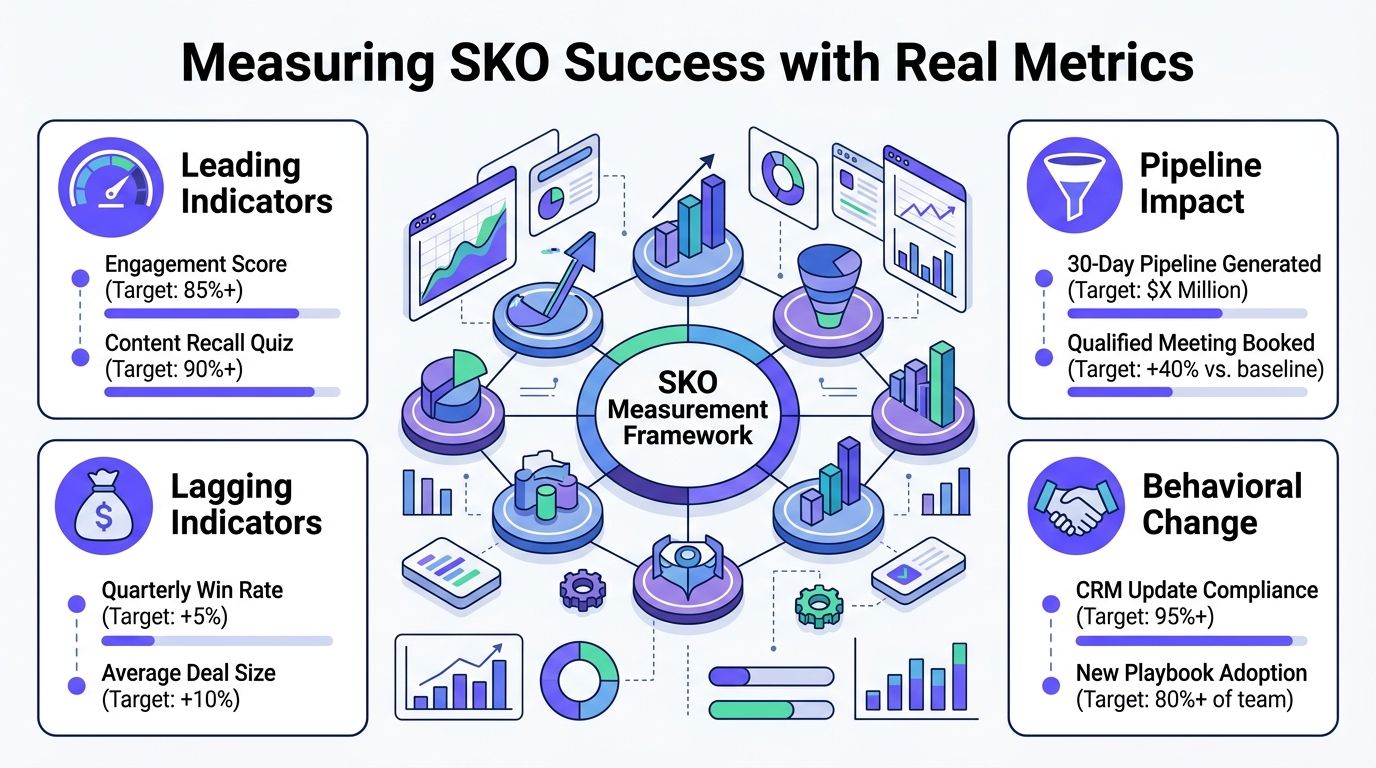
A simple dashboard can be organized around four layers:
- Leading indicators, such as post-event assessment results and session participation.
- Behavioral indicators, such as CRM discipline, playbook usage, and coaching consistency.
- Pipeline indicators, such as the quality and volume of opportunities created after the event.
- Business outcomes, such as quota progress, deal quality, and the team's ability to execute the new plan.
The key is consistency. Pick a few metrics, define them before the kickoff, and use the same definitions afterward so leadership isn't comparing apples to anecdotes.
What leadership actually needs to see
The best readout doesn't just say people liked the event. It shows whether the SKO changed how the team sells. That means tying the kickoff to specific behaviors and then asking whether those behaviors showed up in the pipeline and in manager coaching.
If the only evidence is applause and a good survey score, the event probably felt better than it performed.
A clean measurement story also makes future planning easier. The next budget conversation becomes about what the event changed, not whether people had a good time.
Planning Tips and Common Mistakes to Avoid
Good SKO planning starts earlier than many teams expect. Content needs time to mature, product and marketing need time to align on messaging, and presenters need time to rehearse with the actual flow they'll use on stage. If those pieces come together too late, the event starts to feel stitched together.
What experienced teams do differently
They lock the calendar early and protect the agenda from constant churn. They also assign owners for every major workstream, because no single person can manage content, logistics, speakers, and post-event reinforcement without something slipping.
A good reference point for the logistics side is this corporate event execution guide, which reinforces a point many teams learn the hard way, execution quality shows up in the details long before the first session starts.
Mistakes that create avoidable pain
- Too many outside speakers, especially when they don't know the product or the customer reality. A polished talk doesn't help if it doesn't fit the business.
- No rehearsal for breakouts, which usually means managers run sessions differently and the learning becomes inconsistent.
- No post-event capture, which leaves remote or absent reps out of the loop and forces managers to recreate the event from memory.
- No buffer time, which turns one late session into a domino effect across the rest of the agenda.
A planning checklist that actually holds up
The simplest checklist is the one teams can maintain under pressure. Confirm the business objectives, define the audience by role, map each agenda block to a specific outcome, and decide what happens after the event to reinforce the message. If a session doesn't connect to one of those items, it probably belongs in the appendix, not the main stage.
The strongest kickoffs feel calm on the surface because the work was done early. That calm usually comes from clear ownership, realistic timing, and a willingness to cut anything that doesn't help the team sell better.
Overvue helps revenue teams turn kickoff ideas into repeatable practice, so SKO content doesn't disappear after the event ends. It gives managers and enablement leaders a way to simulate buyer conversations, assess selling behavior consistently, and build follow-through into the training rhythm. If this topic is on your calendar right now, visit Overvue and see how it can support the work your SKO is meant to drive.