

You're on a discovery call, the buyer's camera is still on, the keyboard clicks are getting louder, and the rep has been talking long enough that the prospect's first real contribution is just a polite, tired “mm-hmm.” In a meeting, it feels similar. One person keeps holding the floor, the room gets quieter by the minute, and the discussion stops feeling like a conversation and starts feeling like a broadcast.
Monopolizing the conversation is rarely hard to spot once the pattern settles in. The core mistake is treating it only as a personality problem, because in business settings it's often also a facilitation problem, a structure problem, or a signal that nobody has set a clear turn-taking norm. That difference matters, because the fix changes depending on whether the issue is one speaker, or a room that's designed to let one speaker run.
Recognizing When Someone Monopolizes the Conversation
A rep opens a discovery call with energy, asks one decent question, then spends the rest of the call explaining the product, the process, the implementation path, and a client success story. The prospect stays courteous, but the structure of the conversation has already shifted. In sales calls and interviews, that shift usually points to a facilitation problem as much as a personality problem, which is why a sales personality assessment can help separate natural talkativeness from a breakdown in turn-taking.

Research on conversational rhythm gives a useful benchmark. A widely cited summary of turn-taking patterns in conversation notes that average utterances are only about 2.7 seconds in dyads and 3.7 seconds in triads, with roughly 72% of turns lasting up to 10 seconds, 22% lasting 10 to 20 seconds, and only 6% reaching 30 seconds dangerousintersection.org. Analysis of conversational turn-taking in human dialogue points in the same direction, showing that ordinary exchanges are built from short turns, not long uninterrupted stretches. Once one person keeps the floor far beyond that rhythm, the conversation stops feeling like shared work and starts feeling one-sided.
What it feels like in the room
The signs are visible if you know what to watch for. Responses get shorter, camera attention drifts, and the other side starts signaling disengagement in small ways, like delayed replies, fewer follow-up questions, or a flat “got it.” In live calls, the strongest clue is often not what the talker says, but what everyone else stops doing.
A better operational line is airtime. The same conversational summary notes that frustration often rises when one person claims more than 30 to 40% of total airtime dangerousintersection.org. That is a practical benchmark for meetings, interviews, and sales calls because it turns vague discomfort into something a manager can observe and coach against.
Practical rule: long speaking is not automatically a problem. A long answer that lands, clarifies, and invites a reply is different from a string of uninterrupted monologues that leaves no opening for the other side.
The distinction matters. Passionate expertise-sharing still leaves room for pushback and curiosity. Monopolizing the conversation usually closes those doors, and in buyer-facing work that closure is where trust starts to erode. For teams that want a more disciplined way to review call behavior, the coaching examples in sales training insights from VideoLearningAI are useful because they focus on how reps respond after a prospect signals hesitation, not just on how much the rep speaks.
Cost of Conversational Dominance in Sales and Meetings
The cost shows up quickly in sales calls. Analysts at Prattle found that in one major corporate call dataset, men accounted for 92% of speaking time across more than 155,000 corporate conference calls over 19 years Yahoo Finance. In a separate analysis of 519,000 sales calls, male salespeople spoke 61% of the time with female buyers, and their monologues were longer with female clients, 108 seconds versus 91 seconds with male clients. Those patterns are not just awkward. They shape who gets heard, who asks questions, and who gets to influence the decision.
What balanced talk time does differently
Sales analytics already makes the point clear. A 40 to 60% host talk ratio in discovery conversations and 60 to 70% in demos is associated with stronger engagement, while keeping any single monologue to 76 seconds or less is reported to correlate with deal progression gains of up to 31% Demodesk. The practical takeaway is straightforward. Measure the ratio, shorten uninterrupted blocks, and coach for better questions instead of longer explanations.
That is why call review should focus on the structure of the conversation, not just the tone. When a rep dominates, discovery quality drops because the buyer has fewer chances to surface pain, constraints, and real buying context. If the rep keeps filling the air, the rep keeps collecting less useful information.
For teams that train on objections, sales training insights from VideoLearningAI is a useful companion resource, especially when the issue is less about knowing what to say and more about learning when to stop talking and let the buyer respond. That same principle applies internally. Meetings suffer when one voice controls the frame, because quieter people stop offering the details and objections that improve the decision.
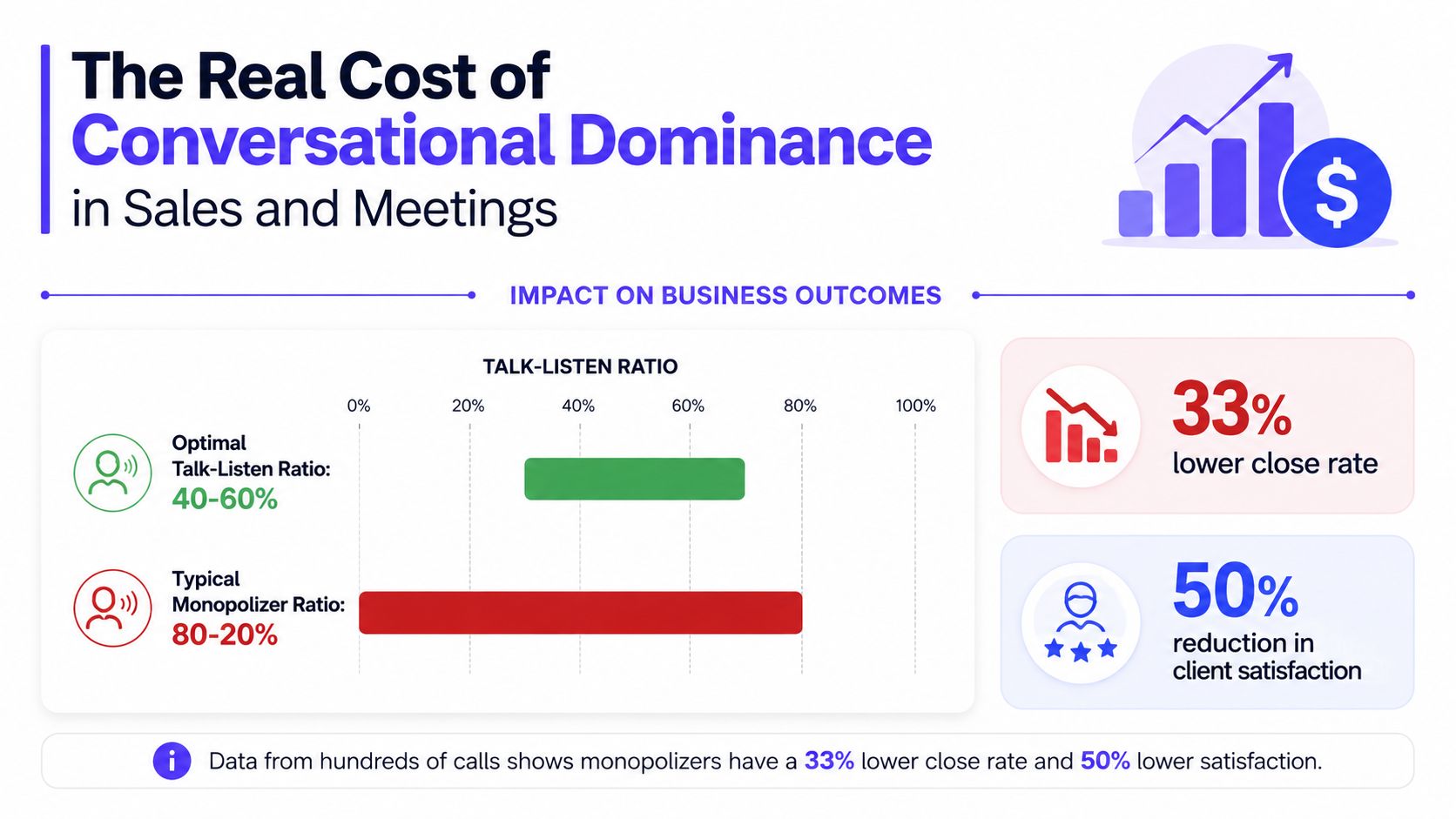
A useful comparison sits inside enablement as well. Over at Overvue for enablement teams, the value is in simulated buyer conversations that make talk behavior visible before it hits a real call. That matters because the business loss from dominance is not only social. It can distort discovery, weaken rapport, and leave no room for the buyer to reveal what matters.
Why the Problem Is Not Always the Over-Talker
A person who speaks at length is not always the source of the problem. In many meetings, the issue starts earlier, when the room gives no real path for other voices to enter, so the most prepared or most assertive person fills the gap. The better diagnostic question is not only who talked the most, it is whose perspective never got airtime.
Weak facilitation creates the pattern
A manager can train dominance without meaning to. If the same person answers first, closes last, and sets the tone for every open discussion, the meeting teaches everyone else to wait their turn, or stop offering one. That pattern gets reinforced quickly, because confidence and speed start to look more valuable than range, balance, or curiosity.
The useful frame from inclusive-conversation guidance is simple. The core issue is often structure, not volume alone, because repeated exclusion comes from how the interaction is run University of Pennsylvania. A long speaker can still be dominating, but they may also be working inside weak prompting, vague agendas, or a facilitator who never actively brings quieter participants into the exchange.
Coaching should target the architecture
That changes the coaching conversation. Strong managers look at turn-taking rules, facilitation gaps, and whether the meeting design supports broader participation. It is easier to improve conversational architecture than to spend time labeling someone's personality.
A seasoned coach reads the room for setup problems first. If one person keeps taking over, the question is whether the agenda is loose, the moderator is passive, or the group has no clear handoff points. In interviews and sales calls, the same logic applies, because a candidate or buyer will often defer when the interviewer or rep keeps opening new threads without pausing for response.
The fastest way to misread a meeting is to assume every long turn is ego. Sometimes the agenda is muddy, the moderator never cues another voice, or the room is waiting for permission to speak.
This is especially visible in cross-functional teams. Engineers, buyers, candidates, and front-line managers often contribute in different ways, and an unstructured discussion tends to favor the most verbal participant. Better structure improves the conversation without asking anyone to become a different person.
For teams practicing these moments, Overvue's cold call roleplay tools can help surface how turn-taking plays out before the habit reaches a live call.
Assertive Redirection Techniques for High-Stakes Conversations
The fix in the moment is not silence, and it's not confrontation for its own sake. It's assertive redirection. In sales calls, interviews, and meetings, the goal is to regain structure without making the other person defensive or killing rapport.
Use a clean interruption
A polished interruption is usually short, calm, and directional. Phrases like “Can I pause you for a second?” or “Let me make sure I'm tracking, then I'd like to add something” work because they reset the frame without accusing anyone of hogging the floor. The point is to create a turn, not start a fight.
The best boundary-setting language names the need, not the flaw. “I want to hear the rest of the team's view” works better than “You're talking too much,” because it makes the exchange about access and clarity. In high-stakes settings, that distinction preserves dignity on both sides.
Use structure when the room gets loose
For meetings, a two-minute rule or other timed speaking turns can keep the conversation from drifting into one-person ownership, and round-robin input helps pull in quieter voices Hyperbound. The safest version is the simplest one. Set the timebox in advance, summarize the point, then explicitly invite another person to respond before reopening open discussion.
A practical sequence works well:
- Use a transitional phrase. “Can I shift us for a second?”
- Ask a clarifying question. “What's the main issue you want solved?”
- Summarize and pivot. “So the key concern is rollout timing. Let's hear the buyer's view.”
- Use the parking lot method. Capture extra detail, then return to it later instead of letting it derail the current thread.
For team members who need help practicing these moves, Overvue's roleplay tools for cold-call practice can simulate buyer interruptions, objections, and turn-taking pressure before the call. That kind of rehearsal matters because live redirection feels different from reading a script.
Practical rule: don't wait until frustration boils over. The longer a conversation stays lopsided, the harder it is to restore a respectful balance without sounding abrupt.
The trade-off is real. Too much softness leaves the other person in control, but too much force can shut down rapport. The sweet spot is direct, brief, and tied to the business objective.
Coaching Your Team Toward Better Talk-Listen Balance
Managers usually need a system, not a lecture. In call reviews, the cleanest coaching loop starts with recording conversations, then reviewing who held the floor, then giving feedback on the exact moments when the rep should have stopped, asked, or handed the conversation back. Without that loop, “talk less” turns into a vague behavior note that nobody can use under pressure.
Measure What Happened
Talk balance is easiest to improve when it is visible. Sales teams that review calls can compare discovery calls, demos, and objection handling against the talk-ratio ranges that fit each stage. That gives managers something concrete to coach beyond “be more concise.”
One helpful lens for that review comes from listening frameworks. The levels of listening for impactful coaching reminder is useful because listening is not passive. The better question is whether the rep is listening just long enough to wait for a turn, or listening well enough to respond to what was said.
Practice in a Safe Environment
Live pipeline is the wrong place to learn this skill from scratch. Roleplay environments let reps practice discovery, objection handling, and demo delivery while getting immediate feedback on call control and responsiveness. That is where behavior changes faster, because the rep can hear how often they cut off the buyer, how often they leave silence, and how quickly they recover after a stumble.
A workable coaching cadence usually includes:
- Daily short practice. One focused scenario instead of a long, unfocused drill.
- Specific call feedback. Name the exact moment the rep should have pivoted.
- Shared scoring criteria. Use the same expectations across hiring, onboarding, and live coaching.
- Visible team norms. Publicly reward questions, clean handoffs, and concise summaries.
Overvue fits naturally here as one platform option for simulated sales conversations, automated scoring, and repeatable practice with AI buyers modeled on an ICP. That matters because the conversation skill being trained is observable behavior, not personality.

The best managers do not praise quietness for its own sake. They coach reps to keep the buyer in the conversation long enough to surface the information that closes deals and improves decisions.
Your Action Plan for Balanced Conversations
Balanced conversations come from design, self-awareness, and timely redirection. Before the next call or meeting, check three things. First, watch for long uninterrupted stretches, especially once the speaker starts explaining instead of asking. Second, keep one or two redirecting phrases ready so the recovery sounds calm instead of reactive. Third, set the room up so quieter people have an actual opening, not just a hope.
A practical checklist helps:
- Track airtime. If one person keeps carrying the exchange, reset the format.
- Use concise interruption language. Redirect without blaming.
- Timebox where needed. Two-minute turns beat endless open floor drift.
- Invite the quiet voices in. Structure beats hope.
- Coach to a standard. Review calls for talk-listen balance, not just enthusiasm.
The deeper point is simple. Great conversations aren't about speaking as little as possible, they're about making room for the information, objections, and perspective that move a business forward. When the structure supports that exchange, nobody has to dominate to be heard.
Overvue helps teams turn that standard into something measurable with AI buyer roleplays, call scoring, and repeatable practice that exposes talk balance before it reaches a live prospect. If this topic hits close to home, visit Overvue to see how structured simulations can help reps practice control, listening, and cleaner turn-taking.