

Last updated: March 2026
Securing the right sales talent dictates revenue trajectory, making the sales hiring assessment process a critical strategic function for any growing organization. This guide distills best practices for you, the hiring manager, covering how to define success by mapping your required candidate profile to your actual sales environment, the essential questions you must ask to vet technical and behavioral competencies, and the warning signs that indicate a risky hire.
You will learn to interpret psychological markers and past performance data, moving beyond surface-level interview responses to uncover genuine potential. We examine how leveraging objective data through modern sales assessment test technology minimizes inherent bias in selection, and we review what elite candidates expect from your organization before they commit.
Understanding these components allows you to build a consistent, high-yield recruiting engine that consistently delivers quota-achieving professionals ready to ramp up quickly.
The 5 Ws of High-Performance Sales Hiring
Building a world-class sales organization requires more than just reviewing resumes; it demands a strategic framework. By addressing the fundamental questions of sales hiring, leaders can reduce turnover and ensure every new hire is set up for long-term success.
To build your high-performance team, focus on these five critical pillars:
- Who: Identify the specific traits required for your environment, such as coachability, grit, and technical aptitude, rather than just industry experience. A structured sales aptitude test can help you measure these traits objectively.
- What: Define the precise responsibilities of the role and the Key Performance Indicators (KPIs) that will measure success in the first 90 days.
- Where: Determine the most effective sourcing channels, whether through passive headhunting on LinkedIn or leveraging *AI-driven assessment platforms* that include a sales candidate assessment** as part of the screening workflow. Overvue offers an AI sales assessment to streamline this process.
- When: Align your hiring timeline with your revenue roadmap to ensure reps are ramped and ready exactly when your lead volume increases.
- Why: Understanding the high stakes of a bad hire is essential. According to data from the Harvard Business Review on Sales Hiring, annual sales turnover averages 25% to 30%, with replacement costs often exceeding $300,000 per rep.
Defining Your Ideal Customer and Buyer Persona
High-performance hiring starts with a deep understanding of your Ideal Customer Profile (ICP). Your sales reps are the bridge between your product and your buyers; if they don't understand the buyer's pain points, they cannot effectively sell the solution.
When vetting candidates, look for individuals who have experience navigating the specific buying committees relevant to your industry. A rep who excels at selling to CFOs may struggle when pitching to CTOs or Creative Directors.

Aligning Product Value with Candidate Experience
The candidate experience is a reflection of your company culture and the value of your product. Top-tier sales talent is in high demand, meaning you must sell the opportunity just as much as they must sell their skills.
Ensure your interview process demonstrates the value proposition of your organization. Candidates should leave the process with a clear understanding of how your product solves market problems and how they will contribute to that mission.
Mapping the Sales Funnel
Your hiring strategy must be dictated by the current state of your sales funnel. If your top-of-funnel is overflowing but your close rates are low, you likely need a Senior Account Executive with strong closing skills.
Conversely, if your AE's calendars are empty, your priority should be hiring Sales Development Representatives (SDRs) to drive outbound volume. Mapping your hires to specific funnel bottlenecks ensures a higher return on investment for every headcount added.
Essential Sales Interview Questions for Vetting Candidates
The right software sales interview questions (and their equivalents across industries) go beyond "tell me about yourself." A strong sales test should evaluate how a candidate thinks on their feet, handles rejection, and navigates complex buying cycles. Our AI sales assessment acts as a sales talent predictor by analyzing candidate performance in simulated sales calls.

Behavioral and Situational Questions
- "Tell me about a time you lost a deal you were confident in; what did you learn?"
A high-quality answer demonstrates self-awareness and a specific strategic adjustment made to prevent similar losses in the future.
- "Describe a situation where you had to deal with a difficult client. How did you handle it?"
Top candidates show empathy and a de-escalation strategy that prioritizes the long-term relationship over a short-term win.
- "How do you prioritize your leads when you have a full pipeline?"
Strong responses highlight a data-driven approach to identifying high-intent prospects rather than simply working in chronological order.
- "Walk me through a time you had to pivot your strategy mid-cycle."
High-performers explain how they used customer feedback or market signals to change course without losing momentum.
Skill-Based and Technical Vetting
- "What is your process for researching a prospect before a discovery call?"
Quality answers mention looking for specific business triggers or personal LinkedIn insights that allow for a highly tailored opening.
- "How do you use CRM data to manage your sales forecast?"
Ideal candidates describe a disciplined routine of data entry and the use of weighted pipelines to ensure accuracy.
- "Describe your favorite sales methodology and why it works for you."
Effective responses demonstrate a deep understanding of frameworks like MEDDIC or SPIN and explain how they apply those principles to the buyer journey.
- "How do you handle a scenario where a prospect has technical requirements your product doesn't meet?"
High-quality answers focus on transparency and exploring workarounds or core business outcomes rather than overpromising.
Tactical Knowledge and Objections
- "The prospect says 'We don't have the budget.' How do you respond?"
A professional response focuses on reframing cost as an investment and uncovering the cost of inaction for the prospect's business.
- "How do you transition from discovery to a hard close?"
Strong candidates explain how they use tie-down questions and mutual action plans to make the close a natural next step.
- "What is your strategy for re-engaging a 'ghosted' lead?"
Successful reps share multi-channel outreach strategies that provide new value rather than just "checking in."
- "A prospect says they are happy with their current provider. What is your next move?"
Top-tier answers involve asking probing questions about the current provider's limitations to identify unmet pain points.

To streamline this process, many organizations now use AI sales assessment tests to observe how candidates handle these scenarios in real-time. For more traditional lists, you can also review these common sales interview questions from industry leaders.
Want to see how candidates handle these questions in real time? Overvue's AI sales assessment puts candidates through live roleplay scenarios so you can evaluate skill, not just storytelling. Try it free.
Identifying Potential: Red and Green Flags in Sales Candidates
In sales hiring, the most charismatic candidate isn't always the highest performer. Relying on "gut feeling" during an interview often leads to expensive mis-hires. Instead, top-tier organizations use a sales skills assessment backed by objective psychological markers and behavioral evidence that predict long-term success.
By focusing on specific indicators during the evaluation process, especially during AI sales assessments, you can separate those who can talk about selling from those who can actually execute.
Analyzing Past Performance History
High-performing sales reps rarely achieve success by accident. When evaluating a candidate's history, look for a repeatable process rather than just a high percentage of quota attainment. A candidate who hit 120% of their goal because they inherited a "whale" account may not be as valuable as a rep who consistently hit 100% through disciplined prospecting and a structured sales methodology.
Ask candidates to walk you through a complex deal they won. A "Green Flag" candidate can explain the discovery triggers, the stakeholders involved, and how they handled specific objections. Conversely, a "Red Flag" is a candidate who attributes their success entirely to "luck," "a great territory," or "unlimited leads," as this suggests a lack of strategic control over their pipeline.
| Indicator | Red Flag (Warning) | Green Flag (Strength) |
|---|---|---|
| Past Success | Credits "the market" or "great leads" solely for wins. | Details a specific, repeatable process used to hit quota. |
| Coachability | Becomes defensive or dismissive when receiving feedback. | Immediately incorporates feedback into the next attempt. |
| Preparation | Has not researched your product or ICP (Ideal Customer Profile). | Asks insightful questions about your sales cycle and pains. |
| Ownership | Blames the product, manager, or territory for misses. | Takes accountability for losses and identifies lessons learned. |
| Communication | Dominates the conversation and fails to listen. | Uses active listening and discovery to uncover needs. |
Curiosity and Hustle Indicators
The Challenger Sale methodology highlights that the most successful reps are those who "teach, tailor, and take control." This requires an immense amount of natural curiosity. While a sales personality test can surface some of these traits, direct observation during the sales hiring process is equally important. Pay attention to the types of questions the candidate asks.
Are they focused only on their OTE (On-Target Earnings) and benefits, or are they curious about the customer's journey? A candidate who dives deep into how your product solves specific pain points demonstrates the "Hustle" required to navigate difficult discovery calls. In a sales roleplay or simulation, look for candidates who don't just accept the first answer but dig deeper to find the root cause of a problem.
Transparency and Accountability
Resilience is a core psychological marker for any successful salesperson. Because sales is a profession of rejection, how a candidate handles failure is more telling than how they handle victory.
During the interview, ask about their biggest professional failure.
- The Red Flag: They provide a "fake" failure (e.g., "I work too hard") or blame external factors.
- The Green Flag: They transparently discuss a lost deal, admit where they mismanaged the relationship, and explain the steps they took to ensure it didn't happen again.
This transparency correlates directly with coachability. Reps who take ownership of their mistakes are significantly easier to train and develop using tools like AI-driven coaching simulators, ensuring they ramp faster and stay at peak performance longer.
Leveraging Assessment Technology for Objective Sales Selection
Traditional sales hiring often relies heavily on a recruiter's intuition, yet "gut feelings" are frequently clouded by unconscious bias and the candidate's ability to "sell themselves" rather than the product. To build a high-performing team, organizations are shifting toward sales talent assessment technology that prioritizes objective performance data over subjective impressions.
Beyond the Interview: The Rise of AI Assessments
The modern hiring stack now incorporates AI sales assessments to standardize the evaluation process. While marketing claims often promise a complete elimination of bias, the objective benefit is more nuanced: technology provides a consistent baseline for every candidate.
By utilizing AI-driven simulations, hiring managers can observe how a candidate handles real-world scenarios (such as discovery calls or high-pressure negotiations) before they ever reach a final interview. This allows for a merit-based filter that ranks candidates on skill execution rather than just personality or resume prestige.
Short, automated evaluation cycles ensure that high-potential talent doesn't slip through the cracks due to recruiter fatigue. These tools offer a level of scalability and precision that manual screening simply cannot match.
Identifying High-Potential Candidates through Data
Data-driven selection removes the "likability trap." Often, the most charismatic interviewee isn't the most disciplined salesperson. A well-designed sales skills assessment test identifies the specific competencies, like resilience and objection handling, that correlate with long-term retention and quota attainment.
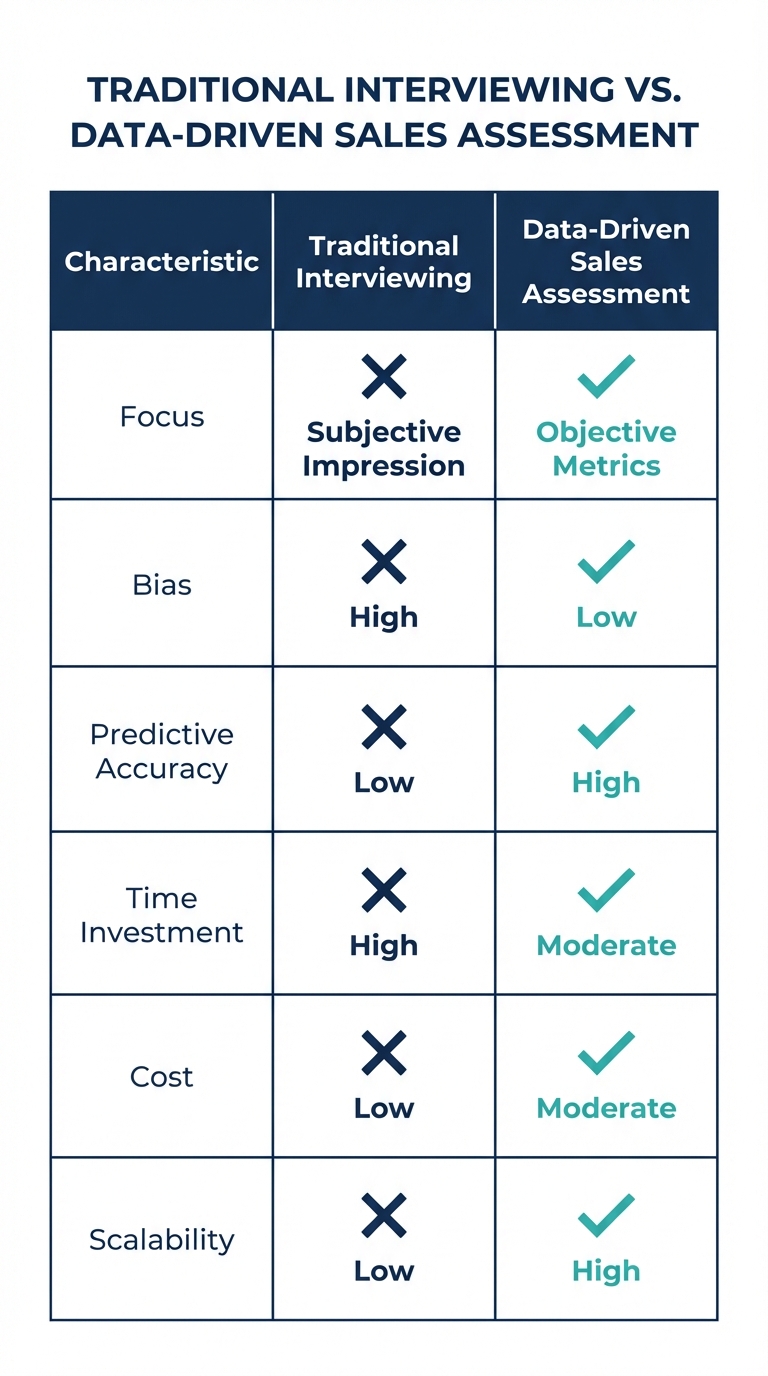
By analyzing behavioral data and role-play outcomes, sales leaders can see a candidate's actual proficiency in action. This quantitative approach reduces the "error of intuition," ensuring that the hiring decision is backed by evidence rather than a fleeting rapport built during a 30-minute conversation.
Integrating these insights early in the sales hiring funnel ensures that only the top 10% of performers move forward, saving hundreds of hours in wasted interview time and significantly lowering the risk of a "bad hire" cost.
What High-Quality Candidates Look for in a Sales Organization
The power dynamic in sales hiring has fundamentally shifted. Top-tier sales professionals are no longer just looking for the highest commission ceiling; they are vetting your organization as rigorously as you are vetting them. To attract "A-players," your company must demonstrate specific cultural markers and operational efficiencies that promise long-term success.
According to the LinkedIn Global Talent Trends report, modern candidates are increasingly prioritizing flexibility, professional development, and work-life balance. In the competitive landscape of 2025, clarity regarding role expectations and company health is the primary currency for attracting talent.

Evaluating the Sales Environment
High-quality candidates look for a culture that balances high performance with high psychological safety. They aren't just looking for a "work hard, play hard" mantra; they are looking for cultural alignment and operational transparency.
- Flexibility and Autonomy: Top performers want to be measured by their outcomes, not their activity metrics. Organizations that offer hybrid work models or flexible hours have a significant edge.
- Path to Advancement: "A-players" are career-oriented. They look for clear evidence of internal promotion paths and a commitment to upskilling.
- Diversity and Inclusion: A diverse sales force is increasingly viewed as a sign of a progressive, healthy organization. Candidates want to see themselves reflected in leadership.
- Transparency in Compensation: High-quality candidates expect a clear, uncapped commission structure and a realistic view of what the average rep is actually taking home (OTE vs. Actual).
Support, Tools, and Leadership
The "lone wolf" era of sales is over. Modern sales professionals expect an integrated ecosystem that enables them to spend more time selling and less time on administrative tasks.
- Tech Stack and AI Integration: Candidates are looking for organizations that leverage AI sales assessments and automation. They want tools that reduce "grunt work," such as CRM automation, AI roleplay for training, and advanced lead intelligence.
- Sales Enablement and Training: High-quality hires want to know they will be supported beyond the initial onboarding. They value ongoing coaching and access to sophisticated sales assessment tools that help them identify and bridge their own skill gaps.
- Empathetic Leadership: The quality of the direct manager is often the deciding factor for top talent. Candidates look for leaders who act as coaches rather than micromanagers.
- Product-Market Fit: Sophisticated candidates will research your product's reputation. They want to sell something that provides genuine value and has a strong competitive advantage in the market.

By focusing on these markers, you move from a "recruiting" mindset to an "attraction" mindset, ensuring your sales hiring process yields the highest caliber of talent.
Managing the Sales Hiring Lifecycle and Onboarding Metrics
The transition from a candidate to a high-performing rep is the most fragile stage of the sales hiring process. To minimize churn and maximize ROI, organizations must move beyond "gut feel" and implement technical benchmarks that track both behavioral readiness and output.
Defining Success through Activity and Outcomes
Measuring the success of a new hire requires a dual focus on leading indicators (activity) and lagging indicators (outcomes). By using AI sales assessments, managers can establish a baseline of a candidate's skills before they even start, allowing for more targeted tracking of the following KPIs:
- Time to First Deal: The number of days from the hire date to the closing of the first transaction. This is the ultimate measure of onboarding efficiency.
- Activity Quotas: Weekly targets for outbound calls, personalized emails, and LinkedIn touchpoints. Consistent volume in the first 60 days is a primary predictor of future pipeline health.
- Roleplay Proficiency: Scoring candidates and new hires on their ability to handle objections and maintain call control within a simulated environment.
- Pipeline Contribution: The total dollar value of qualified opportunities generated by the rep within their first 90 days.

The Onboarding and Ramp-Up Roadmap
A structured 30/60/90 day plan ensures that new hires are not overwhelmed and that management has clear "go/no-go" decision points based on performance data.
- Days 1–30: Foundational Mastery. The focus is on product knowledge, buyer personas, and tech stack proficiency. By the end of month one, the rep should pass a certification roleplay using an AI sales training simulator to prove they can deliver the core value proposition without a script.
- Days 31–60: Initial Execution. The rep begins active prospecting or managing small deal cycles. Success is measured by Activity Quotas and the ability to secure initial discovery meetings. Coaching should focus on refining the "hook" and early-stage objection handling.
- Days 61–90: Full Quota Attainment. The rep is expected to operate independently. Key metrics shift to Conversion Rates (from discovery to qualified lead) and Pipeline Velocity. By day 90, the rep should be hitting 100% of their ramped quota.
Evaluating Long-Term Fit and Growth
The final stage of the hiring lifecycle is determining if the rep has the "DNA" for long-term success. For leadership-track hires, a sales and leadership assessment test can help evaluate management potential alongside selling ability. Technical skills can be taught, but two traits are essential for growth:
- Coachability: How quickly a rep implements feedback from recorded calls or AI simulations. Reps who stall in their development despite intensive coaching are high-risk for long-term failure.
- Performance Consistency: While "home run" deals are valuable, the most successful sales hiring strategies prioritize reps who show steady, week-over-week improvement in their core metrics.
By integrating data-driven assessments with a rigorous onboarding roadmap, companies can identify "false positives" early and double down on the talent most likely to reach President's Club.
Frequently Asked Questions
What is the average cost of a bad sales hire?
A bad sales hire typically costs a company between $100,000 and $200,000 when accounting for salary, recruitment expenses, and lost revenue opportunities. This financial impact often equates to 1.5 to 2 times the employee's annual salary.
How do you verify a sales candidate's past performance?
The most reliable way to verify performance is through data-backed AI sales assessments that simulate real-world selling scenarios. This allows you to measure their discovery, objection handling, and closing skills objectively rather than relying on self-reported quotas or resumes.
Should I prioritize industry knowledge or raw sales ability?
Prioritize raw sales ability and coachability, as specific industry knowledge can be taught relatively quickly during onboarding. A candidate with strong fundamental "sales DNA" will usually outperform a subject matter expert who lacks core prospecting and closing disciplines.
How many interview rounds are standard?
A standard, effective process usually involves three to four rounds: a recruiter screen, a hiring manager interview, a practical roleplay assessment, and a final culture-fit check. Keeping the process efficient is critical to ensure top-tier talent isn't lost to faster-moving competitors.
How do you handle candidates who interview well but perform poorly?
To filter out "professional interviewers," implement a live roleplay simulation early in the process to evaluate actual skill in a controlled environment. Shifting from talking about sales to demonstrating them ensures you hire based on objective performance rather than just charisma.
Modernize Your Sales Vetting Process
Stop relying on gut instinct to make your next sales hire. With Overvue's AI sales assessment platform, you can watch candidates navigate real discovery calls, handle objections, and close in a simulated environment before they ever join your team.
Companies using Overvue's assessment and sales training tools cut onboarding time and identify top performers earlier in the hiring funnel.
Get started today and see how data-backed roleplay simulations can transform your sales hiring process.