
The most popular advice about sales objections is often wrong. Successful objection handling doesn't mean defeating a buyer, talking over hesitation, or delivering the cleverest rebuttal. It means identifying what the objection signals, choosing a response that preserves trust, and advancing a specific next step. A concern may indicate a genuine risk, weak relevance, missing evidence, the wrong stakeholder, or a polite attempt to end the conversation.
That makes sales objection handling techniques measurable. Managers can assess listening quality, diagnosis, evidence relevance, conversation control, authenticity, adaptability, and next-step execution rather than judging whether a rep sounded persuasive. A large-scale analysis of more than 300 million cold calls found that the top five objections represented 74% of all pushback, with dismissive, situational, and existing-solution objections forming recognizable patterns (Prospeo's analysis of sales objections). Reps don't need an answer for every imaginable sentence. They need disciplined ways to recognize recurring objection families.
The eight techniques below show how each method sounds, when it works, what can go wrong, and how managers can practice it in consistent AI buyer simulations. Platforms such as Overvue can turn sales calls into content for training libraries and use standardized scenarios to score candidates or team members against the same observable behaviors.
1. The Feel-Felt-Found Method
The Feel-Felt-Found method starts with empathy. The salesperson acknowledges the buyer's concern, establishes that similar customers have experienced it, and then explains what those customers learned after examining the issue more closely.
For a price objection, the conversation might sound like this:
Salesperson: “That concern makes sense. Several customers initially felt the investment was difficult to justify. After comparing the implementation effort, operating impact, and expected business outcome, they found that the decision made more sense when evaluated against the full cost of the current process.”
The framework works because it lowers defensiveness before introducing evidence. It also gives the buyer a relevant reference point. The risk is that the language can sound rehearsed, especially when every objection receives the same “many customers felt” response. It can also feel dismissive if the salesperson uses a customer story to avoid addressing a legitimate commercial or technical concern.
When to use it authentically
The method works best when the reference customer resembles the buyer in industry, operating model, company scale, stakeholder concern, or implementation context. A procurement leader doesn't need a generic success story. They need evidence that another organization faced a comparable approval or risk question.
The “found” portion should also be concrete. It might involve a phased rollout, a security review, a narrower initial scope, or a change in internal ownership. If the salesperson doesn't have credible evidence, the response should stop after validation and move into diagnosis rather than inventing reassurance.
Teams should prepare a small set of customer stories linked to their most common objections, then practice changing the wording instead of memorizing paragraphs. Overvue's AI roleplay can expose reps to varied buyer reactions, including buyers who challenge the similarity of the example or ask for supporting documentation.
Managers can score whether the rep acknowledges the concern, selects relevant proof, avoids unsupported promises, and checks for buyer acceptance. A strong rep doesn't merely tell a story. The rep connects the story to the buyer's stated risk and secures agreement on whether that risk has been reduced.

2. The Reframe Method
A reframe changes the question without denying the buyer's concern. Instead of arguing that the objection is wrong, the salesperson examines whether the buyer is evaluating the issue through the most useful lens.
Consider a buyer who says, “We're not ready to implement.” A weak response insists that implementation is easy. A stronger reframe asks whether the pre-implementation period could be used to align workflows, owners, and success criteria before launch. The concern remains valid, but the conversation shifts from “Are we ready to deploy?” to “What preparation would make deployment safer?”
A feature comparison can use the same logic:
“Having fewer features may be a concern if the team needs broad functionality. If the main priority is fast adoption and a manageable workflow, though, fewer unnecessary features may reduce training and administration. Which outcome matters more for this team?”
Reframing requires diagnosis
The technique fails when the seller reframes too early. “Too expensive” might mean the buyer lacks budget, doesn't trust the expected outcome, is comparing the product with a cheaper alternative, or has assigned the project a low priority. Each cause requires a different conversation. Reframing price as value before understanding the comparison can sound like evasion.
The best reframes usually connect the buyer's own criteria to a different implication. A concern about implementation may reveal a need for control. A concern about limited integrations may reveal a preference for stability. A concern about timing may reveal that internal alignment hasn't happened.
Salespeople should prepare alternative frames for recurring objections, but each frame needs a question that tests buyer buy-in. Useful indicators include the buyer expanding on the new perspective, volunteering additional context, or agreeing to examine a specific workflow. Silence, repeated objections, or a quick change of subject suggests that the reframe missed the underlying concern.
Managers can score the technique through observable behavior:
- Evidence of listening: The rep uses the buyer's stated priorities.
- Relevance: The new frame addresses the actual decision criteria.
- Authenticity: The rep doesn't pretend a disadvantage is universally beneficial.
- Control: The rep asks a focused question and earns a clear response.
- Execution: The rep proposes a next step tied to the reframed issue.

3. The Curiosity Method
Curiosity is often the safest first response because a stated objection rarely contains enough information to solve itself. When a prospect says, “Your software is too complex,” the salesperson shouldn't immediately launch into a product tour. The concern could involve onboarding, user permissions, integrations, support, change management, or a previous experience with similar software.
A useful response sounds conversational:
“What part feels most complex for your team? Is the concern the initial learning curve, the ongoing administration, or how the system would fit into the current workflow?”
The question gives the buyer several possible directions without forcing a preferred answer. If the buyer says the concern is administrative burden, the salesperson can investigate who owns that work, how it happens today, and what a workable future state would look like.
Questions should uncover, not prosecute
Curiosity becomes counterproductive when it resembles an interrogation. Reps who fire off question after question without reflecting what they hear can make the buyer feel analyzed rather than helped. Open-ended questions should therefore be paired with summaries, pauses, and evidence that the salesperson is updating the conversation based on the answer.
Questions should also avoid leading the buyer toward a predetermined conclusion. “Wouldn't a simpler workflow solve that?” is advocacy disguised as discovery. “What would a simpler workflow need to change?” gives the buyer room to define the problem.
Teams can build a question bank around recurring objections, but the questions must remain flexible. The best open-ended questions for sales conversations should help uncover business impact, decision criteria, stakeholder concerns, and timing without turning discovery into a script recital.
A practical AI simulation can present the same objection through different personas. An operations leader may focus on workflow disruption. An IT stakeholder may focus on access controls. A finance stakeholder may focus on value justification. Managers can score whether the rep:
- Clarifies the objection before responding
- Uses neutral, open questions
- Reflects the buyer's answer accurately
- Avoids interrupting or rushing toward a pitch
- Connects the eventual response to the discovered cause
Research from an analysis of more than 800,000 objection calls found that 39% of objections can be overturned when handled well, while “No Immediate Need” and “Lack of Time” reached 46% success rates when handled effectively. “Lack of Trust” reached only 32%, which reinforces why diagnosis and credibility matter more than a generic rebuttal (MaxContact's objection-handling analysis).
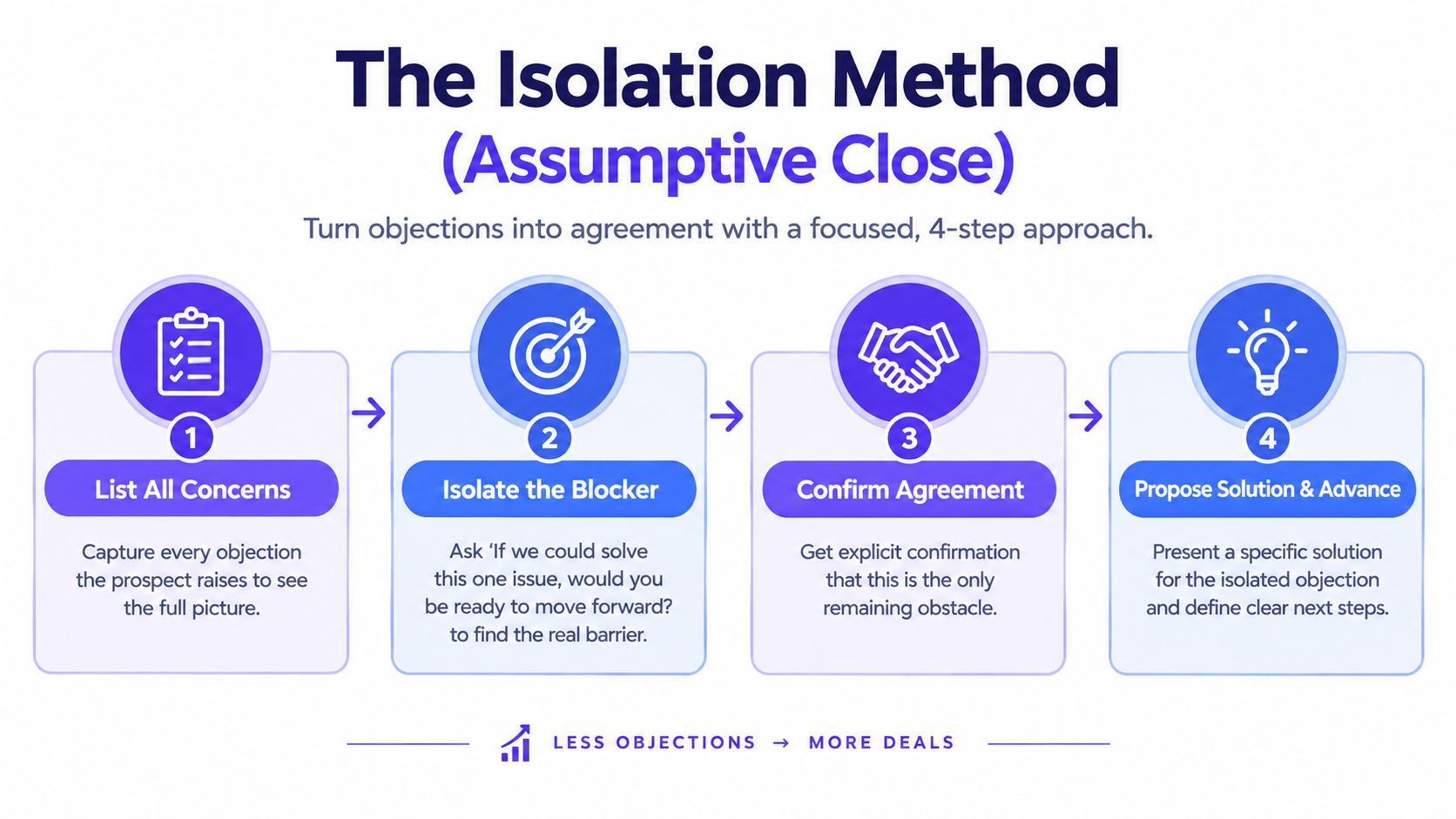
4. The Isolation Method
The isolation method tests whether a stated objection is the barrier to progress. It's especially useful when a buyer lists several concerns at once, such as cost, implementation timing, and integration.
The salesperson first reflects the full set of concerns:
“It sounds like the decision depends on the commercial model, the rollout timeline, and the integration work. If those three areas were addressed with an agreed plan, would the team be ready to evaluate a decision?”
That question doesn't promise that every concern can be solved. It establishes a conditional path and invites the buyer to confirm whether other barriers exist.
Isolate without forcing a close
The method is frequently described as an assumptive close, but aggressive use can damage trust. A buyer may not yet have enough information to commit, and “If we solve this, will you sign?” can sound like a trap. The better approach is to isolate the decision condition at the appropriate stage.
A rep might ask, “If the security review confirms the required controls, is security still the main reason the project can't advance?” That wording produces useful information without pretending that a complex purchase has only one remaining step.
The technique also works in multi-stakeholder deals. A contact may confirm that price is resolved for their department while admitting that legal, IT, or leadership still needs to review the proposal. That distinction prevents a rep from treating one person's conditional agreement as organizational consensus.
Managers can practice this with AI buyers who introduce multiple objections, then score four behaviors:
- Enumeration: The rep accurately names each concern.
- Permission: The rep asks whether working through them would be useful.
- Isolation: The rep tests one blocker at a time.
- Next-step precision: The rep identifies the person, evidence, or action required to resolve each concern.
The method should end with a defined action, such as a security review, stakeholder meeting, technical validation, or commercial discussion. If no action follows, isolation becomes a diagnostic exercise rather than a way to advance the deal.
5. The Proof and Testimonial Method
Proof reduces perceived risk when the buyer's concern is credibility, adoption, business impact, or practical fit. The salesperson uses a customer example, testimonial, implementation artifact, product evidence, or documented result to answer the specific question behind the objection.
For example, a buyer worried about team adoption might hear:
“Adoption is a reasonable concern, especially if the team already has a crowded workflow. A comparable customer used a phased rollout with role-specific training. The relevant question is whether that rollout model would fit your team, so the next step could focus on the user groups, owners, and support requirements.”
The example works because it doesn't treat one customer's outcome as a guarantee. It uses the story to make the buyer's risk more concrete and to open a discussion about applicability.
Similarity matters more than volume
A large library of generic testimonials won't compensate for irrelevant proof. The buyer needs to recognize the environment, use case, constraints, and stakeholders. A manufacturing team may not care about a startup story. A security lead may need architecture documentation rather than a marketing quote.
Proof also has to match the objection. A revenue result doesn't automatically resolve a data residency concern. A customer logo doesn't prove ease of implementation. The salesperson should state what the evidence demonstrates and what it doesn't demonstrate.
That discipline is central to effective objection-handling training. AI simulations can test whether a rep chooses evidence based on buyer context, explains it accurately, and invites the buyer to challenge its relevance rather than flooding the call with proof points.
Managers should maintain objection-specific proof libraries and score:
- Source fit: Does the example resemble the buyer?
- Claim discipline: Does the rep avoid overgeneralizing?
- Timing: Does proof follow diagnosis rather than interrupt it?
- Buyer engagement: Does the rep ask whether the evidence addresses the concern?
- Action: Does the rep offer an appropriate validation step?
Proof is powerful, but it shouldn't replace direct answers. If the buyer asks about security, implementation ownership, or contractual exposure, the rep needs the relevant artifact and subject-matter support, not just an enthusiastic reference.

6. The Boomerang Method
The boomerang method turns an objection into evidence about the buyer's priorities. It doesn't claim that every concern proves the product is right. It asks what the concern reveals about the environment and then connects that priority to a relevant capability.
A buyer might say, “We're worried about disruption during implementation.” A thoughtful response could be:
“That concern suggests operational continuity matters more than a rapid, disruptive change. The relevant question is whether a phased rollout can protect the current workflow while the team validates the new process.”
The response uses the objection as information. It doesn't announce that disruption is good.
A second example involves integrations. If a buyer says that a competitor offers more integrations, the salesperson can ask whether the organization values breadth, stability, maintainability, or a specific connection. The concern may reveal a preference for control rather than a simple feature-count comparison.
Use insight, not cleverness
Boomerang responses often fail because sellers try to sound inventive. “That's exactly why you need us” can feel manipulative when the product doesn't clearly address the stated risk. The technique should only be used when the connection between the objection, buyer priority, and solution capability is genuine.
The seller should also leave room for the buyer to reject the interpretation. “Is that a fair reading?” or “Does stability matter more here than having every possible integration?” gives the buyer control and prevents the rep from assigning motives.
A useful practice scenario presents the same objection to different personas. A technical buyer may prioritize maintainability. A business sponsor may prioritize speed to value. A frontline manager may prioritize team acceptance. Managers can score whether the rep identifies the priority accurately, avoids overclaiming, and adapts after the buyer corrects the interpretation.
The sales meeting script guidance can support preparation, but the best boomerang delivery won't sound like a script. The rep should acknowledge the concern, ask what it protects, connect that value to a specific capability, and confirm whether the connection matters to the buying decision.
7. The Trade-Off Method
Trade-offs belong in negotiation, not in every objection conversation. A buyer who says, “The budget doesn't fit until next fiscal year,” may need a different commercial structure, but the buyer may also lack urgency or confidence in the expected outcome. Offering a concession before diagnosing the cause teaches the buyer that resistance produces discounts.
A disciplined response could sound like this:
“If the business case is approved but the timing of the spend is the constraint, the team could examine a smaller initial scope with the remaining work scheduled for the next planning period. In return, the agreement would need a clear commitment to the rollout conditions. Would that structure address the budget timing issue?”
The exact terms must follow company policy and approval authority. A salesperson shouldn't promise payment changes, custom work, pricing protection, or implementation capacity without confirming that the organization can deliver them.
Every concession needs reciprocity
The trade-off method protects value by exchanging something rather than giving something away. The buyer might trade a longer commitment for additional configuration, a narrower initial scope for faster approval, or a defined start date for a specific commercial arrangement. The exchange should be explicit and documented.
Managers should track concession patterns because repeated exceptions can reveal weak qualification, poor value communication, or uncontrolled margin erosion. AI simulations can present buyers who ask for multiple concessions, change the requested terms, or refuse reciprocity. The rep's score should reflect whether the seller maintains boundaries, explains the exchange, and secures a verifiable next step.
Useful behaviors include:
- Diagnosis before concession: The rep confirms that the issue is commercial rather than strategic.
- Value protection: The rep proposes an alternative instead of reflexively discounting.
- Reciprocity: The rep asks for a defined commitment in return.
- Authority control: The rep avoids promising unauthorized terms.
- Documentation: The rep summarizes the agreed conditions and owners.
Trade-offs work when both sides are solving a legitimate constraint. They don't work when the seller uses artificial deadline pressure or vague promises to create urgency. Authentic flexibility sounds like a structured option, not a last-second favor.
8. The Direct Method
Direct responses are appropriate when the objection rests on a factual misunderstanding, outdated information, or an incorrect assumption. If a buyer says, “Your software doesn't integrate with Salesforce,” a clear response should correct the record and provide verifiable documentation.
“The current product does support Salesforce integration. The technical documentation shows the supported workflow, and the next step could be a validation call with the person who owns that integration.”
The salesperson should correct the fact without humiliating the buyer. Acknowledging why the buyer believed the information can preserve rapport: the documentation may be old, a competitor may have made a comparison, or a previous product version may have worked differently.
Direct doesn't mean argumentative
The direct method should not be used for subjective objections. “Your product is too expensive” isn't a factual error that requires contradiction. “Your implementation will be difficult for our operating model” requires diagnosis and evidence. Treating every concern as something to rebut makes the seller sound defensive.
Reps should prepare an evidence library for common misconceptions, including current product documentation, security materials, independent review references, and approved competitive responses. Company claims alone may not satisfy a skeptical buyer, especially when the concern involves reliability, compliance, or commercial risk.
Managers can score whether the rep:
- Identifies the factual issue accurately
- Uses current and relevant evidence
- Explains the correction plainly
- Avoids condescension
- Checks whether the correction resolves the concern
- Moves to a practical validation step
The direct method is also a useful test of adaptability. An AI buyer can challenge the source, introduce conflicting information, or reveal that the factual concern was only a surface objection. A strong rep corrects the misconception, then returns to curiosity if the buyer remains hesitant.
8 Sales Objection Handling Techniques Compared
| Method | Implementation Complexity 🔄 | Resource Requirements ⚡ | Expected Outcomes ⭐ / 📊 | Ideal Use Cases 💡 | Key Advantages ⭐ |
|---|---|---|---|---|---|
| The Feel-Felt-Found Method | Low–Medium 🔄, three-step structure, needs natural delivery | Low ⚡, needs a few authentic customer stories | Builds rapport and reduces defensiveness; moderate conversion uplift ⭐📊 | Early-stage objections; relationship-driven sales; new-hire training 💡 | Empathy-first; easy to train; broadly applicable ⭐ |
| The Reframe Method | High 🔄, quick thinking and deep product/context knowledge | Medium ⚡, training + scenario prep | Shifts prospect perspective; uncovers root concerns; can expand deal scope ⭐📊 | Strategic/consultative sales; when mindset change is needed 💡 | Repositions objections as opportunities; reveals underlying issues ⭐ |
| The Curiosity Method (Question-Based) | Medium 🔄, requires disciplined questioning and patience | Low–Medium ⚡, prep open-ended questions and practice | Reveals true blockers; stronger alignment; longer but higher-quality discovery ⭐📊 | Complex deals, discovery calls, qualification conversations 💡 | Diagnostic, collaborative, prevents talking past the issue ⭐ |
| The Isolation Method (Assumptive Close) | Medium 🔄, skillful control and phrasing required | Low ⚡, process-focused, minimal collateral | Clarifies single blockers; accelerates decision when blocker is real ⭐📊 | Multi-stakeholder deals; closing conversations; scope clarification 💡 | Creates momentum; tests buying intent; time-saving ⭐ |
| The Proof and Testimonial Method | Low–Medium 🔄, straightforward but needs relevant assets | High ⚡, requires case studies, testimonials, metrics | Highly persuasive; reduces perceived risk; strong conversion impact ⭐📊 | Price/ROI objections; skeptical or late-stage prospects 💡 | Third-party validation; scalable across teams; cross-personality effectiveness ⭐ |
| The Boomerang Method | High 🔄, requires pattern recognition and business acumen | Medium ⚡, training and tailored examples needed | Can flip objections into advantages; often ends cycling quickly ⭐📊 | Consultative selling when objections expose prospect values 💡 | Highly persuasive when authentic; shows strategic insight ⭐ |
| The Trade-Off Method (Concession Strategy) | Medium 🔄, negotiation discipline and boundaries required | Medium–High ⚡, approval processes, concession tracking | Often closes stalled deals; may lower margin; creates reciprocity ⭐📊 | Price/timeline objections; enterprise negotiations and pilots 💡 | Flexible, creates win-win outcomes; practical for closing ⭐ |
| The Direct Method (Rebuttal with Evidence) | Low–Medium 🔄, requires factual preparedness and tact | Low–Medium ⚡, evidence library, docs, third-party sources | Quick resolution for factual misconceptions; builds credibility with analysts ⭐📊 | Tech/engineering buyers; misconceptions or outdated info scenarios 💡 | Efficient, fact-based, strong with analytical prospects ⭐ |
Turn Techniques Into Observable Sales Behaviors
The strongest teams don't ask reps to memorize eight scripts. They teach reps to diagnose the objection, match the response to its cause, confirm whether the concern has changed, and secure a defined next step. The right technique depends on the situation. Curiosity usually belongs before proof or reframing. Isolation helps when several blockers are mixed together. Trade-offs belong when the buyer is negotiating terms, not when the buyer still doubts the solution's relevance.
A manager can use a compact scorecard for every simulated or live conversation:
- Empathy: Did the rep acknowledge the concern without minimizing it?
- Discovery: Did the rep clarify what the objection meant?
- Relevance: Did the response address the buyer's actual priority?
- Credibility: Did the rep use accurate, appropriate evidence?
- Control: Did the rep guide the conversation without interrupting or pressuring?
- Adaptability: Did the rep change approach when the buyer added information?
- Next-step execution: Did the rep secure an owner, action, timing, and decision condition?
Each criterion should describe observable behavior rather than personality. “Sounds confident” is difficult to score consistently. “Summarizes the concern before responding” is visible in a transcript and repeatable across buyers.
Practice works best when the team isolates one objection set at a time. Reps can run standardized scenarios, review transcripts, identify the moment where diagnosis was skipped, and repeat the conversation with a different buyer persona. Research cited in sales-training literature associates active practice with about 75% retention, compared with roughly 5% for lecture-style learning, and reports that regular role-play can improve close rates by 20% to 45% while reducing ramp time by 2 to 4 weeks (ATD's role-play retention guidance).
Measurement should include leading indicators, not only closed revenue. Independent sales-training guidance recommends tracking completion rate, scorecard trends, and behavior change. Its benchmark suggests 70% to 90% completion of assigned practice sessions within a week and 10% to 20% score improvement over 60 to 90 days for new reps (RevenueRoleplay's sales training measurement guidance).
Overvue provides a practical option for teams that need repeatable AI roleplays, buyer personas based on ICP details, criteria-based scoring, candidate comparison, and ongoing practice without relying only on manager-led roleplays. Managers can use the same objection scenarios for hiring and onboarding, then compare performance against consistent standards.
The broader shift is from verbal rebuttal to stakeholder enablement. Recent sales guidance increasingly emphasizes security and AI risk, implementation risk, and committee consensus, with assets such as security review packs, phased rollout plans, executive briefs, procurement materials, and champion decks (Apollo's guidance on modern sales objections). A rep who handles the live objection well still needs to help the buyer resolve concerns across IT, legal, finance, procurement, and leadership.
Overvue offers AI buyer simulations built around ICP-specific objections, buyer roles, competitors, pains, and deal stages, with automatic scoring for objection handling, responsiveness, call control, and next-step execution. Visit Overvue to standardize sales practice, compare candidates consistently, and help reps improve through repeatable simulated conversations.