
A manager can spot the problem fast. The new rep finishes onboarding, sits through product training, nods through roleplay feedback, and then freezes on the first real discovery call. Another rep in the same cohort sounds polished, but still sends the wrong follow-up, uses the wrong asset, or misses the next step, and the team ends up asking the same question every quarter, why do trained people still sell so differently?
That gap is where sales training enablement earns its place. It turns training from a one-time event into a system for building, observing, reinforcing, and measuring seller behavior across hiring, onboarding, coaching, and live selling. The point is not more content. The point is consistent behavior that shows up in the field, in manager reviews, and in revenue results.
Introduction to Sales Training Enablement
Sales leaders usually feel the pressure in the same place, the pipeline looks healthy on paper, but new hires still need too much hand-holding and experienced reps still improvise their way through the same objections. Traditional training can create a brief lift, yet without a system for practice, coaching, and measurement, the gains fade once reps return to live calls.
Sales training enablement solves that by linking learning to the work sellers do. It combines structured training, manager reinforcement, and operational support so a rep is not just exposed to knowledge, but expected to use it. That matters for revenue, and it matters just as much for hiring quality and onboarding speed, because the same standards can guide candidate assessment, new-hire ramp, and ongoing development.
The most useful way to think about it is simple, training builds skill, enablement makes skill repeatable. When those two pieces stay separate, teams get inconsistent execution. When they work together, managers can coach to one standard, new hires can ramp against one playbook, and leaders can see whether behavior changed or whether only course completion did.
Understanding Key Concepts
Sales Training and Sales Enablement in Practice
Sales training is the structured part of the system. It teaches product knowledge, process, messaging, objection handling, and the behaviors a rep needs to sell well. Sales enablement is broader, it wraps that learning in the assets, tools, workflows, and reinforcement that help the skill show up during real buyer conversations, which is why the two are stronger together than apart, as described in the distinction between sales enablement and sales training.
The easiest way to separate them is to ask what changes after each activity. A workshop changes what a rep knows. Enablement changes what a rep can access, practice, and apply inside the daily sales motion. Training is the classroom, enablement is the operating system.
Practical rule: If the work ends when the session ends, it's training. If the work continues in the CRM, content library, coaching cadence, and manager review, it's enablement.
How the Discipline Became Formalized
This discipline did not stay informal for long. A Cirrus Insight summary shows that fewer than 20% of organizations reported using sales enablement in 2013, while more than 60% did by 2019. The same source says that by 2026, 76% of organizations have a dedicated sales enablement function and 90% report a program or team dedicated to enablement, with ownership most often sitting in RevOps, then sales, then the C-suite, which makes the reporting line part of the story, not just the title Cirrus Insight sales enablement statistics.
That shift matters because it shows how the job changed. Sales enablement is no longer just “somebody's coaching task.” It's a formal business function with clear ownership, shared systems, and measurable expectations. Teams that treat it that way can coordinate sales leadership, managers, and L&D around one version of the truth instead of letting each group define success differently.
Designing Effective Sales Training Processes
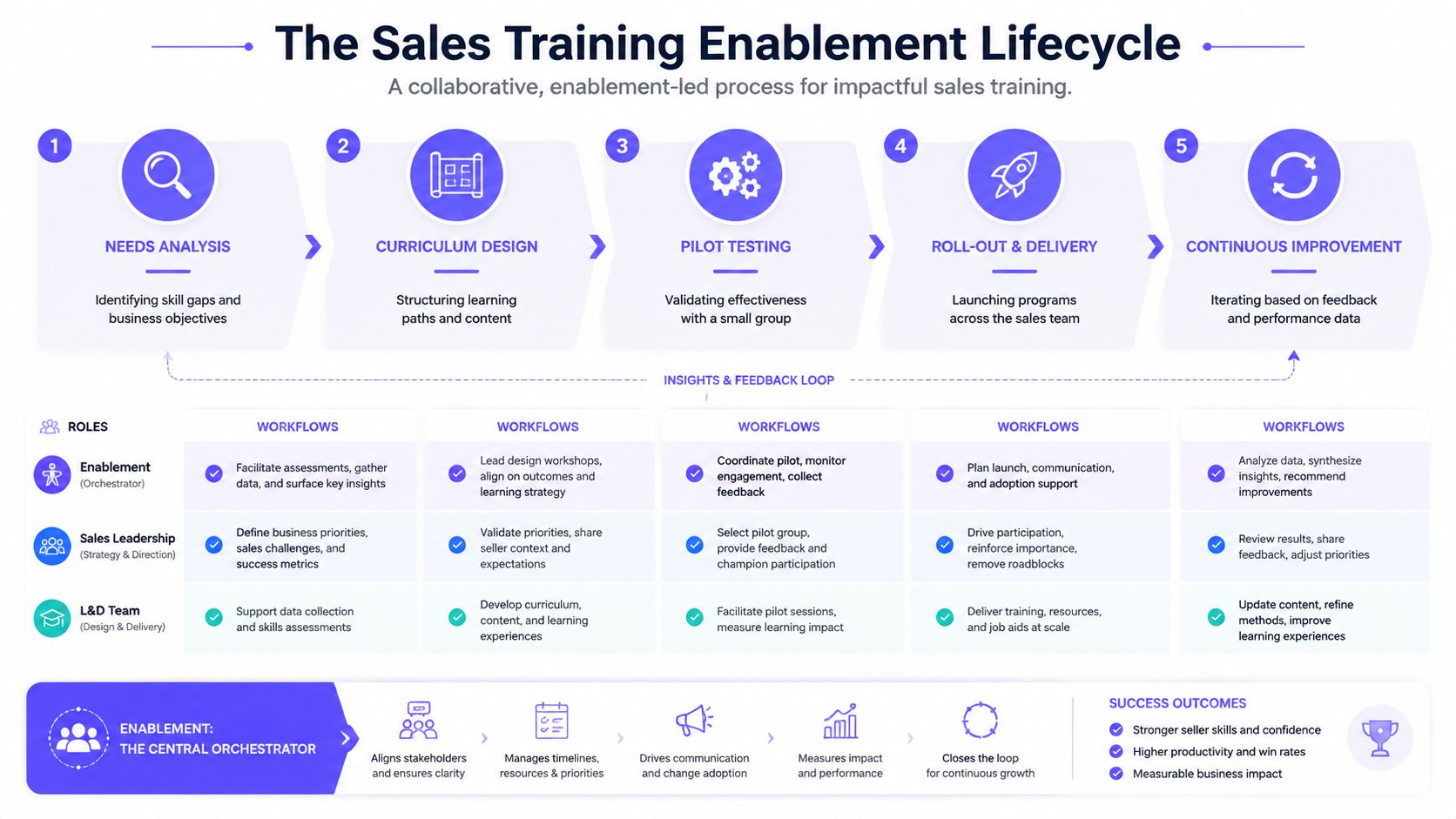
A solid sales training process works like a relay, not a lecture. One person gathers the signal, another shapes the content, managers reinforce the behavior, and enablement keeps the loop moving after rollout. Without that handoff, training becomes a one-time event, and one-time events do not change seller habits for long.
The process should also connect to hiring and onboarding, because the same behaviors that matter in a sales role can be tested before a rep ever carries a quota. Objective simulations help teams see how a candidate or new hire handles discovery, objections, and follow-up, while AI-native tools can standardize what gets observed and scored. That gives enablement a cleaner bridge from talent selection to ramp, instead of treating each stage as a separate program.
Start with the problem, not the curriculum
Needs analysis should begin with observable business friction. That might be weak discovery, slow ramp, poor follow-up quality, or inconsistent objection handling. Sales leadership brings the performance pain, subject matter experts bring authentic scenarios, and enablement translates both into a training brief with clear behaviors, not just a list of topics.
Curriculum design works best when it mirrors the job. Reps should practice the conversations they are expected to have, with the same buyer roles, objections, and handoff moments they will see in the field. If a team is also tightening its early-stage talent process, a practical sales onboarding checklist such as this sales onboarding checklist can help align the sequence so hiring, onboarding, and training reinforce the same behaviors.
A useful external planning reference for create high-performance training programs can help teams map the learning logic before they build content. That matters because the best programs do not start with slides, they start with the few moments where a seller usually succeeds or stalls. From there, the exercise design can match the actual job instead of an idealized version of it.
Pilot before scale
Pilot testing protects the team from polishing the wrong thing. A small group reveals where the roleplay feels unrealistic, where the assessment rubric is too vague, and where managers disagree on scoring. That feedback should shape the delivery version before the program reaches the whole team.
Training quality improves when managers know exactly what “good” looks like, and when they can score it the same way every time.
The pilot also gives managers a chance to practice the coaching language they will use later. If they cannot explain why a call landed well or missed the mark, the training has not yet become usable. The point is not to produce perfect facilitation on the first pass, it is to make the scoring and coaching process consistent enough that different managers can apply it the same way.
Rollout and delivery should then feel operational, not ceremonial. The team should know who owns facilitation, who captures feedback, and who updates the materials after launch. A helpful companion for onboarding structure is this sales onboarding checklist, because onboarding and training break down for the same reason when no one owns the sequence.
Keep the loop open
Continuous improvement is where the process earns trust. Business outcome data can be compared against the training inputs, and the process can be adjusted when behavior changes are weak or uneven. Leaders still need a way to connect learning activity to results, which is why the ROI model for training teams matters, even when the numbers are not the only signal.
A formal process reduces variance in three places, the quality of the scenario, the quality of manager feedback, and the quality of what gets measured after rollout. That is what makes the program repeatable instead of dependent on one strong facilitator. It also makes the training process easier to compare across hires, tenured reps, and teams that enter the program from different onboarding paths.
Building a Technology Stack for Sales Enablement
The right stack is less about buying more tools and more about connecting the right ones. A training program usually needs a place to host learning, a way to practice live selling behavior, a system of record for buyer activity, and reporting that shows whether sellers are using what they learned. Without that integration, teams collect fragments instead of evidence.
What belongs in the stack
An LMS handles structured learning, certifications, and completion tracking. A simulation engine handles practice, especially objection handling, discovery, and next-step execution. CRM integration matters because it connects learning to actual deal work, while dashboards help enablement see patterns across cohorts, managers, and regions.
For teams that want to build realistic practice content, create hyper-realistic videos can support scenario creation without turning every exercise into a live, manager-led production. That matters for scale, because the more realistic the practice, the easier it is for reps to recognize the same situation later in a real deal.
Data needs to show behavior, not just attendance
Many stacks frequently fall short here. A platform can track attendance, but attendance alone doesn't tell anyone whether the rep used the skill in a customer conversation. Effective programs use multi-layer activity telemetry to track content activities, task completion, external sharing, and metadata for deeper behavioral insights, which helps teams distinguish exposure from adoption Allego telemetry guidance.
A rep who finishes a module and never uses the related asset is not the same as a rep whose content-sharing and task patterns show the skill is part of the workflow.
That's also why consistency across systems matters. If the LMS calls a skill one thing, the CRM tags it another, and the coaching notes use a third label, analytics become hard to trust. One naming convention, one scenario library, and one dashboard definition keep the stack usable for managers and leadership alike.
For teams comparing simulation tools, this guide to cold call roleplay tools can help frame the decision around practice quality, scoring consistency, and manager time. The stack should support the job, not add another place for reps to click.
Developing a Content Strategy for Sales Training
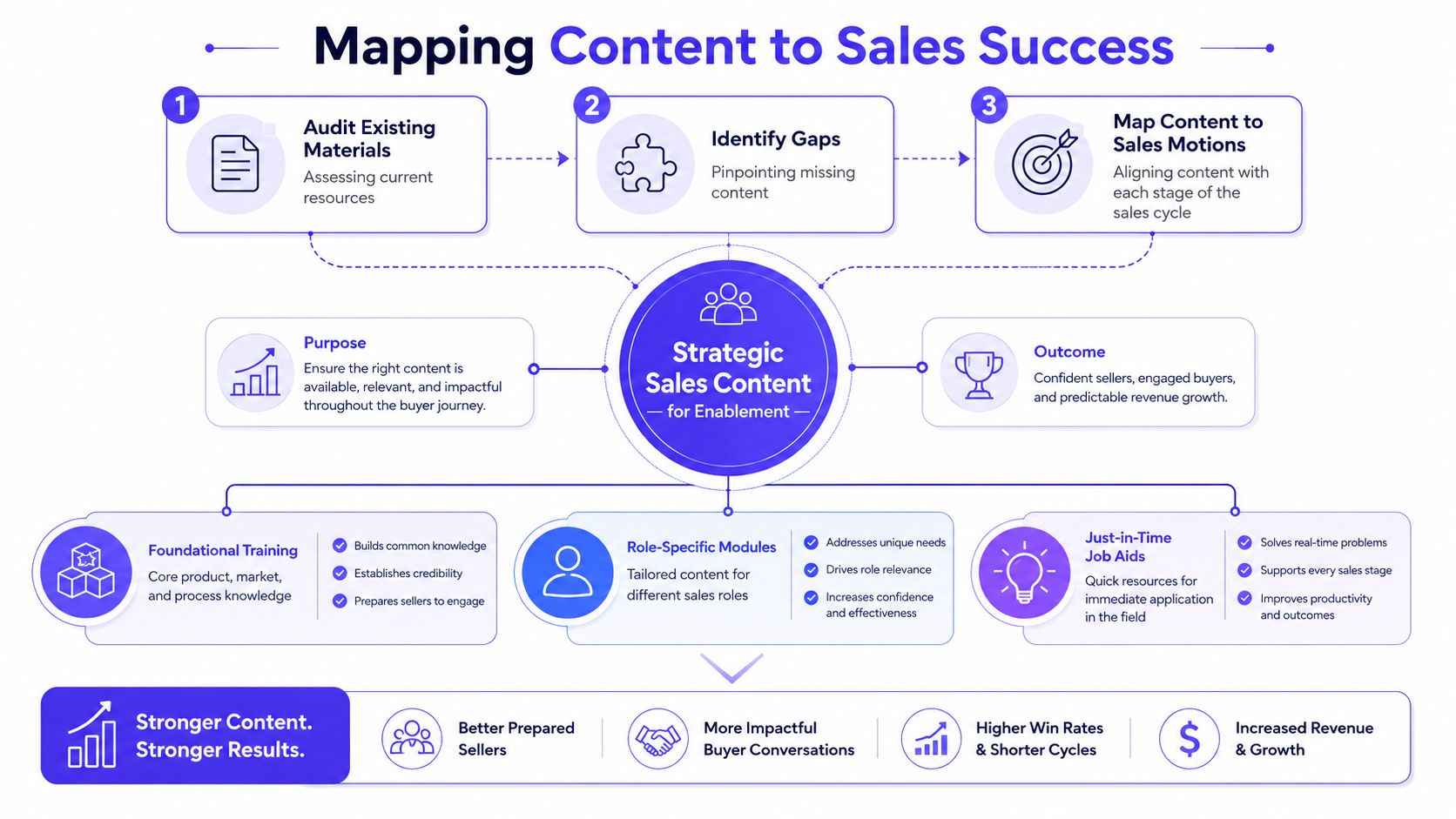
Content strategy starts with an audit, because sales teams often already have too much content in the wrong shape. Product decks, old talk tracks, and one-off manager notes often exist in separate folders, but they aren't organized around the buyer journey or the seller workflow. A clean strategy turns that clutter into a sequence of learning, practice, and reinforcement.
Build the content around motion, not format
A useful audit asks three questions. What do sellers already have, what's missing, and what content maps to each sales motion? Once that's clear, the team can build four content pillars, foundational training, role-specific modules, just-in-time job aids, and reinforcement assets.
Foundational training covers core product, market, and process knowledge. Role-specific modules handle the differences between SDRs, AEs, managers, and specialists. Job aids help reps in the moment, usually when they need a reminder during a live deal. Reinforcement content keeps the skill alive after the initial session.
Make practice feel like the buyer's world
Many teams miss the mark. Reps don't need generic roleplay prompts, they need the kinds of objections, delays, and next-step decisions they'll face from actual buyers. Few guides address training for AI-native buyer expectations and multilingual teams, and that gap matters because global sellers need the same scenario to feel believable in different languages and markets Highspot best practices.
A strong content strategy uses the same scenario family across learning stages. The first pass may be a guided module. The next pass may be a simulated call. The final pass may be a manager-reviewed certification or a daily challenge that keeps the behavior fresh.
The most durable programs don't overload reps with more material. They reduce guesswork. When the content matches the motion, managers coach faster, reps retain more, and practice feels relevant instead of academic.
Measuring Impact and Aligning with Hiring and Onboarding
Measurement gets easier once the team stops treating training as a black box. The best model pairs lead measures with lag measures, so leaders can see both whether reps engaged with the learning and whether the business moved afterward. That link is what gives enablement credibility in hiring, onboarding, and revenue reviews.
Lead and lag measures that actually matter
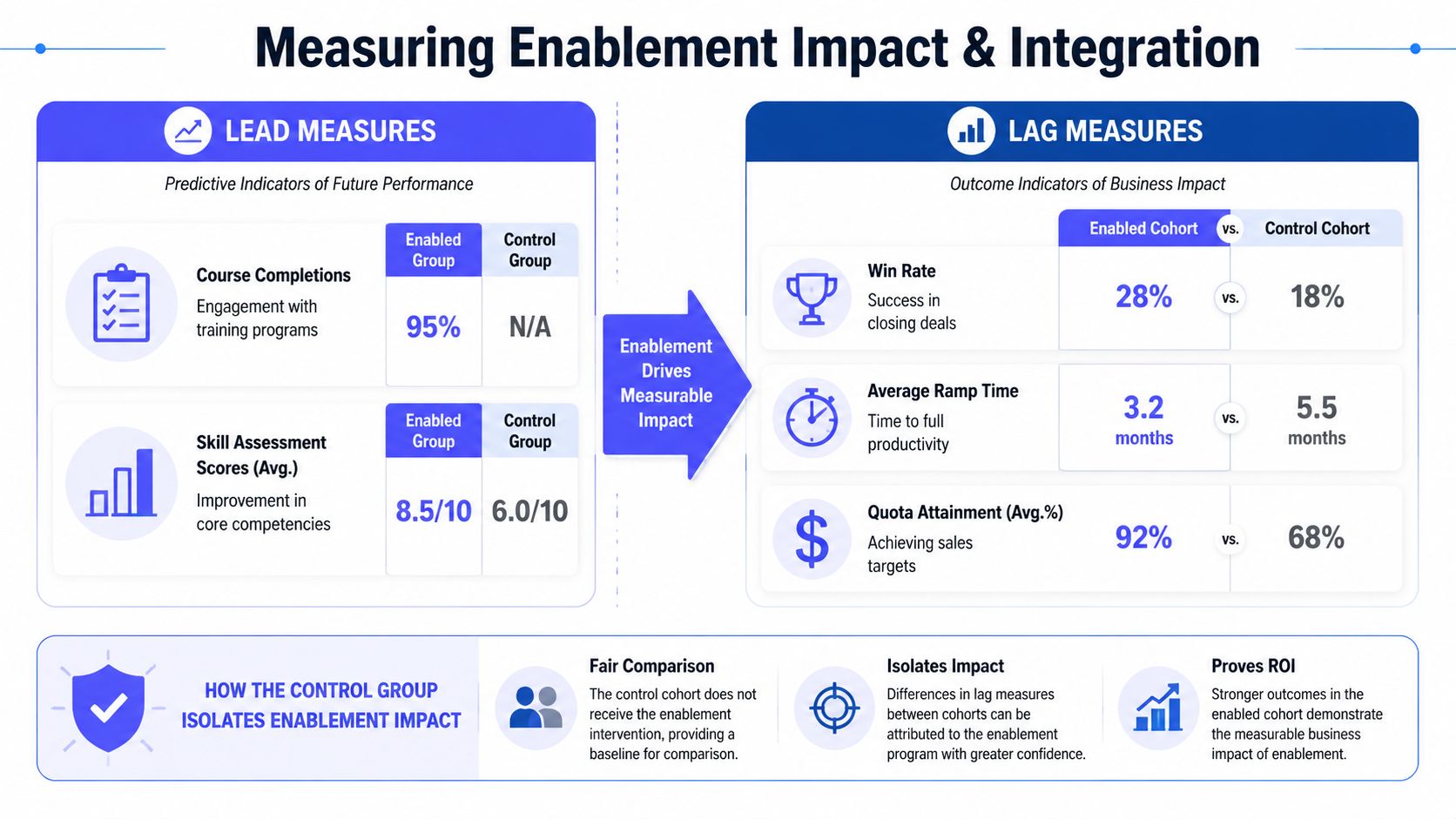
Lead measures are the early signals. Those include readiness, course completions, certification, engagement, and skill progress. Lag measures are the business outcomes, such as win rate, time to productivity, quota attainment, sales-cycle length, discounting, and turnover, which is the mix recommended in Bigtincan's metrics guide.
A defensible design also compares trained cohorts with untrained cohorts over the same period. That comparison helps isolate whether the change is linked to enablement or just market movement. For teams building an operating view, this KPI guide can help organize which metrics belong on the dashboard and which belong in manager conversations.
Measurement rule: If the team can't compare a trained group with a similar untrained group, the result is interesting, but it isn't clean evidence.
Using the same simulations for hiring and onboarding
The cleanest alignment comes from using one set of scenarios across candidate assessment, onboarding, and reinforcement. The same discovery prompt, objection set, and next-step challenge can show how a candidate thinks, then later show how a new hire improves with coaching. That makes expectations visible from the start and reduces the common mismatch between interview performance and live selling behavior.
A resource for guide for L&D professionals can help teams connect assessment design to learning measurement, especially when the goal is to prove change rather than just completion. In practice, the hiring manager gets a comparable scorecard, the onboarding manager gets a practice roadmap, and the enablement leader gets a common standard.
This is also where Overvue fits naturally as one option in the stack. It provides AI buyer roleplays, objective scoring, and shared scenarios for hiring and onboarding, which helps teams compare candidate behavior and new-hire behavior against the same criteria without relying on improvised roleplays.
The big mistake is to use training only after hire and only after onboarding. The stronger model uses the same behavioral standard from assessment to ramp, so the organization stops guessing about readiness and starts seeing it.
Examples of Sales Training Enablement in Action
A growth-stage software team might use AI roleplays before a new rep ever takes a live call. The candidate or new hire gets the same buyer persona, the same objection, and the same scoring rubric, which makes it easier for the hiring team to compare performance fairly and for onboarding managers to coach the exact behavior they need to see.
Another team might use daily practice challenges after onboarding ends. A rep completes a short simulated objection drill before the morning pipeline review, then a manager uses the scorecard to spot the exact habit that needs coaching. That rhythm turns enablement into a habit, not a quarterly event.
When the scenario stays consistent, feedback gets sharper. When feedback gets sharper, managers stop coaching general confidence and start coaching observable behavior.
Distributed teams see a different benefit. A multilingual organization can run the same objection scenario across regions, then compare scores against the same criteria instead of trusting each local manager to interpret performance differently. That matters for fairness, but it also helps leadership spot where language, product knowledge, or buyer motion is creating friction.
The common thread is simple. The best programs do not rely on charisma in the interview, memory in onboarding, or manager availability in coaching. They use the same realistic selling task to assess, teach, and reinforce.
Conclusion and Next Steps
Sales training enablement works best when process, technology, content, and measurement all point in the same direction. A practical first step is a process design workshop, where the team defines what good looks like before anyone starts coaching it. From there, a tech audit shows whether the current stack can support repeated practice, a content audit reveals whether the team is teaching the right behaviors, and a measurement plan ties leading indicators to later outcomes. The next step is to pilot shared simulations in hiring and onboarding, compare results across cohorts, and keep the practices that hold up under real selling conditions.
That sequence matters because it gives sales leaders something more durable than instinct. It creates a system for teaching behavior, proving impact, and standardizing the behaviors that matter across the revenue team.
Overvue helps teams assess candidates and train reps with AI buyer simulations, objective scoring, and shared scenarios for hiring and onboarding. If this topic is on your desk right now, visit Overvue.ai to see how a single practice environment can support hiring, ramp, and ongoing sales training enablement.