
A promising B2B call can lose momentum in a few seconds. The buyer says, “The timing isn't right,” and the rep immediately launches into a product explanation, offers a discount, or lists customer results. The buyer gets quieter. The next meeting remains vague. By the time the opportunity reaches the forecast review, nobody can explain whether timing was the actual problem or just the safest way to end the conversation.
That moment creates a practical challenge for sales managers and enablement leaders. Objection handling is often treated as a personality trait, a library of clever replies, or a test of product knowledge. Those measures can reward confident talkers while missing the rep who listens carefully, identifies the actual blocker, and secures a realistic next step.
This guide defines what objection handling means in B2B sales, why buyers raise concerns indirectly, and how timing changes the quality of a response. It also gives managers a behavioral lens for interviews, coaching, and team development. By the end, a manager should be able to recognize strong handling in a simulated conversation, diagnose the exact behavior that needs improvement, and train reps without relying on charisma as a substitute for skill.
Introduction Why Objection Handling Makes or Breaks B2B Deals
A buyer has described a costly operational problem, agreed that several stakeholders are affected, and accepted a product demonstration. Near the end of the call, the buyer says, “We already have a provider.” The next few seconds reveal whether the rep can diagnose the concern or deliver a faster pitch.
A weak response starts with defense: “Our platform is different because…” The rep adds features, speaks more quickly, and tries to prove superiority. The buyer hears another sales message when a clarifying question would show what the statement means. The discussion shifts from understanding the situation to arguing about alternatives.
A stronger rep pauses and asks, “That makes sense. What would you want to improve about the current provider before considering a change?” The question does not treat the objection as a challenge to defeat. It makes the concern specific. The answer might point to reporting, implementation support, contract flexibility, or genuine satisfaction. Each answer calls for a different response.
That distinction matters because buyers do not always state resistance directly. A seminal 1994 study of real-life sales negotiations found that buyers often raised objections implicitly, while both sides negotiated these nonacceptances in “veiled, indirect and delicate ways,” as summarized in historical research on objection handling. The rep must listen for the concern beneath the sentence, clarify its meaning, respond to the actual issue, and confirm whether the buyer is ready for a next step.
Managerial lens: Confidence is easy to hear. Diagnosis, timing, and confirmation are observable behaviors that managers can coach.
Strong objection handling therefore resembles a careful handoff rather than a rebuttal contest. The rep pauses before answering, tests the meaning of the concern, offers relevant evidence or an option, and checks whether the response changed the buyer's position. Managers can evaluate those actions in calls, role-plays, and coaching reviews without treating charisma as proof of skill. The sections ahead examine the definitions, buyer psychology, categories, measurement, and training practices that support this approach.
What Objection Handling Really Means in B2B Sales
A useful analogy is a doctor listening to a patient. A patient may say, “My chest hurts,” but a responsible doctor doesn't prescribe treatment after hearing only those words. The doctor asks where the pain occurs, when it started, what makes it worse, and whether other symptoms are present. Objection handling follows the same logic: diagnose before prescribing.
In B2B sales, an objection is a concern, hesitation, or condition that makes the buyer unwilling to continue toward a decision. Objection handling is the observable process of understanding that concern, testing its meaning, responding appropriately, and agreeing on what happens next.
The process has several distinct behaviors:
- Acknowledge: Show that the buyer's concern has been heard without automatically agreeing with its conclusion.
- Isolate: Establish whether the stated issue is the main blocker or one concern among several.
- Validate: Recognize why the concern is reasonable in the buyer's context.
- Respond: Offer a relevant explanation, proof point, question, or option.
- Confirm: Check whether the response addressed the concern and identify the next step.
This sequence is consistent with the acknowledge, isolate, validate, respond, and confirm framework. It keeps the rep from treating every objection as a debate that requires an immediate counterargument.
Objection handling is a negotiation phase
Objection handling isn't limited to the final stage of a deal. Buyers may raise concerns during prospecting, discovery, evaluation, procurement, security review, or approval. The concern may be explicit, such as “The price is too high,” or indirect, such as “Send something over and we'll take a look.”
The historical record supports treating this as a distinct negotiation phase rather than a late-stage rebuttal tactic. Buyers may signal nonacceptance without stating the full concern, so the rep must listen for omissions, softened language, changes in energy, and conditions attached to progress. The conversation advances when the rep makes the concern discussable.
What objection handling isn't
Hard closing pushes for commitment before the buyer's concern is understood. Discounting changes commercial terms without proving that price caused the hesitation. Scripted rebuttals deliver prewritten answers whether or not they match the buyer's situation.
A useful definition is simple:
Objection handling is the disciplined act of turning buyer hesitation into shared understanding and a credible next step.
That definition changes how managers evaluate candidates. A candidate who gives a polished answer but never asks a diagnostic question may sound impressive while demonstrating weak handling. A candidate who pauses, clarifies, and responds with less verbal flourish may show stronger selling behavior.
Why Strong Objection Handling Matters More Than You Think
A deal reaches the proposal stage, then stalls. The buyer has not rejected the solution, but the opportunity has no documented decision criteria, no confirmed blocker, and no agreed event that would restart progress. The rep may still feel positive about the conversation. The forecast, however, is built on assumption rather than buyer evidence.
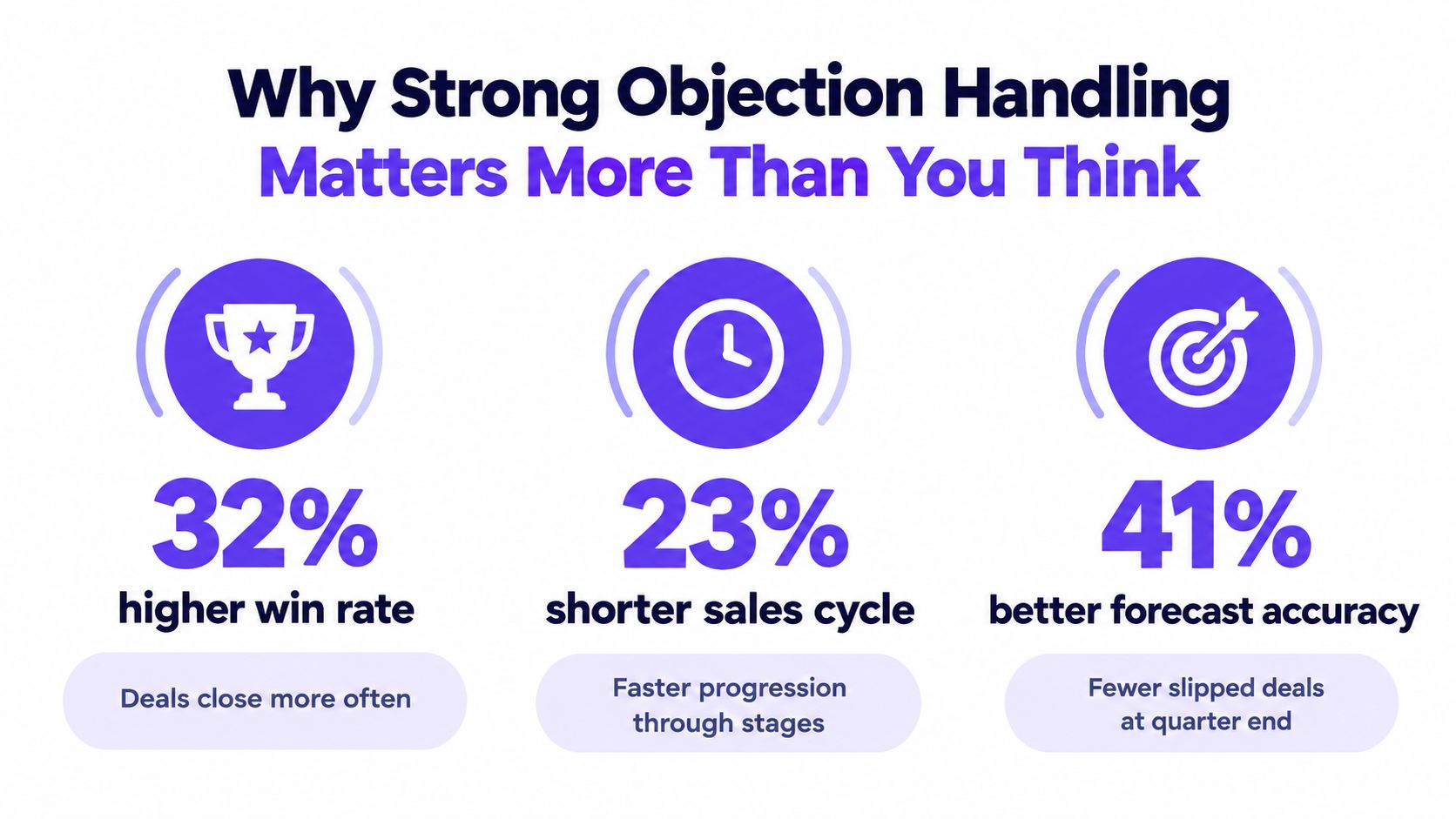
Objection handling affects more than the moment when a buyer raises a concern. It influences whether the opportunity stays active, whether stakeholders remain engaged, and whether the forecast reflects a real buying process. Industry reporting on objection handling indicates that 44% of deals fail to close because objections are not answered adequately, while only about one-quarter of salespeople say they are confident responding effectively, according to the compiled objection-handling statistics. The useful lesson is behavioral: confidence alone does not show that a rep can identify, address, and confirm resolution of the actual concern.
The gap produces recognizable pipeline symptoms:
- Opportunities remain in one stage without a documented decision condition.
- Reps send more collateral instead of asking what the buyer still needs to believe.
- “Follow up next quarter” appears without a defined trigger or business event.
- Forecast calls center on rep confidence instead of buyer-confirmed progress.
- Discounts appear before the team knows whether value, trust, authority, or timing is causing hesitation.
The cost of answering the wrong question
A buyer who says, “We do not have budget,” may be worried about implementation effort. “We need to think about it” may signal missing internal agreement. “We are happy with the current provider” may reflect satisfaction, loyalty, or reluctance to change.
A rebuttal library treats each statement as a category with a matching answer. Strong handling treats it as a working hypothesis. The rep pauses, asks a focused question, listens for the buyer's context, and then selects evidence that fits. Confirmation completes the sequence: the rep checks whether the response addressed the concern before asking for the next commitment.
That sequence matters in major B2B markets, where buyers often expect consultative conversations. They need sellers to understand operational context, explain trade-offs, and support internal decision-making. A generic response can add friction even when the product is relevant.
Why interviews can misjudge the skill
Interviews reward speed, fluency, and social confidence. Sales conversations reward observable timing and listening:
- The rep lets the buyer finish.
- The rep acknowledges the concern without becoming defensive.
- The rep asks a question that narrows the issue.
- The rep responds to the stated context.
- The rep confirms whether the concern has been addressed.
- The rep secures a next step with a clear owner and purpose.
Managers should evaluate that sequence rather than whether a candidate sounds confident. A calm pause can reveal more skill than an energetic monologue because it gives the buyer room to name the blocker.
The Most Common Types of Sales Objections and What They Signal
The same words can represent different buying problems. “It's too expensive” may mean the budget is unavailable, the value is unclear, or the buyer doesn't trust the promised outcome. “The timing isn't right” may mean a genuine scheduling constraint, weak urgency, competing priorities, or fear of implementation risk.
A manager can coach more effectively by separating the surface statement from the likely signal.
| Objection Type | Underlying Signal | Handling Difficulty |
|---|---|---|
| Price | The buyer doesn't yet see sufficient value, lacks budget, or compares alternatives narrowly | Moderate to high, because the rep must connect investment to priorities without rushing to discount |
| Timing | The initiative lacks urgency, competes with other work, or carries execution risk | Moderate, provided the rep can identify a real trigger |
| Need | The buyer sees no meaningful gap, or the problem hasn't been quantified in their context | High, because the rep may need to return to discovery |
| Authority | The current contact can't approve the decision or hasn't built internal consensus | Moderate, with risk of losing control during an unstructured handoff |
| Trust | The buyer doubts the vendor, evidence, implementation plan, or representative | High, because pressure usually reinforces skepticism |
| Competition | The buyer prefers an incumbent or another option, often based on criteria not yet understood | High, since the rep must compare decision factors rather than attack a competitor |
A large call-analysis dataset containing more than 800,000 analyzed sales calls reported that 39% of objections could be overturned when handled well. “No Immediate Need” and “Lack of Time” were each overturned 46% of the time, while “Not Interested” appeared more than 150,000 times and had a 23% success rate. Trust-based objections represented 22% of all objections, and “Lack of Trust” had a 32% success rate, according to the sales call objection analysis.
Those differences show why one universal script fails. Some objections respond to clarification, some to proof, and some to a respectful disqualification. “Not Interested” often requires more care than a timing concern because it may indicate low relevance rather than a solvable obstacle.
Surface language versus buyer meaning
Consider a buyer who says, “We don't have time for a change.” A rep could explain how fast onboarding is. A better question might be, “Is the concern the time required from the team, or the risk of disrupting the current process?” The first answer points toward implementation planning. The second points toward risk management.
Reps who need practical examples can use resources such as objection responses SDRs need to prepare language for common situations. Preparation should support listening, not replace it. Managers can also use sales objection handling techniques as a reference when building coaching exercises around these categories.
How Buyer Psychology Shapes Every Objection
Buyers rarely object in a vacuum. They may be protecting an existing process, avoiding personal risk, managing internal politics, or testing whether the seller understands their situation. A short objection can therefore function as a shield while the buyer decides whether it feels safe to explain more.
The first statement is often a reflex response. A buyer may say “Send information,” because the conversation arrived at a bad time. Another may say “We already have a solution,” because changing vendors feels risky. If the rep responds to the literal words without checking the context, the conversation can become a sequence of irrelevant answers.
The first three to five seconds
The first few seconds after pushback should be treated as a listening window:
- Pause. Resist the urge to fill silence.
- Mirror or label. Repeat the concern in neutral language.
- Ask one diagnostic question. Invite the buyer to explain what sits underneath it.
- Respond only after the issue is clear.
Call-analysis summaries for 2026 report that top performers are said to pause about 5x longer after an objection, while average reps often launch into a 21.45-second monologue. The same summary reports that clarifying questions before counterarguments correlate with stronger outcomes, as described in recent objection-handling analysis.
A pause isn't passive. It signals that the rep is processing the buyer's concern rather than waiting for a chance to speak. A mirror such as “The implementation effort feels like the bigger concern?” gives the buyer an easy way to correct the interpretation.
Listening sequence instead of script library
A script library is useful for language, but it can't determine what the buyer means. Effective handling depends on the order of actions. The rep first creates psychological space, then narrows the concern, then chooses evidence that fits the buyer's answer.
For example:
- Buyer: “The price is higher than expected.”
- Rep: “Higher than the range your team planned?”
- Buyer: “Higher than the value we can justify without clear implementation support.”
- Rep: “So the concern is the total risk of adoption, not only the subscription amount. What would your team need to see to evaluate that risk?”
The rep hasn't defended the price. The rep has converted an ambiguous objection into a decision criterion. That shift helps both sides determine whether a real path exists.
Practical rule: If a rep hasn't confirmed what the buyer means, the rep hasn't earned the right to counter.
How to Measure Objection Handling as an Observable Skill
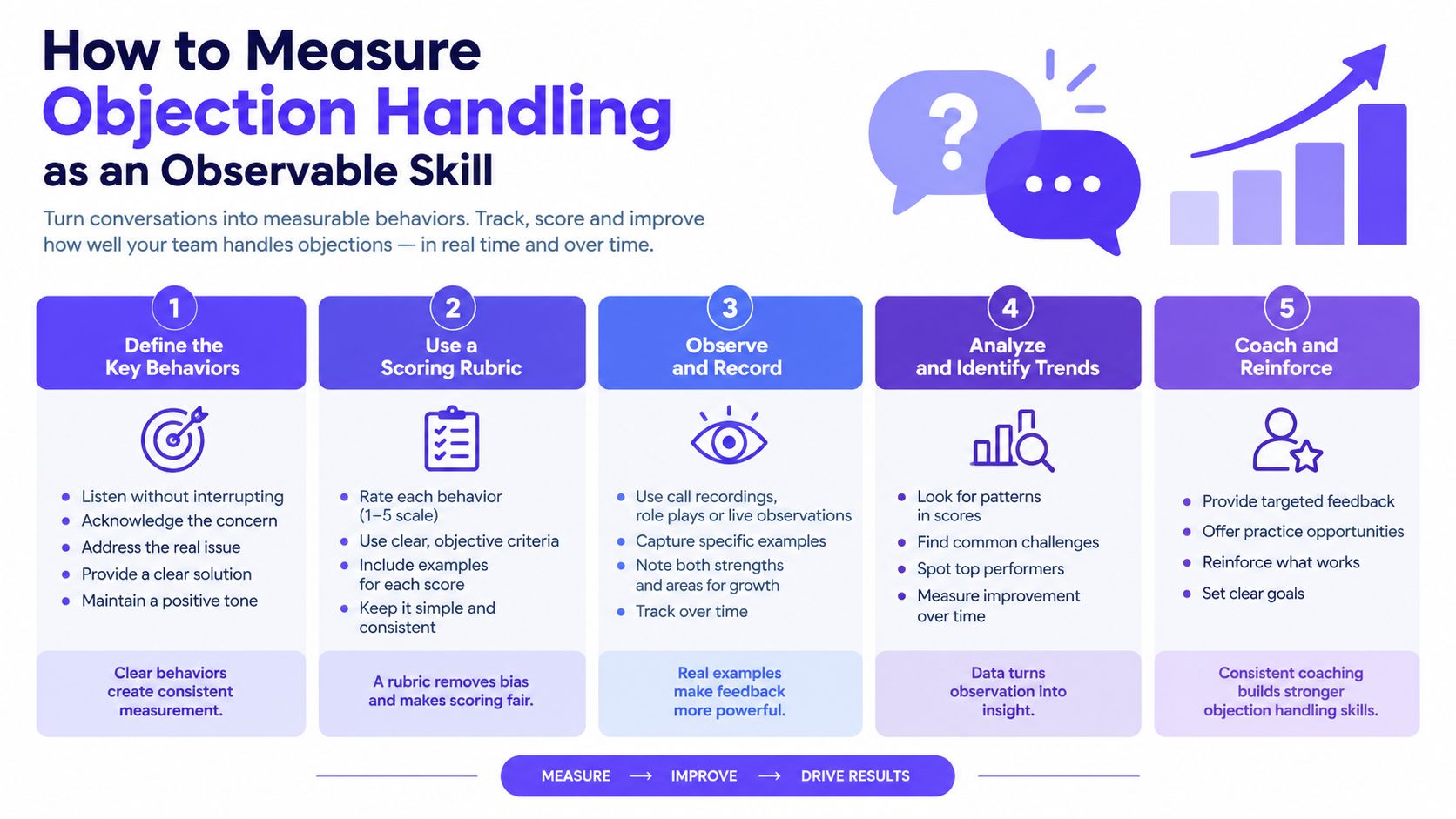
Managers can't coach “be more persuasive” with much precision. They can coach whether a rep interrupted, asked a diagnostic question, paraphrased the concern, selected relevant evidence, and confirmed resolution.
A practical scorecard should separate the behaviors that occur during the conversation from the outcome that follows later. A buyer may raise a valid objection that cannot be resolved in one call. The rep can still demonstrate excellent handling by clarifying the issue and agreeing on a meaningful next step.
Behavioral indicators
A hiring manager or enablement leader can score the following:
- Pause behavior: Does the rep allow a moment for the buyer to finish and elaborate?
- Acknowledgment: Does the rep recognize the concern without dismissing it or making an unsupported promise?
- Diagnostic questioning: Does the rep ask a question that distinguishes among price, risk, timing, need, authority, trust, or competition?
- Response relevance: Does the rep use the buyer's answer to shape the response?
- Confirmation: Does the rep ask whether the concern has been addressed?
- Next-step execution: Does the rep define the action, participants, purpose, and timing of the next interaction?
These criteria make performance comparable. They also expose the difference between product knowledge and selling skill. A candidate may know every feature in a demo but still fail to discover why a buyer hesitates.
Outcome measures with context
Teams can track overturn rates by objection type, but they shouldn't treat all objections as equally resolvable. The call-analysis data described earlier shows that some objection categories resolve at very different rates. That variation makes category-level review more useful than one blended team number.
Objections can also be treated as engagement signals. One industry source cites research indicating that win rates rise nearly 30% when prospects raise objections, and that reps who handle objections well can close at rates as high as 64%, according to sales objection handling and close-rate analysis. The finding supports a careful interpretation: an objection may show that the buyer is actively evaluating the purchase, but only if the rep responds with questions and confirms resolution.
Managers can review call samples alongside pipeline outcomes. Useful questions include:
- Did the buyer continue discussing the issue after the response?
- Did the buyer introduce another stakeholder or decision condition?
- Did the opportunity advance for a documented reason?
- Did the rep record the actual blocker, or only the surface phrase?
For a structured framework covering broader sales capability evaluation, managers can consult sales skills assessment. A consistent rubric is more reliable than a manager's general impression of whether a call “felt good.”
Building Consistent Objection Handling Across Hiring and Training
Consistency begins when hiring and onboarding use the same definition of good behavior. If interviews reward fast answers but training emphasizes discovery and listening, new hires receive conflicting signals. A shared simulation can show whether a candidate handles the exact behaviors the team expects after hiring.
The scenario should reflect the company's ideal customer profile, buyer role, business pain, current tools, competitors, and likely objections. A candidate might face a timing concern from an operations leader, a trust concern from a security stakeholder, or an authority concern from a functional champion. The scenario should also include a clear evaluation rubric.
A practical operating model
A repeatable program can include:
- Scenario design: Build buyer conversations from real call patterns and documented ICP details.
- Behavioral scoring: Assess pause, acknowledgment, diagnosis, response relevance, confirmation, and next-step control.
- Candidate comparison: Use the same scenario and criteria for every applicant.
- Onboarding practice: Reuse the scenario format with new personas and deal stages.
- Coaching cadence: Review specific moments rather than giving broad advice about confidence.
- Team visibility: Track recurring objection categories and the behaviors associated with stronger conversations.
The objection handling training resource can help managers structure practice around realistic pushback rather than memorized answers. Overvue provides AI buyer simulations built from ICP details and produces criteria-based scores for behaviors such as objection handling, call control, responsiveness, and next-step execution. That makes it one option for teams that need remote, repeatable assessment and practice.
The strongest implementation checklist is short:
- Define the behaviors before selecting a tool.
- Build scenarios from real buyer conditions.
- Score the listening sequence, not just the final answer.
- Review performance by objection type.
- Use the same standards in hiring, onboarding, and coaching.
- Update scenarios when real calls reveal a recurring blocker.
Managers don't need louder reps. They need evidence that reps can pause, diagnose, respond with relevance, and confirm what happens next.
Overvue helps sales teams assess candidates and train new hires through AI buyer simulations built around real ICP details and common objections. Visit Overvue to explore standardized scoring for objection handling and structured practice that managers can use before real pipeline is at risk.