
Effective sales enablement doesn't begin with a larger content library. It begins when a revenue team can observe selling behavior, score it consistently, and improve it repeatedly. That distinction matters because sales enablement has moved from a niche practice to a mainstream operating model. Fewer than 20% of organizations used sales enablement in 2013, compared with more than 60% in 2019, and 90% now have a dedicated person, program, or function, according to this sales enablement statistics summary.
The strongest sales enablement examples therefore connect capability to an operating problem. Hiring teams need evidence beyond interview charisma. Enablement leaders need onboarding that resembles real selling. Managers need objective coaching signals. Global revenue organizations need consistent scenarios across time zones and languages. Scaling teams need capacity controls that support changing hiring volumes without forcing rigid commitments.
The 10 examples below follow that progression, from realistic assessment and standardized criteria to safe practice, continuous learning, distributed access, and infrastructure. Each one explains why the approach works, where it creates trade-offs, and how a revenue team can adapt it. Overvue appears where AI simulations, standardized scoring, remote assessments, and shared hiring and training workflows make the operating model concrete.
1. AI-Powered Sales Simulations and Role-Play Scenarios
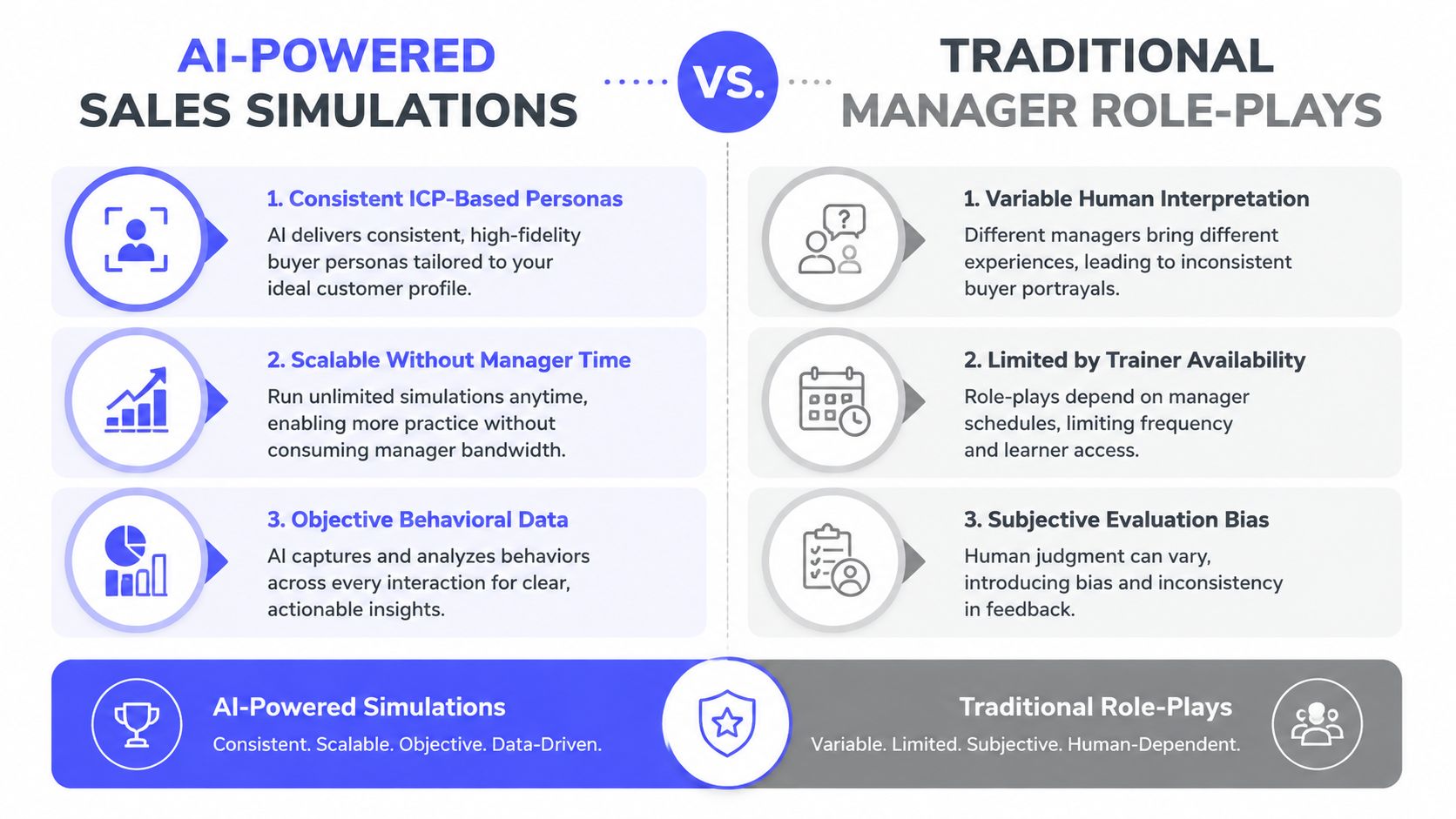
A candidate can sound polished in an interview and still struggle when a buyer raises a difficult objection. AI-powered sales simulations address that gap by placing SDRs and AEs inside realistic conversations with buyer personas based on a company's ideal customer profile.
The scenario can include the buyer's role, business context, pains, competitors, technology environment, and likely objections. Unlike manager-led role-play, the simulation presents a repeatable experience to every participant. That consistency makes the resulting evidence easier to compare, while also reducing the amount of live manager time required for practice.
A B2B SaaS company might use one simulation during SDR hiring, then reuse a closely aligned version during onboarding. A distributed team can give candidates and new hires access without coordinating a live session across regions. Multilingual teams can adapt the buyer persona and conversation context without abandoning the underlying competency criteria.
Design scenarios from real conversations
Scenario quality determines assessment quality. Enablement leaders should build personas from customer research and recorded sales calls, then include objections that sellers encounter. Difficulty can increase gradually, allowing a new hire to move from basic discovery toward complex enterprise conversations.
Overvue's guide to designing, running, and scoring sales simulations offers a practical model for connecting scenarios with defined selling behavior. Teams comparing adjacent technologies can also find AI tools for sales.
Central lesson: A useful simulation isn't a synthetic conversation for its own sake. It's a repeatable test of whether a seller can perform in the situations that matter to the business.
2. Automated Scoring Against Defined Selling Criteria
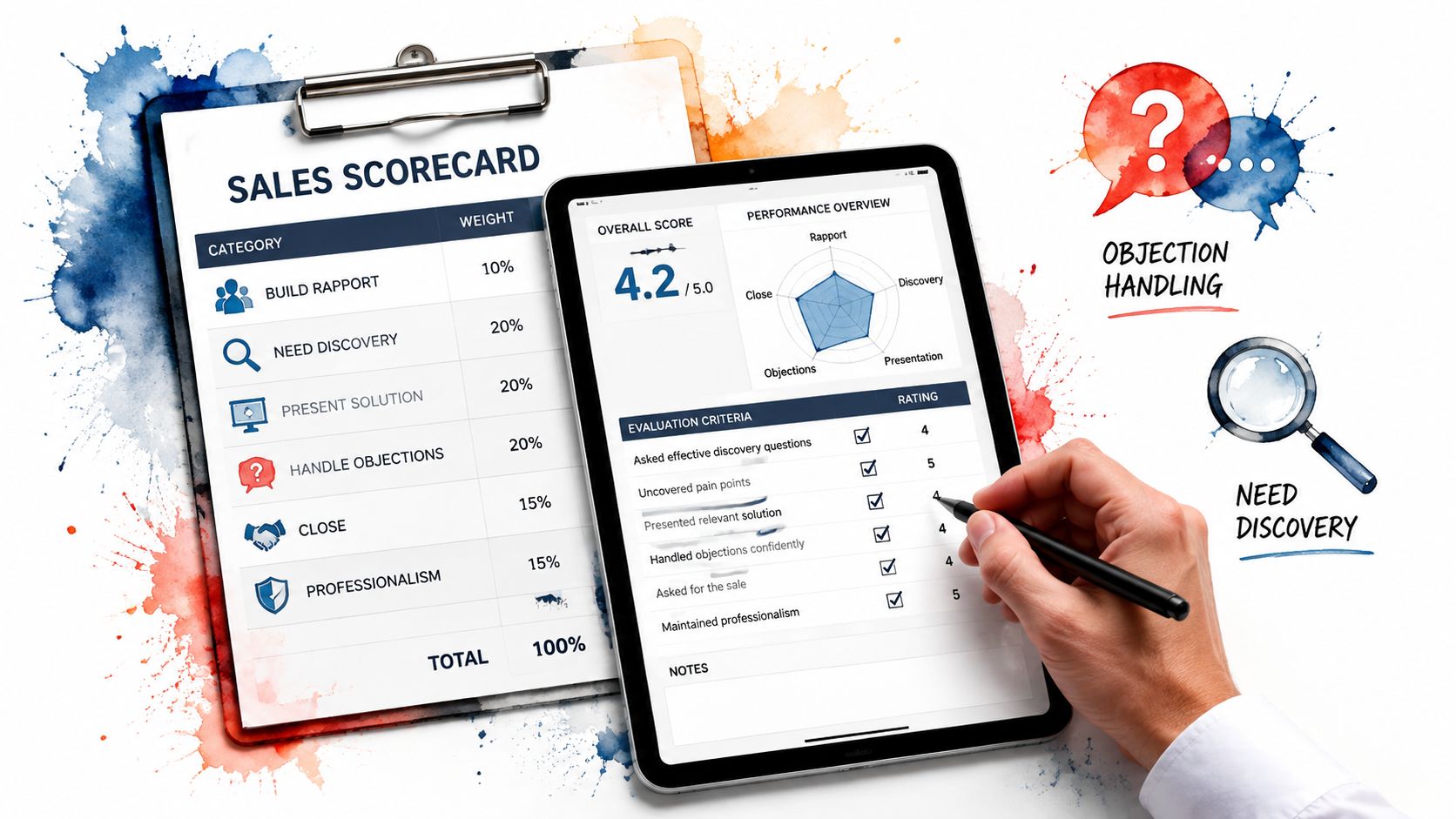
Simulation only becomes useful for enablement when the organization knows what it's evaluating. Automated scoring turns a live conversation into structured evidence against criteria such as objection handling, call control, discovery quality, responsiveness, and next-step execution.
That framework changes the internal question from “Did the candidate seem strong?” to “Which observable behaviors met the company's standard?” Hiring teams can compare performance against a defined sales methodology, while training leaders can identify a specific gap rather than assigning another broad refresher course.
The criteria should come from the organization's ideal customer profile and actual sales motion. A transactional SDR team might prioritize responsiveness and call control. An enterprise AE team may place greater weight on discovery depth, stakeholder alignment, and next-step discipline. The same scorecard shouldn't be copied across roles without adjustment.
Treat the scorecard as a managed system
Sales leaders and top performers should help define the criteria, then test the framework against current representatives who already perform well. Quarterly review can reveal whether a criterion predicts useful behavior or merely rewards a preferred speaking style.
A score should guide a decision, not replace judgment. Managers still need to inspect the scenario, understand the context, and check whether the rubric reflects real customer outcomes.
Central lesson: Standardization isn't the removal of judgment. It's the discipline of making judgment visible, consistent, and open to validation.
3. Standardized Assessment Scenarios for Hiring and Onboarding
Hiring and onboarding often operate as separate systems. Recruiting evaluates a candidate with one set of questions, then enablement introduces a different set of expectations after the offer. Standardized scenarios close that gap by giving both functions a shared view of what competent selling looks like.
A technology company hiring SDRs can use a prospecting scenario during assessment and revisit the same competency during the first weeks of onboarding. An enterprise sales organization can preserve a common discovery structure while increasing persona complexity for new AEs. A fast-growing SaaS business can also update one governed scenario set instead of allowing every interviewer and manager to create a private version.
The advantage isn't just convenience. A candidate who succeeds on a relevant assessment has already encountered the behavioral standard that onboarding will reinforce. That alignment gives managers better evidence for individualized coaching and helps new hires understand performance expectations from the start.
This pre-hire assessment guide for 2026 describes how structured evaluation can support hiring decisions. Teams can pair the approach with practical onboarding templates for startup teams.
Govern the scenario lifecycle
Recruiting and enablement leaders should jointly own scenario updates. Competitive positioning, buyer concerns, and product messaging change, so the scenarios need a review process tied to real selling conditions. Progressive difficulty can also turn assessment content into a learning path rather than a single pass or fail event.
The most useful validation question is whether assessment performance relates to later new-hire performance. If it doesn't, the scenario or scoring criteria may be measuring the wrong capability.
Central lesson: The best hiring assessment is also the first chapter of onboarding. Shared scenarios make the capability system continuous instead of fragmented.
4. Safe Practice Environment for New Hire Skill Development
New hires shouldn't have to learn every core behavior on live prospects. A safe simulation environment lets them practice discovery, objection handling, prospecting, and call control without putting an active opportunity at risk.
This matters most during the transition from knowledge to execution. A new representative may understand the product and memorize the messaging, yet hesitate when a buyer challenges the business case. Repeated practice gives the representative a place to test responses, receive feedback, and try again before the conversation affects pipeline.
A new SDR can rehearse an opening and common objections before receiving a prospecting assignment. A new AE can practice qualification with different buyer priorities. A territory representative launching a new product can work through realistic scenarios before entering conversations with unfamiliar accounts.
Build a progression toward live work
Enablement leaders should define observable milestones for moving from simulation to pipeline. The simulator shouldn't become a separate game that rewards performance unlike real selling. Its criteria should reflect the behaviors managers inspect in live calls and CRM notes.
Practice also works best when managers connect simulated performance with observed conversations. A representative who handles pricing objections well in simulation but fails to establish next steps with real buyers needs targeted coaching, not a generic completion badge.
The trade-off is that simulations can create false confidence if scenarios are too predictable. Buyer personas need varied objections, deal stages, and levels of resistance to keep practice close to the uncertainty of real conversations.
Central lesson: A safe practice environment protects both the learner and the pipeline, but only when its feedback reflects the demands of live selling.
5. Continuous Learning Through Repeatable Practice
Onboarding can establish a foundation, but selling skills decay when representatives don't revisit them. Short, repeatable scenarios create a practical training loop around actual pipeline situations, such as handling a pricing concern, clarifying a vague pain, or securing a specific next step.
A shared scorecard can make progress visible across a distributed organization. The criteria should reflect the sales method the team actually uses and make improvement clear without turning development into a public ranking.
Regular practice also creates a useful coaching signal. If several SDRs struggle with the same objection, the problem may sit in the messaging or scenario design rather than in individual motivation. If one AE repeatedly misses next-step execution, a manager can use the scorecard result as a prompt for a focused one-on-one.
This guide to designing and scoring sales roleplays shows how scenarios, feedback, and shared criteria can support ongoing practice.
Measure improvement, not only completion
Absolute scores can discourage representatives who start below the team average. Looking at improvement and competency progress keeps the exercise tied to development. Managers should review performance in team meetings and one-on-ones, using the data to choose coaching topics.
Central lesson: Practice becomes useful when the scorecard leads to a clear coaching action, not another completion metric.
6. Objective Candidate Comparison and Side-by-Side Analytics
Recruiters often have to compare candidates who completed different interviews, answered different questions, or impressed different interviewers. Standardized scenarios and criteria create a more defensible comparison by giving hiring teams a shared evidence base.
A revenue leader can review how candidates performed on the same objection-handling scenario, discovery prompt, or next-step task. The discussion then centers on capability data rather than CV polish or the most memorable interview moment. Recruiters can present clear differentiation to hiring managers, while managers can investigate why one candidate outperformed another on a critical competency.
The approach also helps identify candidates who pass overall but show a meaningful weakness. A candidate might demonstrate strong responsiveness and weak discovery. That pattern doesn't automatically reject the candidate, but it informs role fit, onboarding design, and the level of manager support required.
Calibrate before comparing
Scoring calibration sessions should involve the hiring team, particularly when human review remains part of the process. Teams should examine high performers, borderline candidates, and failed assessments to determine whether the criteria distinguish useful behavior or encode interviewer preference.
Candidate comparison becomes more valuable after hiring teams track subsequent performance. If the strongest assessment scores don't correspond with stronger new-hire execution, leaders need to revise the rubric instead of assuming the candidates were the problem.
Teams evaluating the financial logic behind structured hiring can also review guidance on how to measure sales hiring ROI.
Central lesson: Side-by-side analytics improve hiring conversations only when the comparison is built on identical situations and criteria that have earned trust.
7. Early Mis-Hire Prevention Through Evidence-Based Capability Assessment
A resume describes experience. An interview reveals communication style. Neither necessarily shows how a seller responds when a buyer pushes back, asks for proof, or avoids committing to a next step.
Behavioral assessment through simulated conversations gives hiring teams earlier evidence of those capabilities. That evidence can protect manager capacity and pipeline quality by identifying a mismatch before the organization invests heavily in onboarding and live opportunities.
For a revenue team, the most important benefit isn't a faster rejection. It's a clearer role-fit decision. A candidate who struggles with rapid prospecting objections may still be better suited to a sales motion with longer discovery cycles and stronger research support. Conversely, a candidate with polished enterprise language may not show the call control needed for high-volume outbound work.
Establish a decision rule
Hiring pressure can weaken a scorecard quickly. Leaders should define passing standards before reviewing results and document when a candidate falls short. A lower score shouldn't become an automatic verdict if the scenario is flawed, but it should trigger a deliberate review rather than an exception made for urgency.
New-hire performance should feed back into the assessment process. Underperforming hires can reveal missing criteria, unrealistic scenarios, or gaps in onboarding. Successful hires can show which behaviors deserve greater weight.
The broader lesson is that assessment doesn't eliminate mis-hires. It makes the risk more visible before a hiring decision becomes expensive to reverse.
Central lesson: Evidence-based assessment protects the pipeline only when leaders use it to improve role fit, not to pretend that one score predicts every outcome.
8. Remote, Asynchronous Assessment via Secure Links
Global and distributed hiring teams lose momentum when every candidate assessment depends on a live calendar slot. Secure, on-demand links let candidates complete a sales simulation within a defined window, reducing scheduling friction across regions and time zones.
The format can also support a more equitable process. Candidates aren't forced to coordinate an interview around a narrow local-hour schedule, and every participant receives the same scenario and instructions. A European SaaS company hiring across the Americas, Europe, and Asia-Pacific can preserve a common evaluation method without requiring every interviewer to attend every session.
Asynchronous assessment carries its own responsibilities. Instructions need to explain the task, expected environment, and support route. Links should be tested across devices and browsers, and candidates need a clear completion deadline so the hiring process doesn't stall.
Preserve candidate experience
A secure link isn't automatically a fair assessment. Technical failures, unclear audio requirements, or unfamiliar interfaces can distort results. Recruiting teams should offer technical guidance and record completion issues as part of process quality review.
Assessment timing can also function as a signal of candidate commitment, but it shouldn't be interpreted without context. Accessibility needs, time-zone differences, and technical problems deserve consideration before a hiring team draws conclusions.
Central lesson: Asynchronous delivery solves coordination problems, but fairness depends on clear instructions, reliable access, and thoughtful interpretation.
9. Multilingual Assessment and Training Capabilities
Language can obscure sales capability when every candidate must perform in a language that isn't the one used with their buyers. Multilingual assessment and training let organizations evaluate the selling behavior itself while preserving the buyer context required for the role.
A European SaaS company may hire representatives who sell in English and Finnish. A global team may need localized versions of discovery, objection handling, and product positioning scenarios. Translation alone isn't enough, because buyer expectations, competitive references, and communication patterns can differ by market.
Native speakers should review scenarios for cultural appropriateness and natural phrasing. Local competitive context can make a persona more credible, while language-specific feedback can help managers separate vocabulary issues from failures in discovery or call control.
Keep the competency model consistent
Global consistency doesn't mean identical wording. The underlying criteria can remain stable while the buyer persona, examples, objections, and conversational norms change for each market. That allows leaders to compare competency patterns without forcing every region into one linguistic template.
Hiring teams should review performance by language and market to find systematic gaps. If one localized scenario produces unusually low results, the scenario may be poorly translated or misaligned with local selling conditions.
The trade-off is governance complexity. More languages create more content to maintain, review, and update. A smaller set of carefully governed scenarios is usually more useful than a large collection that no regional team trusts.
Central lesson: Localization should change the conversation context, not weaken the standard for observable selling behavior.
10. Scalable Assessment Infrastructure with Flexible Capacity Controls
Enablement infrastructure has to match the uneven rhythm of sales hiring. A team may pause hiring, open a new regional cohort, or move from a small intake to a larger recruiting campaign. A rigid assessment system can create cost and capacity problems at each turn.
Usage-based capacity, concurrent call support, team analytics, and rollover of unused hours give revenue organizations more room to adapt. A growth-stage SaaS company can use the same infrastructure for candidate assessment during a hiring push and for training practice during a slower recruiting period, provided the subscription remains active and the usage terms support that transfer.
The operating advantage comes from visibility. Hiring and enablement leaders can review usage dashboards, compare expected headcount plans with actual activity, and identify upcoming pressure before candidates or managers encounter capacity limits.
Plan for peaks without overbuilding
Teams should audit historical hiring patterns and coordinate capacity planning with recruiting forecasts. Regional sales leaders need clear guidance on available usage and concurrency so that assessments don't become an invisible bottleneck.
Flexible capacity still involves trade-offs. Rollover rules, subscription conditions, and concurrent call limits need to be understood before a peak period begins. Leaders should also avoid treating unused hours as a reason to create unnecessary training activity. Practice should follow capability needs, not budget expiration.
Central lesson: Scalable enablement infrastructure isn't simply larger capacity. It's the ability to redirect capacity between hiring, onboarding, and practice as business conditions change.
Top 10 Sales Enablement Feature Comparison
| Item | 🔄 Implementation Complexity | ⚡ Resource Requirements | 📊 Expected Outcomes | 💡 Ideal Use Cases | ⭐ Key Advantages |
|---|---|---|---|---|---|
| AI-Powered Sales Simulations and Role-Play Scenarios | Medium–High, ICP & persona setup, AI tuning | Medium, platform, customer data, initial config; low ongoing manager time | Standardized, repeatable behavioral assessment; objective call data | Hiring at scale, onboarding, remote/multilingual teams | Measures actual selling behavior; scalable; reduces evaluator bias |
| Automated Scoring Against Defined Selling Criteria | Medium, define rubrics and calibrate | Low–Medium, scoring engine + rubric design time | Consistent, comparable scores across candidates and cohorts | Candidate shortlisting, competency tracking, training ROI | Removes subjective bias; transparent standards; targeted feedback |
| Standardized Assessment Scenarios for Hiring and Onboarding | Medium, cross-team alignment and governance | Medium, scenario library maintenance and updates | Aligned expectations, faster ramp, predictable onboarding outcomes | SDR/AE onboarding, scaling orgs with repeatable workflows | Ensures hire-to-job alignment; reduces onboarding surprises |
| Safe Practice Environment for New Hire Skill Development | Low–Medium, scenario provisioning and milestone design | Low, platform access; manager oversight for transitions | Increased rep confidence and faster time-to-pipeline contribution | New hires, product launches, territory onboarding | Risk-free deliberate practice; protects revenue during ramp |
| Continuous Learning Through Daily Challenges and Leaderboards | Low, challenge design and automation | Low, ongoing content refresh and platform automation | Sustained engagement, frequent feedback, measurable skill improvement | Ongoing skill retention, distributed teams, coaching programs | Keeps skills fresh; fosters healthy competition and accountability |
| Objective Candidate Comparison and Side-by-Side Analytics | Low–Medium, dashboard setup and calibration | Medium, analytics tooling and reporting workflows | Evidence-based hiring decisions; clearer stakeholder alignment | High-volume hiring, leadership hiring reviews | Transparent candidate differentiation; reduces mis-hire risk |
| Early Mis-Hire Prevention Through Evidence-Based Capability Assessment | Medium, assessment design + baseline benchmarking | Medium, additional assessment time per candidate | Lower mis-hire rate, reduced replacement costs, protected pipeline | Revenue-sensitive roles, rapid scaling, enterprise hiring | Identifies poor fits early; saves replacement cost and manager time |
| Remote, Asynchronous Assessment via Secure Links | Low, secure link delivery and tracking | Low, minimal scheduling overhead; basic tech support | Higher completion rates, equitable access across time zones | Global hiring, distributed candidates, multilingual cohorts | Eliminates scheduling friction; scales assessments globally |
| Multilingual Assessment and Training Capabilities | Medium–High, translation, localization, cultural review | Medium–High, native speakers, localized content maintenance | Fair evaluation across languages; improved candidate experience | International expansion, local-market hiring | Reduces language bias; improves assessment validity in local markets |
| Scalable Assessment Infrastructure with Flexible Capacity Controls | Low–Medium, capacity & pricing setup, monitoring | Medium, usage-based spend, analytics for forecasting | Cost-efficient scaling, predictable spend, preserved budget via rollover | Variable hiring volumes, seasonal hiring, fast-growth firms | Flexible capacity, predictable costs, avoids wasted resources |
Turn These Sales Enablement Examples Into One Operating System
The 10 sales enablement examples become more valuable when they share one capability model. A simulation used for hiring should resemble the scenarios used in onboarding. The onboarding scorecard should reflect the behaviors managers inspect in live calls. Daily challenges should reinforce the same competencies, and team analytics should show whether those behaviors appear consistently across roles, regions, and cohorts.
A practical sequence starts with defined selling criteria. Sales leaders, enablement managers, recruiters, and strong representatives should agree on what good performance means for each role. Objection handling, call control, responsiveness, discovery quality, and next-step execution are useful starting points, but the final criteria need to match the company's sales methodology and buyer context.
The next step is to build ICP-based scenarios. Each scenario should include enough buyer detail to create realistic pressure, including the buyer role, business pain, competitive context, and likely objections. Scenario governance matters because stale prompts can produce misleading assessments.
Recruiting can then use those scenarios for assessment and comparison, while enablement uses them for onboarding. This creates a shared language between hiring managers and training leaders. It also lets the organization personalize ramp support around demonstrated gaps instead of assigning every new hire the same content.
Choose a starting point based on the operating problem
Teams facing hiring pressure should begin with standardized scenarios, criteria, and side-by-side candidate analytics. Teams struggling with ramp should prioritize safe simulation practice, progressive difficulty, and feedback tied to live-call expectations. Teams with inconsistent coaching should establish a shared scorecard that makes behavior visible. Distributed or multilingual organizations should add secure asynchronous delivery and localized scenarios. Teams preparing for variable growth should address capacity controls after the core measurement model is reliable.
Measurement needs the same discipline. A useful framework separates leading indicators from downstream outcomes. Completion and engagement belong in the early weeks, proficiency can be assessed through role-play or rubric scores, behavior change can be observed through CRM and call-note signals, pipeline impact can be reviewed over subsequent months, and revenue outcomes can include win rate, ACV, cycle time, and forecast accuracy. This sales training measurement framework explains why those stages should not be collapsed into one KPI.
A score is not a standalone verdict. The scorecard needs validation against real new-hire performance, cohort-level behavior, and business outcomes. A benchmark framework also identifies pre and post assessment lift, talk-to-listen ratio change, and ramp time by cohort as useful signals, with benchmark targets including at least 20% improvement in pre and post scores, training NPS of 40 or higher, SDR ramp of roughly 2 to 4 months, and AE ramp of 4 to 6 months. Those figures come from this sales training KPI framework, and they should be treated as reference points rather than universal standards.
The strategic shift is from measuring training finished to measuring process run. Recent enablement coverage reports that 80% of enablement content is unused, while less than 23% of teams use just-in-time content delivery, according to sales enablement trend research. That evidence supports a contrarian conclusion: more assets and more examples won't fix an execution problem unless the examples appear in the selling workflow and produce observable behavior.
Overvue is one relevant option for teams that want AI buyer simulations, shared hiring and onboarding scenarios, custom scorecards, remote assessments, multilingual support, training practice, feedback, and team analytics in one workflow. The platform's value in this operating model comes from connecting assessment with repeated execution, rather than treating hiring, training, and coaching as separate activities.
Overvue provides AI-powered sales simulations built around a company's ICP, automated scoring against defined criteria, secure remote assessments, and training practice for new hires and existing teams. Sales hiring managers and enablement leaders can use Overvue to connect candidate evaluation, onboarding, feedback, and team analytics through shared sales scenarios.