
Interviews are still the most common way companies sell themselves to candidates, but they're a weak way to predict who'll perform. A major 2024 industry survey found that 84% of organizations already use some form of pre-employment or pre-hire skills testing, and in many of those organizations the results influence 33% to 67% of the final hiring decision, which says the quiet part out loud, the core decision is happening before the final interview wrap-up EmployTest Industry Report 2024. For sales teams, that shift matters because polished answers, rapport, and rehearsal can all look like readiness long before anyone checks whether a candidate can handle objections, control a call, or move to a next step.
Why Interviews Alone Are Costing You Hires
A sales interview is a performance stage, not a diagnostic tool. Candidates with strong presence, a practiced story, and a clean talk track can move a panel in the moment, then struggle the second they face a live buyer with objections, silence, and pressure. That gap gets expensive fast in revenue hiring, because a mistaken hire doesn't just miss quota, it also consumes manager time, extends ramp, and forces the team to backfill again while pipeline keeps moving.
Interview signal and on-the-job signal are not the same thing
The problem isn't that interviews are useless. It's that they measure a narrow slice of performance, mostly communication under observation, and they do it in a setting where candidates can rehearse. That's why structured input from a pre hire assessment matters so much, it captures behavior before the offer and gives hiring teams something closer to actual job evidence.
Practical rule: if a role's failure mode shows up after the first customer conversation, the interview should never be the only screen.
The market has already moved in that direction. Independent labor-market research summarized in 2023 reported that 76% of organizations with 100+ employees use pre-employment assessments for external hiring, and 82% of Fortune 500 companies use some form of assessment Cogn-IQ statistics summary. That adoption pattern matters because it reflects a simple operating truth, larger teams can't afford to trust interviewer intuition alone when they're hiring for roles that affect revenue, retention, and customer experience.
The interview still has a job, but not the job people give it
The interview should check context, motivation, and communication. It should not carry the whole decision. For sales roles, the best practice is to use the interview as one input inside a larger funnel that includes a job-related work sample, a scoring rubric, and a cutoff defined before candidates are seen. A strong question set helps, and a sales interview guide like these questions to ask during a sales interview is useful as a companion, but it still won't tell you whether a candidate can sell under pressure.
That's the core shift. A pre hire assessment is not a bolt-on filter at the end of hiring. It's the first defensible way to observe real work before the offer.
What a Pre-Hire Assessment Actually Is
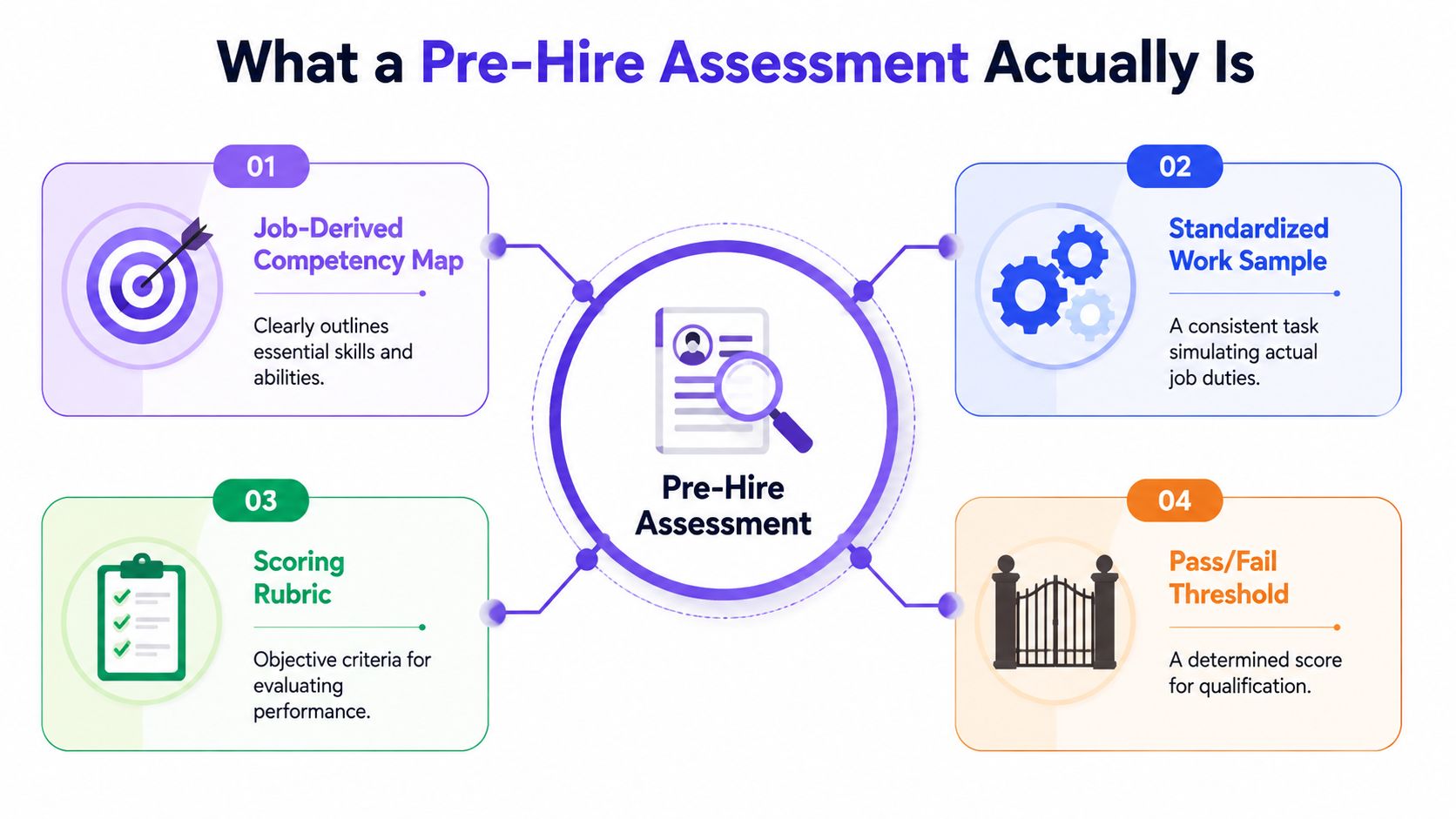
A useful pre-hire assessment is a structured work sample built from the job, not a generic aptitude quiz copied from another requisition. It starts with the role's actual success criteria, then turns those into observable behaviors, a repeatable task, a scoring rubric, and a pass/fail benchmark set before launch. If any of those pieces is missing, the assessment can still look polished, but it will not be reliable enough for hiring decisions.
The four parts that make it real
A chef is judged by the food, not by answers about knife technique. Sales hiring works the same way, the strongest signal comes from a task that closely resembles the work, then gets scored the same way for every candidate.
The core pieces are straightforward:
- Job-Derived Competency Map. Start with the role's real outcomes, not the recruiter's favorite traits.
- Standardized Work Sample. Give every candidate the same kind of task, so comparisons are clean.
- Scoring Rubric. Decide what counts before anyone sits the test.
- Pass/Fail Threshold. Set the benchmark in advance, so the result is not negotiated after the fact.
Assessment programs keep showing up in hiring because they work better than intuition alone when the role affects revenue, retention, or customer experience. Cognitive ability tests have also shown a long-standing validity benchmark of r = .51 against job performance Cogn-IQ statistics summary. The broader lesson is simple. Employers keep using assessments when they are tied to something predictive, not just something convenient.
Short, role-specific assessments win on adoption
The strongest version of the format stays tight. Guidance for building a high-quality test recommends starting from the job description, defining a benchmark before launch, and keeping completion under roughly 30 to 40 minutes because completion rates fall when assessments stretch to 90 minutes, especially for passive candidates Skillbrew guide. That is the tradeoff that matters, more realism helps, but more length without more signal just drives drop-off.
Assessment Types Compared for Sales Roles
Sales hiring usually mixes several assessment types, but they don't all pull their weight equally. Some are easy to deploy and easy to defend, yet weak on prediction. Others are harder to set up, but they reveal how a candidate behaves when the script runs out. The right stack depends on what the role needs, not on what's trendy in the market.
What each assessment type is really good for
| Assessment Type | Best Predicts | Common Blind Spot | Candidate Experience | Operating Cost |
|---|---|---|---|---|
| Unstructured interview | Confidence, communication style, rapport | Real selling behavior under pressure | Familiar, but highly variable | Low per candidate, high manager time |
| Personality inventory | Work style, preference patterns | Closing behavior, objection handling | Usually easy to finish | Low |
| Cognitive ability test | Reasoning, learning speed, problem solving | Live selling judgment and interpersonal nuance | Can feel abstract | Moderate |
| Situational judgment test | Decision-making in realistic scenarios | Actual performance in a live conversation | Better when scenarios feel close to the role | Moderate |
| Work sample | Job-relevant execution | General polish, broad personality fit | Strong if the task is clearly relevant | Higher, because scoring takes time |
| AI roleplay simulation | Objection handling, call control, next-step execution | Deep culture fit and final reference context | Often better than scheduling live mock calls | Moderate to higher, depending on setup |
The interview still belongs in the mix, but it belongs near the end, after a candidate has already proven enough to justify a real conversation. Personality tools can be helpful for manager roles and team fit discussions, though they rarely tell a sales leader whether someone can carry a discovery call. Work samples and roleplays carry more signal for quota-carrying jobs because they test the actual work, not a proxy for it.
A sales team can also use a sales eSignature platform when the process requires cleaner sign-off on offer packets, approvals, or manager acknowledgments, but that sits outside the assessment itself. It's operational infrastructure, not evidence of selling ability.
How the categories behave in practice
The strongest pattern is usually a short stack, not a giant bundle. Structured interviews, work samples, and a role-specific simulation create a better evidence trail than layering multiple broad tests on top of one another. That is also why the SDR assessment guide is worth reviewing when the role is outbound or pipeline-focused, because the failure mode for an SDR is rarely generic intelligence, it's usually a breakdown in live conversation, qualification discipline, or follow-through.
Why sales teams keep shifting toward simulation
AI roleplay exists because traditional mock calls are expensive, inconsistent, and hard to scale. In a sales funnel, that matters more than it does in many other functions, because the best evidence often comes from watching how a candidate reacts in real time. For that reason, AI simulations are becoming a practical middle layer between tests that are too abstract and interviews that are too subjective.
Designing the Assessment From the Job
A useful assessment starts with the place the role usually breaks. If new hires miss quota because they cannot uncover pain, the assessment should test discovery. If they lose momentum after objections, the assessment should pressure that moment directly. The work is not about inventing clever questions. It is about making the test surface the behaviors that drive performance, or cause failure.
Start with failure, not with content
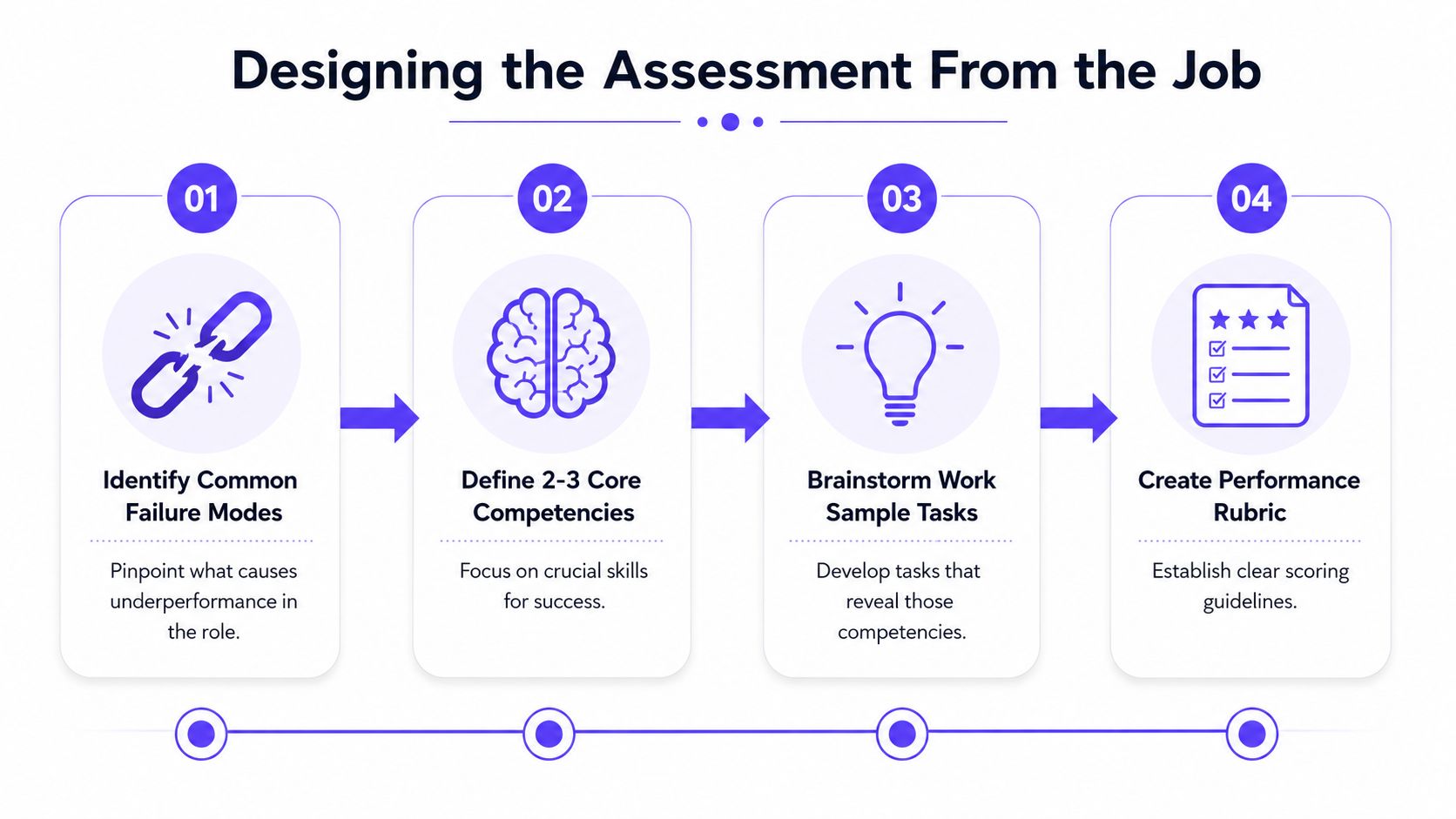
A practical sequence looks like this:
- Identify the failure mode. Ask what causes underperformance in the role.
- Name the two or three competencies that would prevent it. Keep the list tight.
- Write one realistic scenario around those competencies. Keep the context close to the day-to-day job.
- Create the rubric before launch. Two reviewers should score the same response in roughly the same range.
That sequence keeps the assessment tied to the job. It also gives legal and HR reviewers something concrete to evaluate, because the test can be traced back to actual success criteria instead of general preferences. A solid pre-hire assessment starts from the job description rather than a generic template, sets a pass or fail benchmark before candidates see it, and stays short enough that completion does not fall off a cliff when the exercise drags on Skillbrew guide.
A good assessment feels like the work the role already demands, just compressed into a controlled format.
Pilot before it touches candidates
The pilot is where teams find out whether the rubric can be used. Current employees are usually the cleanest first sample, because they already show the range of performance inside the role. The scoring should separate stronger performers from weaker ones without turning every response into a debate about interpretation.
The best assessments usually sit just above the median current performer. If the task is too easy, it will not separate candidates. If it is too hard, it stops measuring readiness and starts measuring frustration. The goal is not to make people fail. The goal is to draw an evidence-based line between ready and not ready.
Scoring, Validation, and Legal Defensibility
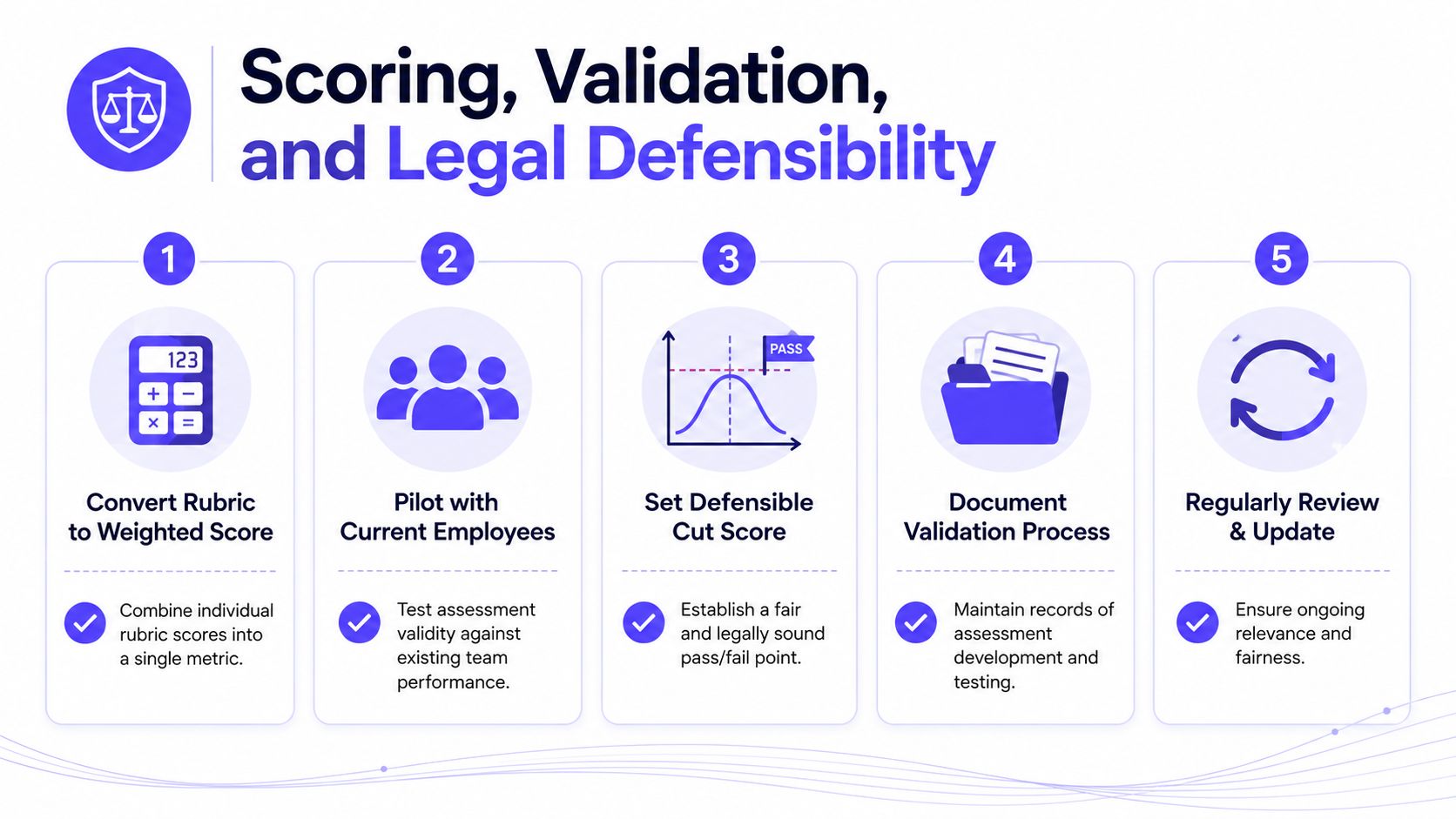
Scoring only matters if the result can stand up to scrutiny. A clever assessment that no one can validate is just an expensive exercise in opinion collection. Hiring teams need a scoring model, a validation plan, and an audit trail that shows the assessment is tied to the role and monitored over time.
Validation is a loop, not a one-time event
Aon's hiring guide recommends mapping assessments to success criteria, running a validation study, and monitoring adverse impact across subgroups. It also aligns with the broader testing discipline that TrueAbility describes, where the benchmark has to be tied to the job and checked against real candidate and employee outcomes later on Aon hiring guide. That is the right operating model. Validation is not a stamp of approval, it is a repeating check that the assessment still predicts what the company says it predicts.
The artifacts legal and HR teams usually want are plain:
- A documented job linkage. Show how each task maps to a success criterion.
- A scoring rubric. Explain how the score is assigned.
- A pilot summary. Show what happened when the assessment was tested on current employees.
- An adverse impact review. Watch subgroup pass rates over time.
- A validation record. Keep the evidence in one place, not scattered across email threads.
What to watch once candidates start taking it
Enterprise teams should track pass-rate distributions, task-completion time, candidate experience, post-hire performance correlation, and funnel conversion rates to tell whether the assessment is predictive rather than merely restrictive. Low completion can mean the test is too hard, too long, or too detached from the role. Weak correlation with later performance means the assessment is measuring the wrong behavior. Benchmarks also need a practical owner, because someone has to decide whether a drop in pass rates reflects a broken rubric, a narrow candidate pool, or a role that was never defined clearly enough in the first place TrueAbility benchmark guidance.
A compliance-friendly program often pairs this work with external guidance on HR leaders compliance with DynamicsHub, especially when hiring managers need a shared reference point for checks, documentation, and process discipline. That matters because a defensible assessment is built as much from records as from scoring logic.
Where AI Roleplay Fits and Where It Does Not
AI roleplay is useful because it standardizes a part of hiring that humans usually improvise. Every candidate gets the same buyer, the same objection pattern, and the same scoring criteria, which makes comparison cleaner than a live mock call run by three different managers. It's especially effective when the job depends on call control, objection handling, and next-step execution.
What AI roleplay does well
The biggest strength is consistency. A simulation can be delivered remotely, on the candidate's schedule, and scored against defined criteria without the drift that comes from interviewer mood or uneven prompting. That's why it fits so naturally into sales hiring, the role itself is conversational, but the evaluation has to be structured.
The same logic applies to sales training after the hire. A building an AI prompt library for sales resource can help teams organize scenarios, objections, and practice prompts once the hiring side is already defined. The assessment and training loops can share the same scenario logic, even if they serve different stages of the employee lifecycle.
Useful boundary: AI roleplay should standardize evidence, not pretend to replace judgment.
What it doesn't replace
AI roleplay doesn't decide culture fit, and it doesn't remove the need for reference checks or legal validation. It also doesn't fix a bad rubric. If the scoring criteria are vague, the simulation just produces a more polished version of a weak process.
For sales teams that want a concrete example of simulation logic, role playing for sales design, run, and score simulations is a useful reference point, especially when the team needs to map candidate responses to observable behaviors. Overvue fits here as one option for AI-based sales simulations that lets candidates hold live conversations with AI buyers and scores them on criteria such as objection handling and call control. Used well, that kind of tool belongs between the initial screen and the final interview, after the role has been translated into a measurable scenario.
Rolling Out the Program and Measuring It
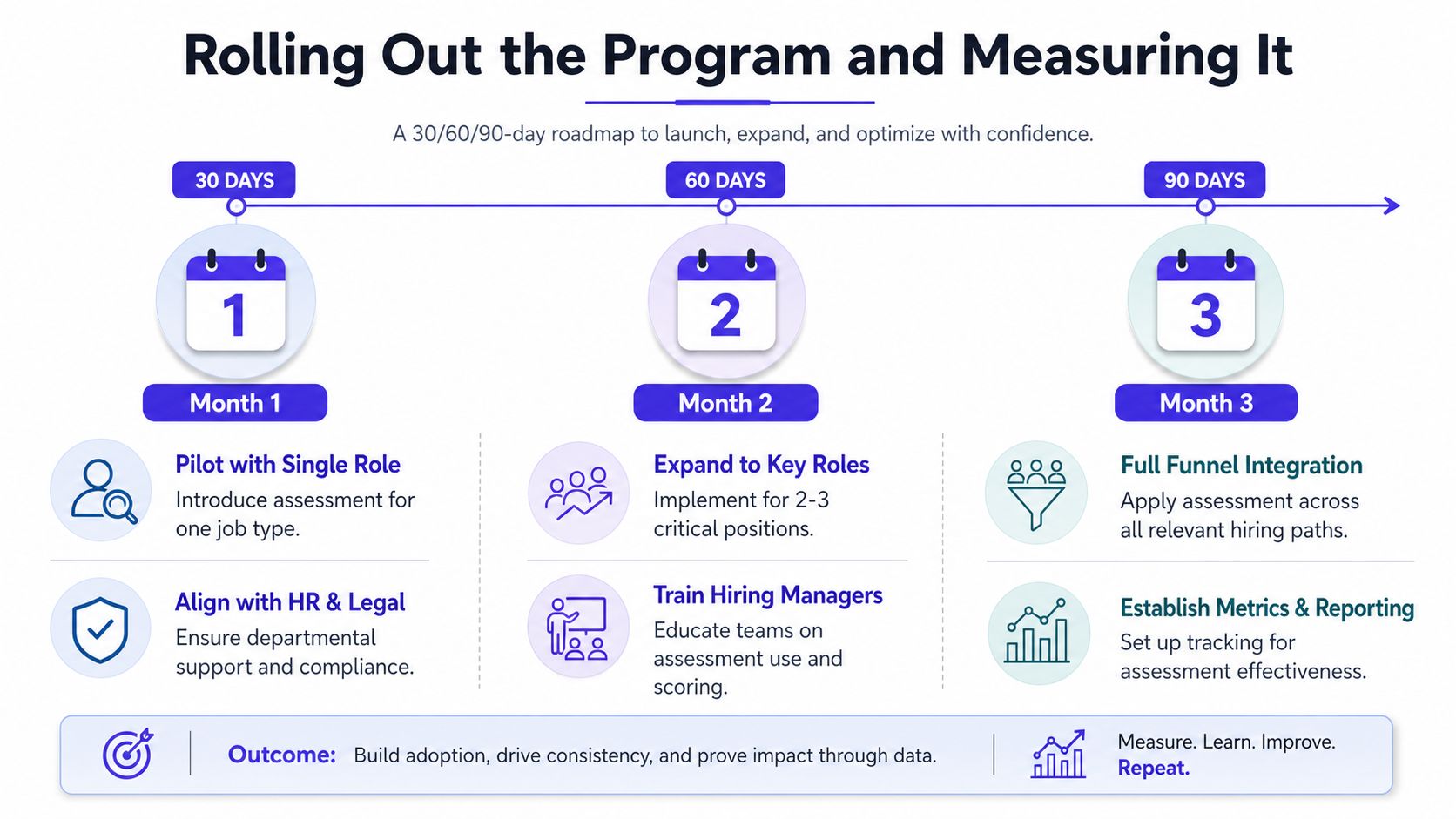
Rollout should feel like a controlled change, not a sudden process rewrite. Start with one role, prove the assessment is tied to the work, then widen the rollout only after hiring managers and legal have signed off on the rubric and the candidate experience holds up. That pace keeps the team from treating the new assessment as a blocker instead of a decision tool.
A clean 30, 60, 90-day sequence
The first month should stay narrow. One role is enough to check whether the assessment matches the job, whether recruiters can explain it clearly, and whether the scoring rubric survives review from HR and legal before candidates ever see it. The second month should extend to a few adjacent roles and train hiring managers on how to score the same behaviors in a consistent way.
The third month should make the assessment visible in reporting. Leadership needs to see whether the funnel is producing better candidates, or just filtering harder, and the dashboard should answer that without a lot of manual cleanup. Keep the metrics practical, including pass-rate distribution, completion time, candidate experience, post-hire performance, and funnel conversion. If completion drops while quality stays flat, the assessment is probably too long, too abstract, or too disconnected from the job.
What good adoption looks like
Good adoption shows up in manager behavior first. Hiring managers stop asking whether the candidate “felt right” and start asking how the candidate scored on the work sample. Recruiters stop describing the test as a hurdle and start explaining it as part of the decision process.
That change only sticks when the assessment is short, job-specific, and tied directly to the role's success criteria. It also has to be easy enough to repeat across candidates, because a process that only works when one manager runs it perfectly will not survive real hiring volume.
Tying the Assessment Loop to Revenue Outcomes
A pre hire assessment only earns its keep if it improves revenue outcomes, not just process cleanliness. For sales teams, that means looking at how assessment scores relate to ramp, pipeline coverage, and replacement cycles, then feeding those outcomes back into the rubric. Every hire becomes both a hiring decision and a data point for the next one.
When that loop is working, the company stops guessing which candidate traits matter. Managers can compare score patterns with later performance, see which tasks predict success, and trim anything that adds friction without adding signal. That's the point of treating assessment as a living funnel, not a one-time gate.
Overvue helps teams do this with AI sales roleplay that standardizes the conversation, scores the response, and gives hiring teams a repeatable way to compare candidates before the offer. If the goal is a sharper sales funnel with evidence at the top, visit Overvue and evaluate whether its assessment and training workflow fits the roles being hired today.