
Most advice on role playing for sales gets the core problem backwards. Teams are told to make sessions “realistic” and “engaging,” but realism without measurement just creates expensive theater, and engagement without scoring doesn't help hiring managers compare one seller to another. The value of role play is that it can turn selling behavior into something observable, repeatable, and defensible.
That matters because practice changes retention. The Association for Talent Development cites a widely repeated estimate that people retain about 75% of what they practice in role play, compared with only 5% from lecture-based learning, which is why role play has long been treated as a skills-acquisition method rather than a passive training event. In sales, that distinction matters most when the conversation is about objection handling, pricing, or next-step execution, because those are behaviors that show up under pressure, not in a slide deck. ATD's retention discussion of role play versus lectures makes the point clearly.
The weak spot isn't the idea of role play. It's the lack of a scoring model that survives different managers, different time zones, and different hiring panels. Public guidance often stops at “use realistic scenarios” and “debrief quickly,” but that still leaves the most important question unanswered, how does one evaluator's “good rapport” compare with another evaluator's? When the answer is vague, role play can't support promotion decisions, and it definitely can't carry hiring decisions on its own.
Why Most Sales Role Play Programs Fail
The most common mistake is treating role play like a one-off coaching moment. A manager finds half an hour, throws out a scenario, gives a few impressions, and moves on. That feels useful in the room, but it produces feedback that's hard to compare across reps, impossible to audit later, and useless for hiring.
Coaching moment or assessment system
A strong role play program starts with a different assumption, it is an assessment system, not just a coaching exercise. That shift matters because behavior only becomes comparable when the scenario, the criteria, and the scoring are all consistent. Without that structure, one manager may reward polished delivery while another rewards curiosity, even if both reps missed the actual next step.
Practical rule: if two managers can score the same recording differently and both feel justified, the rubric isn't ready for hiring.
Many public guides stay too soft. They push realistic objections, short sessions, and timely debriefs, which are all useful, but they rarely solve measurement quality. The result is a program that may help reps practice, yet still can't answer which candidate is more likely to handle pressure in a real buyer call. That gap matters most in distributed teams, where the people evaluating calls may never have coached the same way.
Why charisma can mislead hiring teams
Charisma is easy to notice and hard to trust. A confident candidate can sound persuasive in a simulated conversation while still missing discovery depth, call control, or next-step execution. If those behaviors aren't broken into observable pieces, interviewers end up rewarding performance style instead of selling skill.
Published sales-training research has associated regular role-play practice with 20 to 45% higher win rates versus non-practicing sellers, and about 75% retention for active practice versus roughly 5% for lecture-only learning, with ramp time reductions of two to four weeks in structured programs. Those figures come from published research summarized in a training paper, and they reinforce the point that the practice itself matters, but only if the practice is structured enough to measure. Published sales-training research summary
The most reliable teams stop asking whether a rep “seemed strong” and start asking which behaviors were demonstrated. That's the difference between a useful coaching conversation and a defensible selection process.
Designing Scenarios That Mirror Real Buyer Complexity
Generic objections don't prepare sellers for the conversations that stall deals. Modern B2B calls often involve procurement, security reviews, technical validation, and buyers who've already compared vendors before meeting sales. Scenarios that only rehearse “price is too high” or “call me next quarter” miss the messiness that reps face in live deals.
Build from real buyer context
The cleanest scenario design starts with live call recordings and real customer language. The scenario should reflect the buyer's role, the account's stage, the likely competitor, the tech stack, and the specific friction that pushed the buyer into the meeting. That gives the rep something close to the actual conversation instead of a generic training script.
A simple structure works well:
- Company context. What kind of business is this, and why is now the moment?
- Buyer role. Who is speaking, and what do they control?
- Pain points. What operational problem is forcing the conversation?
- Competitor mentions. Who else is in the evaluation?
- Tech stack details. What systems make the buying motion more complex?
The closer the scenario feels to the rep's real pipeline, the more useful the practice becomes.
That approach also solves a common content problem. Generic scenarios tend to train product recall. Better scenarios train call control, discovery depth, and the ability to move the buyer toward a clear next step even when the conversation branches into multiple threads.
Make the scenario test behavior, not memory
A useful simulation should pressure one behavior at a time. If the goal is discovery, don't overload the buyer with product feature trivia. If the goal is objection handling, keep the buyer focused on a narrow sticking point and make the rep earn the next question by showing restraint, curiosity, and control.
For teams using asynchronous practice, a resource like video message platform for sales can be helpful when the scenario needs quick follow-up recording or review comments from peers and managers. The point isn't the tool itself, it's the workflow, because role play gets stronger when the response can be captured, replayed, and scored without scheduling another meeting.
Scenario design works best when it reflects how deals unravel. Buyers rarely stay on one script, so the simulation shouldn't either.
Live Versus Asynchronous Role Play Formats
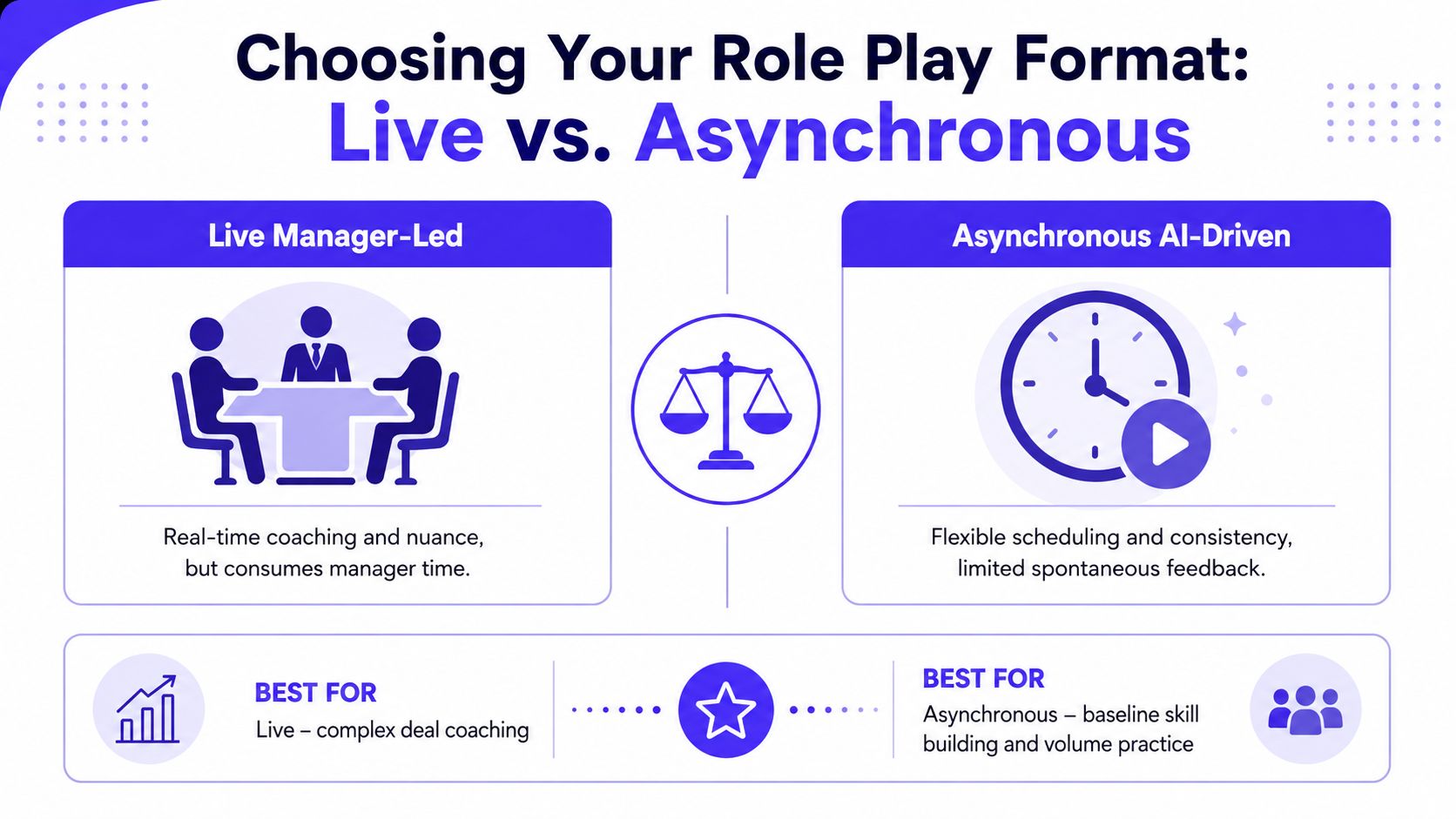
Live manager-led role play still has value, but it solves a different problem than asynchronous simulation. Live practice is better when nuance matters, especially in complex deal coaching where a manager wants to interrupt, challenge, or redirect in real time. Asynchronous practice is better when consistency, scheduling, and scale matter more.
What live sessions do well
Live sessions create immediate interaction. A manager can pause the conversation, test a new angle, or push the rep harder when the answer sounds rehearsed. That makes live sessions especially useful for senior sellers working through tricky objections, negotiations, or multi-stakeholder conversations.
The trade-off is time. Live sessions consume manager hours, and that quickly becomes a bottleneck when the team spans time zones or needs frequent practice. Once role play depends on synchronous calendars, it often gets pushed aside by pipeline reviews, forecast calls, and urgent deal work.
Where asynchronous format wins
Asynchronous simulations solve the scheduling problem. Reps can complete scenarios on their own time, and managers can review standardized recordings later instead of trying to be present for every exercise. That makes the feedback more consistent, because everyone is reacting to the same scenario and the same scoring logic.
The industry signal is moving in that direction. One 2026 summary reported that 76% of sales organizations plan to increase AI training investment by 2025, 67% of sales leaders say AI tools improve coaching effectiveness, and teams using AI sales training were associated in that report with 38% faster onboarding, 52% higher quota attainment, 35% lower training costs, and 47% faster time-to-productivity for new hires. Those are industry report figures, not peer-reviewed research, but they show how the market is shifting from ad hoc practice to standardized simulation workflows. CareerTrainer's AI sales role play statistics summary
The best operating model is often mixed. Use live sessions for high-stakes coaching, and use asynchronous simulations for baseline skill building, hiring screens, and repetition at volume.
Building Objective Scoring Rubrics for Consistent Evaluation
Scoring is where most role play programs break down. Managers default to gut feel, and vague labels like “good rapport” or “strong presence” create scoring drift across evaluators. That makes the results hard to compare and even harder to defend in hiring or promotion discussions.
Score one behavior at a time
The rubric has to be specific enough that another evaluator would arrive at the same conclusion. That means one competency per line, clear pass criteria, and explicit failure indicators. A rep shouldn't be scored on “overall quality” if the question is whether they handled an objection, controlled the conversation, and closed the next step.
| Competency | Pass Criteria | Fail Indicator |
|---|---|---|
| Objection handling | Acknowledges the concern, probes before responding, and ties the answer back to buyer goals | Deflects, argues, or jumps straight to product features |
| Call control | Keeps the conversation moving and regains direction after detours | Lets the buyer own the entire call |
| Responsiveness | Answers the actual question before expanding | Dodges the question or over-explains |
| Discovery depth | Asks follow-up questions that uncover impact, process, or risk | Stays at surface-level facts |
| Next-step execution | Secures a specific, agreed next action | Ends with a vague “let's stay in touch” |
That structure is much closer to how assessment should work. It also creates a useful audit trail for managers, because the score can be reviewed later instead of reconstructed from memory.
Make the rubric comparable over time
Comparable evaluation needs stable criteria and repeated measurement. Track completion rate, score improvement over 30, 60, and 90 days, and objection-to-next-step conversion rate so the team can see whether practice is changing behavior or just creating activity. Those leading indicators are far more useful than a manager's impression after one call.
A practical reference point for this kind of scorecard thinking is Overvue's sales interview scorecard guidance, which reflects the same need for criteria that can be shared across evaluators. The important part is not the label on the document. It's whether the rubric forces the scorer to judge observable behavior instead of personality or polish.
If the rubric can't support a side-by-side comparison, it can't support a hiring decision.
That's the measurement gap in most role play programs, and it's the reason objective scoring has to come before scale.
Running Role Play Sessions at Scale
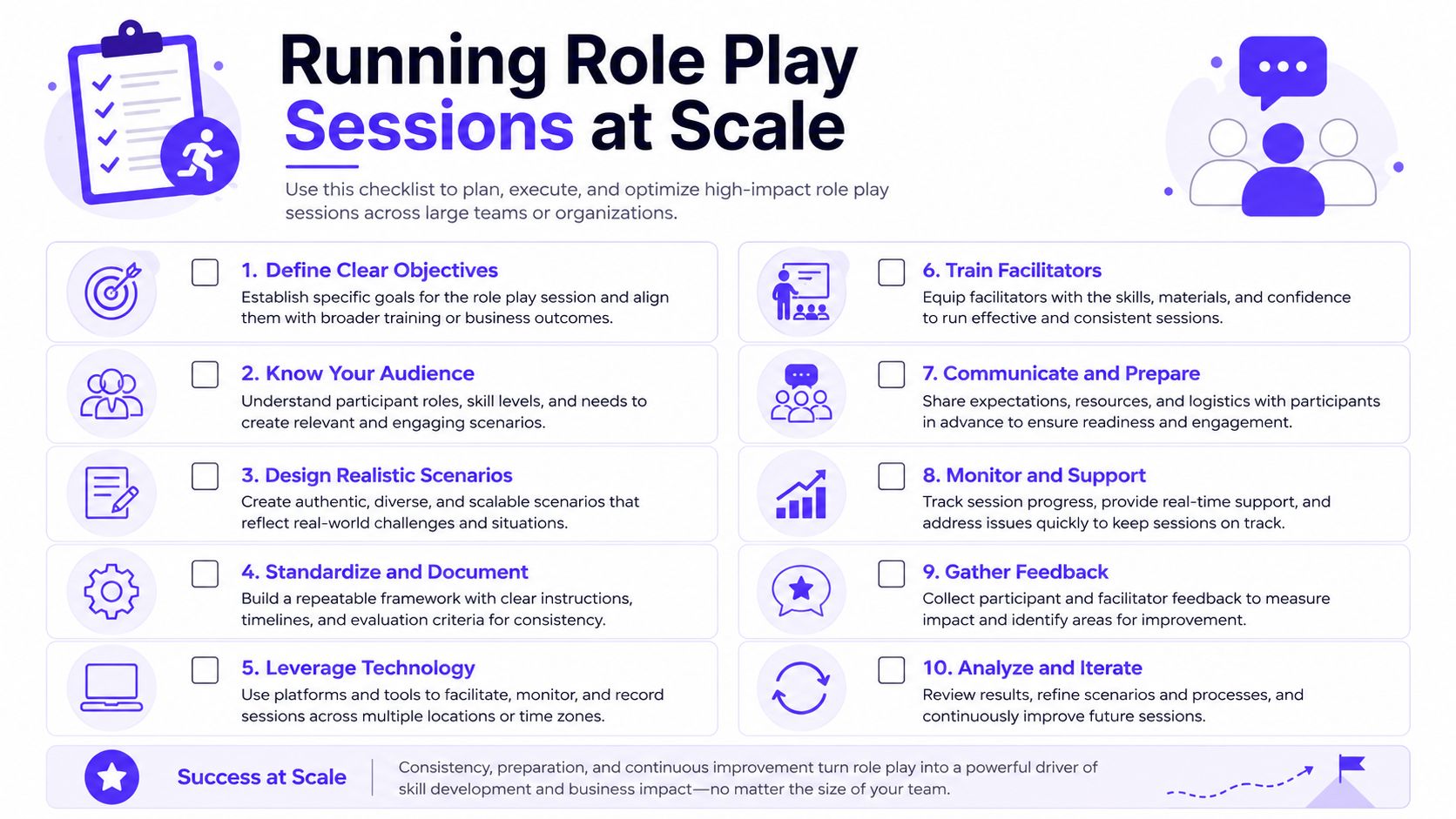
A good scenario and a good rubric still fail if the operating model is messy. Teams need a repeatable cadence, a simple way to assign sessions, and a feedback loop that doesn't depend on a manager remembering to follow up. The logistics matter as much as the content.
Build a cadence people can actually keep
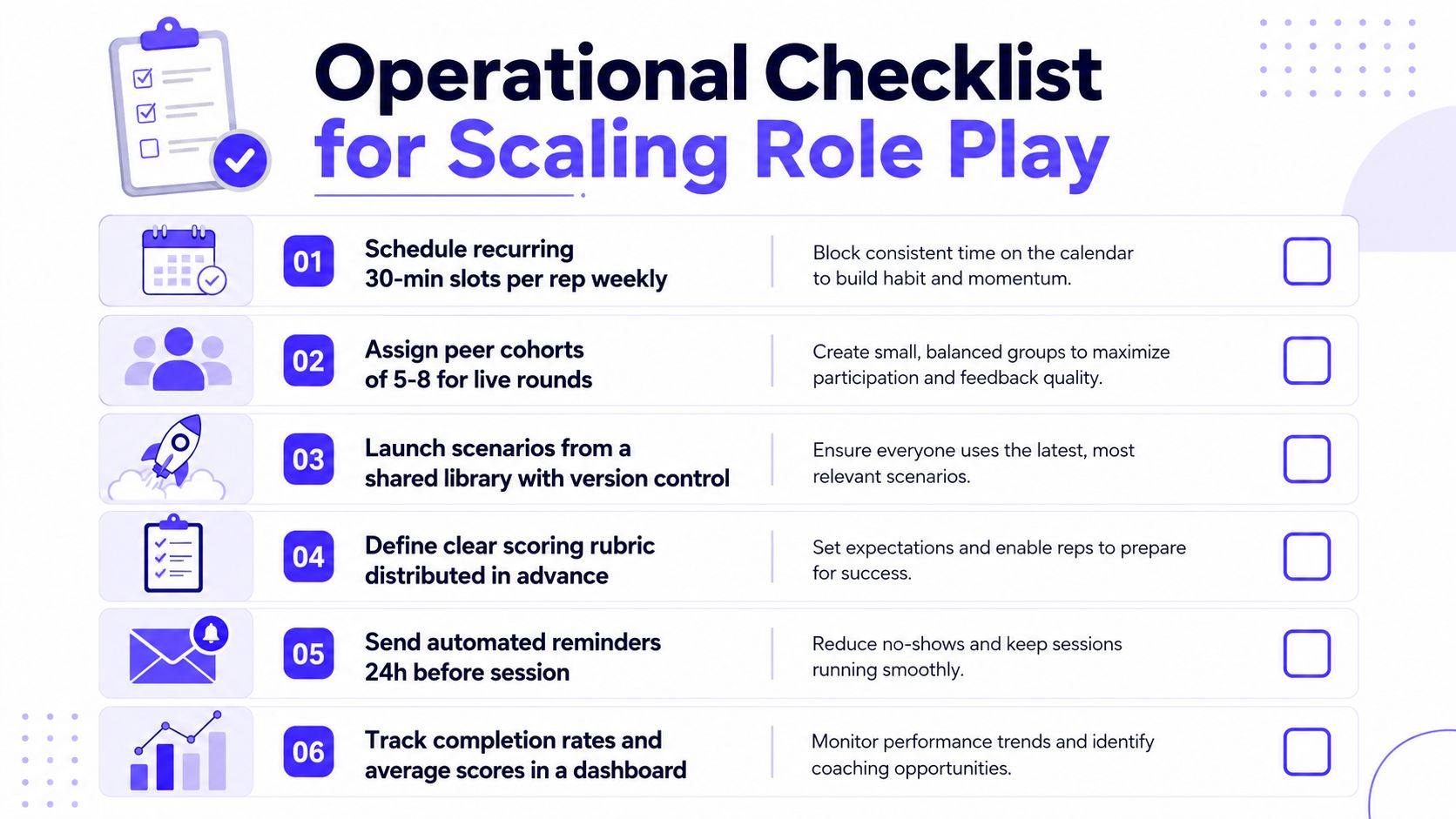
The easiest model is a recurring practice slot with a fixed rhythm. Many teams use short weekly practice blocks, peer cohorts, or daily challenge prompts so reps know exactly when the next session is happening. That consistency matters because sporadic training never forms a habit.
For distributed teams, asynchronous access solves the biggest scheduling failure. Reps in different time zones can complete the same scenario, and managers can review on their own schedule without reshuffling calendars. When multilingual teams are involved, the same setup also helps preserve evaluation consistency across regions.
Use structure to motivate, not embarrass
Leaderboards can work, but only if they're framed carefully. Public competition helps when it rewards completion and improvement, not just top raw scores. Otherwise, newer reps disengage, and the training starts to feel like a ranking exercise instead of a skill-building system.
The operational layer should include:
- Shared scenario library. Keep version control so everyone practices against the same materials.
- Clear reminders. Automate session reminders before practice windows open.
- Dashboard reporting. Track completion, score trends, and recurring failure points.
- Debrief ownership. Assign who reviews, who coaches, and when feedback is due.
A platform that supports this kind of workflow can save a lot of administrative drag. Overvue's sales training and enablement overview is relevant here because the mechanics of scheduling, feedback, and tracking are what make the practice sustainable, not the script itself.
Connecting Role Play Data to Hiring and Revenue Outcomes
Role play creates behavioral evidence that interviews can't. A resume may show tenure and titles, but it doesn't show how a candidate handles pushback, steers a conversation, or secures a next step. Standardized simulation data is useful because it makes those behaviors visible before the offer goes out.
Use the same scenario across hiring and onboarding
The best hiring systems and the best onboarding systems should not feel disconnected. If candidates are assessed on one set of behaviors and then trained against a completely different set, the organization creates confusion. Shared scenarios align expectations, which makes the transition from evaluation to development much cleaner.
That alignment also reduces the temptation to overvalue charisma. A candidate who sounds smooth in a live interview can still struggle in a simulated call if the scoring rubric is built around actual selling behaviors. The opposite also happens, where a quieter candidate may perform better once the conversation becomes concrete and behavior-based.
For teams building that kind of process, competency based hiring for tech sales is a useful external reference because it emphasizes observable capability instead of surface-level impression. That logic pairs well with role play, since simulations show how a candidate behaves under pressure rather than how they perform in a panel interview.
Tie scores back to business decisions
Role play scores should sit alongside the rest of the hiring signal stack, not replace it entirely. Used well, they help recruiters shortlist with more confidence, help managers distinguish coaching needs from hard gaps, and help revenue leaders reduce the risk of a bad hire that drags on ramp and pipeline.
The same data can support promotions when the criteria are stable. If the same rubric is used at multiple points in a rep's development, the organization can show that growth came from demonstrated behavior, not just tenure. That's a better foundation for advancement than subjective consensus after a few strong quarters.
The older research point still matters here, too. Published sales-training research has linked regular role play practice with better win rates and faster ramp, and that's exactly why the data should be treated as operational evidence, not just a learning artifact. The published sales-training research summary supports the broader case for structured repetition.
Moving From Ad Hoc Practice to AI-Scored Simulation
A practical rollout doesn't start with a full transformation. It starts with a small pilot, a narrow scenario set, and a willingness to compare the new process against the old one without pretending the automation will be perfect on day one. The teams that succeed are usually the ones that respect manager skepticism instead of trying to bypass it.
A realistic adoption path
One team can pilot asynchronous simulation with a small cohort of new hires or SDRs, then compare score consistency and coaching efficiency against a manually run group. Managers should review where the system is accurate, where it's too strict, and where it needs better scenario design. That makes the rollout an operational improvement project instead of a tool rollout.

The main pitfall is over-engineering the first version. A simulation doesn't need every possible branch on day one, and it doesn't need a perfect model of every buyer persona. It needs enough realism to surface behavior, enough scoring consistency to compare reps, and enough operational simplicity that managers will use it.
For teams comparing platforms, Overvue's comparison with Second Nature is a useful place to look at how standardized AI role play is being packaged for hiring and training workflows. A broader view of automation in the workplace is also helpful, and Virtustant's AI staffing insights offers a relevant lens on how teams are adapting to more AI-supported operations.
The direction is clear. Role play is moving from occasional manager theater to a measurable system that influences hiring, onboarding, coaching, and eventually territory and promotion decisions.
If sales hiring and enablement teams want role play to produce defensible decisions, Overvue gives them a way to run standardized AI buyer simulations, score them against consistent criteria, and compare candidates or reps on the same behavioral evidence. Visit Overvue to see how structured simulations can support hiring, onboarding, and ongoing coaching without depending on manager-led improvisation.