
Polished interview performance doesn't prove that a candidate can improve selling behavior. A 2016 Journal of Sales, Advertising, Marketing & Allied Research study found that role-play performance did not significantly correlate with actual selling performance across the full sample at the p = 0.05 level in its analysis of sales role-play. That finding doesn't make simulations useless. It means hiring teams should treat interview answers, simulations, references, and performance evidence as separate signals rather than allowing confidence to stand in for capability.
Modern sales enablement emerged as a formal discipline in 1999, and the founding of the Sales Enablement Society in 2013 helped establish it as a recognized profession in an industry history of sales enablement. The role now reaches beyond training delivery. A strong enablement hire should connect program design to hiring, onboarding, coaching, observable rep behavior, and business outcomes.
The eight sales enablement interview questions below cover program design, tools, objection handling, readiness, performance improvement, hiring, global scale, and coaching. Each question includes the capability it tests, signals of a strong answer, interpretation risks, and a practical scoring approach. The framework also introduces Overvue where standardized AI roleplays and criteria-based scoring can add observed behavioral evidence without relying only on charisma or interviewer intuition. For broader interview design, hiring teams can also compare this structure with key interview questions for construction managers, particularly the emphasis on concrete examples and role-specific evidence.
1. Tell me about your experience building or implementing sales enablement programs from scratch
This question separates a program architect from a capable content producer. A candidate should be able to explain how a business problem became a defined enablement program, who contributed to the design, how managers reinforced it, and what changed after launch.
Strong answers usually follow a clear chain: diagnosis, design, implementation, measurement, iteration. For example, a candidate might describe discovering inconsistent discovery calls across a growing software team, working with Sales and RevOps to define a call framework, integrating it into CRM workflows, and giving managers a repeatable coaching rubric. The answer should identify the candidate's own decisions, not just describe what the wider company delivered.
A credible candidate will also discuss resistance. Sellers may reject a new process if it feels like extra administration or if leaders haven't modeled it themselves. The candidate should explain how field input shaped the program, how managers were equipped, and which elements remained standardized versus customizable.

What to probe and how to score it
Ask:
- Ownership: Which parts did the candidate personally design, launch, or change?
- Stakeholder management: Which sales leaders, managers, product partners, or operations teams resisted?
- Measurement: Which behavior and business measures defined success?
- Scalability: How did the program support different roles, regions, or experience levels?
- Talent connection: Did hiring profiles and onboarding expectations reflect the same competencies?
Score the answer from one to five using evidence quality rather than delivery style. A low score reflects activity language such as “we ran workshops” or “we created content.” A middle score includes a structured rollout but weak ownership or measurement. A high score connects a diagnosed selling problem to a repeatable system, names trade-offs, and shows sustained reinforcement.
Practical rule: A candidate who can't explain how managers reinforced the program probably built an event, not an enablement system.
For a useful comparison of program structures and examples, hiring teams can review sales enablement examples to copy in 2026. The source should inform follow-up prompts, not replace evidence from the candidate's own work.
2. What sales enablement tools have you managed, and how did you measure their adoption and impact?
Tool names reveal little by themselves. The interview should establish whether the candidate can match a platform to a selling problem, fit it into existing workflows, and prove that usage changed seller behavior.
Ask for one implementation in detail. A candidate might have managed Seismic for content governance, connected enablement activity with Salesforce workflows, or used conversation intelligence to find recurring discovery and objection-handling gaps. Probe the decision: why that tool, what did it replace, which users had to change habits, and what happened when adoption stalled? Strong answers include a trade-off, such as choosing tighter workflow integration over a broader feature set, or delaying a rollout until managers could reinforce it.
A useful follow-up is: “Show me the evidence at each stage.” Listen for four forms of evidence:
- Usage: intended users access the platform and complete the required actions.
- Behavior: call structure, messaging, objection handling, or next-step discipline changes.
- Performance: relevant conversion or deal-progression measures move in the expected direction.
- Decision quality: the candidate uses those findings to expand, redesign, or retire the intervention.
Do not accept one adoption figure as the whole story. Ask the candidate to segment results by new hires, manager, region, or language. A strong answer may reveal high usage on one team, weak adoption among new hires, or regional differences caused by workflow design. That level of detail shows whether the candidate can diagnose implementation problems rather than report dashboard activity.
Score from one to five based on evidence, not presentation. Give lower marks to answers centered on logins, content views, or completion rates. Give higher marks when the candidate connects a defined problem to a behavior measure, explains the comparison and timeframe, acknowledges competing factors, and states what decision followed. Claims of revenue impact require a clear method for separating enablement effects from pricing, territory, manager, or market changes.
The role is increasingly analytical. Job-market analysis for 2026 reports data analysis in 48% of postings and sales methodology in 42%, according to the 2026 state of sales enablement analysis. Use those figures as context, then require role-specific evidence.
For follow-up prompts, consult sales enablement KPIs to track in 2026. The candidate should select measures that fit the problem, not recite a standard dashboard.
3. Describe your approach to objection handling training and how you measured its effectiveness
Objection handling reveals whether an enablement practitioner can convert a broad skill into observable behavior. “Teach reps to listen and respond with empathy” is only a starting point. The candidate should define the target behavior, create practice conditions, apply a consistent rubric, and explain how coaching reinforces it.
Start by asking how objections were selected. Strong candidates use call reviews, win-loss findings, manager observations, deal-stage analysis, and seller feedback to identify patterns. They distinguish product confusion, pricing resistance, competitive displacement, timing concerns, and weak value creation. Each requires different practice, so a single script is rarely enough.
A useful interview follow-up is: “Show me one objection from diagnosis through reinforcement.” Look for buyer context, likely business consequences, and a response process that helps the seller acknowledge the concern, investigate it, answer with relevance, and secure an appropriate next step. Ask what changes for a new hire compared with an experienced seller. Strong designs increase scenario difficulty as judgment improves.
The candidate's scoring model should cover listening, clarification, relevance, confidence, responsiveness, and next-step control. Ask how managers calibrate scores across reviewers and what evidence triggers more practice. Recorded calls, manager coaching, spaced exercises, and an updated objection library can reinforce the skill, provided each activity connects to a defined behavior.
Overvue provides one example of a simulation approach. Its AI buyer scenarios can use ICP details and assess responses against defined selling criteria. This can provide safer practice and more consistent observation, while still leaving an evidence gap. The 2016 study cited earlier found that role-play alone was not a reliable predictor of actual selling performance across its full sample. Combine simulated performance with live-call evidence and manager judgment rather than treating a simulation score as a hiring or certification decision.
Measure change with a baseline, the same rubric after training, and follow-up observations over time. Satisfaction scores provide context, not effectiveness evidence. Ask the candidate to connect improved objection behavior to pipeline outcomes while accounting for manager support, deal mix, and market conditions.
Use proven objection-handling strategies and scripts to probe whether scripts guide judgment or produce mechanical replies. Score from one to five: higher marks require a diagnosed problem, observable practice, repeatable measurement, and a clear decision based on the results.
4. How do you define and measure sales readiness, and what are your key metrics for assessing whether new hires are ready to carry quota?
Readiness is a decision supported by observed behavior, not a completion badge or an impression of confidence. Ask the candidate to define the evidence required before a new hire receives meaningful customer responsibility, then explain how that evidence changes the hiring, onboarding, and coaching process.
A strong answer separates capabilities by timing and risk. Product knowledge, ICP and use-case accuracy matter, alongside discovery, qualification, objection handling, call control, CRM hygiene, written follow-up, and next-step execution. The candidate should identify which behaviors a seller must demonstrate on day one, which can improve through coaching, and which require manager approval before customer ownership.
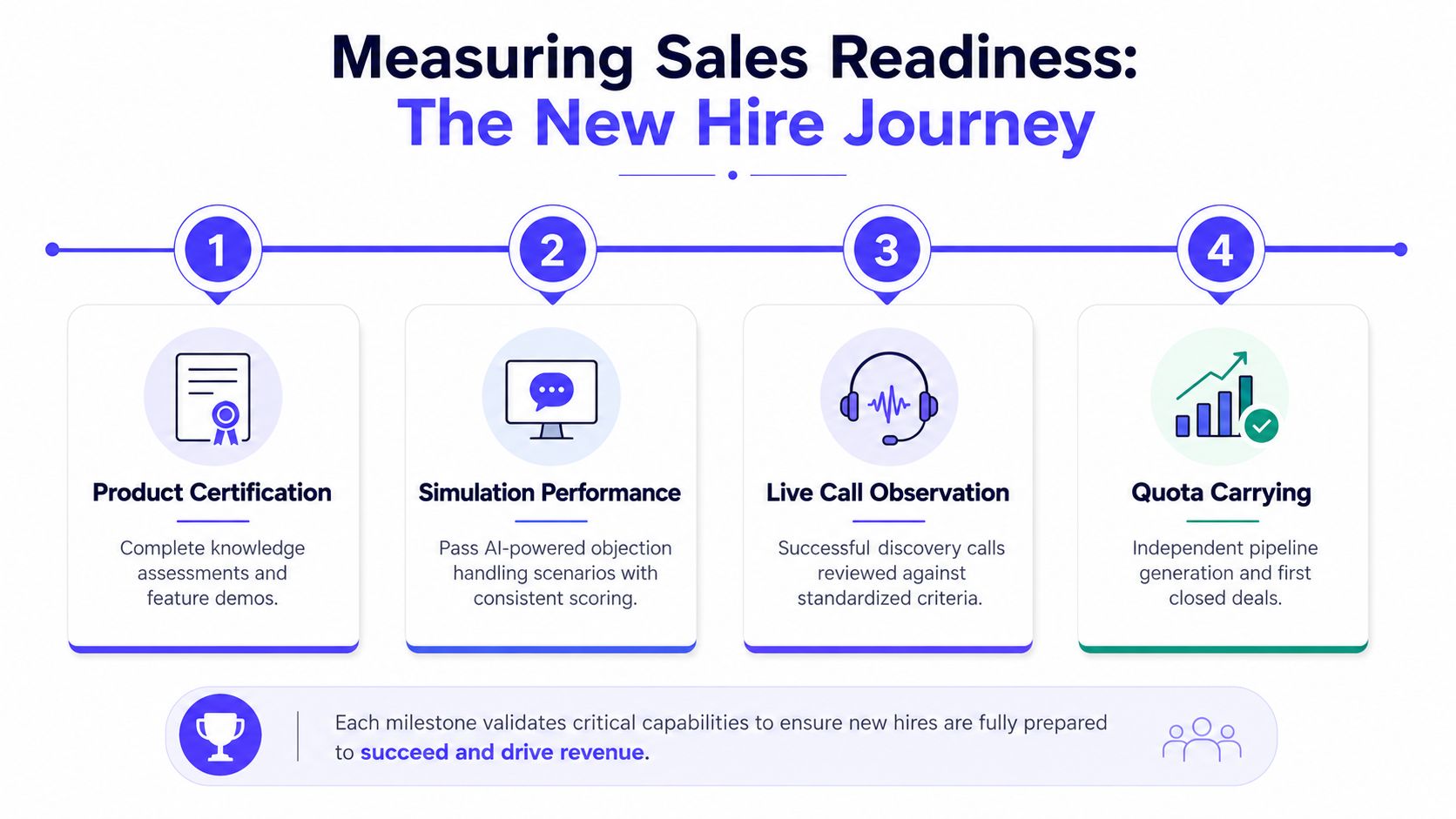
Ask the candidate to map the journey from certification to quota rather than naming a single readiness score:
- Knowledge: Can the seller explain the product, ICP, use cases, and competitive position accurately?
- Simulation: Can the seller handle a realistic buyer conversation against a consistent rubric?
- Call observation: Can a manager identify the same required behaviors in a live or recorded call?
- Execution: Can the seller create an appropriate next step, record it correctly, and respond to buyer information?
The sequence and threshold should match the role. An inbound SDR, enterprise AE, and channel seller need different proof. Strong candidates also connect readiness results to earlier decisions. Repeated discovery failures may indicate gaps in onboarding, manager coaching, interview criteria, or the handoff between them.
Score the answer higher when it includes specific gates, observable standards, early risk detection, and a plan for exceptions. Ask what would delay certification, what evidence would trigger more practice, and who can approve an exception. Treat quota as a later outcome, since territory, lead flow, pricing, and manager support can affect it independently of readiness.
A practical follow-up is: “How would you keep the standard fair across cultures, languages, and communication styles?” The candidate should evaluate selling behavior required by the role, not fluency, accent, or presentation polish.
5. Tell me about a time when you had to improve sales team performance through enablement. What was the gap, what did you implement, and what was the measurable outcome?
A strong answer connects a performance gap to a repeatable enablement system, not merely to a well-received training session. Ask the candidate to show how they diagnosed the problem, selected an intervention, tested it, and transferred ownership to managers.
Listen for a clear chain of evidence. The candidate should identify the original signal, examine possible causes, isolate the behavior affecting performance, and match the response to that behavior. A pipeline shortfall, for example, may reflect weak discovery, inconsistent qualification, or poor next-step control. Training content alone may not address a process or coaching failure.
Test diagnosis, attribution, and durability
Ask what evidence separated the root cause from the visible symptom. Strong candidates can explain why they chose coaching, training, process changes, content, technology, or a combination. They also define success at two levels: observable seller behavior and business outcomes.
Probe with questions such as:
- Root cause: Which call, funnel, manager, or customer evidence confirmed the gap?
- Intervention: What alternatives did you reject, and why?
- Measurement: What baseline, comparison group, or leading indicator did you use?
- Durability: How did managers reinforce the new behavior after launch?
- Trade-off: What work was stopped, delayed, or simplified to support the change?
- Reflection: What would you revise if the result did not hold across teams or segments?
A credible candidate separates program impact from coincidental change. If conversion rose after training, ask whether lead quality, pricing, territory design, management, or product positioning also changed. The candidate should state what the evidence supports and where attribution remains uncertain.
The sales-hiring connection also matters. One independent benchmark reports that only 23% of sales organizations use any validated assessment, while traditional interview-based selection is associated with 20% success compared with 60% to 80% for assessment-based hiring in coverage of sales hiring methods. It also reports first-year turnover of 40% to 50% for interview-based hiring and 10% to 20% for assessment-based hiring. Treat these figures as context, not a forecast. The interview should reveal whether the candidate can connect hiring evidence to onboarding design, practice, coaching, and sustained performance.
Score highest for diagnosis, ownership, honest attribution, measurable behavior change, and manager adoption. A large result without a baseline or comparison deserves less credit than a modest improvement supported by clean evidence and a plan to reproduce it.
6. What is your experience with sales hiring and recruiting? How do you assess whether a candidate has the right skills before they join your team?
Hiring quality sets the ceiling for enablement. This question tests whether a candidate can separate skills that must be present at hiring from skills onboarding can build and managers can develop through coaching.
A strong answer starts with a capability map. The candidate should define the behaviors required for the role, then match each behavior to evidence. Selling fundamentals, learning agility, written communication, resilience, and discovery judgment require different signals from product knowledge or industry terminology. Ask which capabilities deserve an interview question, a work sample, a role-play, or a reference check.
The candidate should also explain how hiring data changes enablement. If successful new hires consistently show curiosity, structured questioning, and responsiveness during assessment, those behaviors should appear in interview rubrics and onboarding simulations. If people from a particular background perform well only after extensive support, examine whether that support is deliberate and scalable before treating the background as a hiring shortcut.
Test the evidence, not the story
Structured interviews reduce inconsistency, but answers alone can reward confidence and polished storytelling. A candidate who proposes simulations should specify how scenarios are standardized, how evaluators score them, and how accessibility and accommodations are handled. Overvue offers secure asynchronous assessments, AI buyer simulations, and criteria-based scoring for objection handling, call control, responsiveness, and next-step execution. It can support observed-behavior evaluation, but it should sit alongside other hiring signals rather than replace them.
Gartner recommends peer benchmarking based on data-backed metrics, customized reporting, and segmentation in its sales benchmarking guidance. Ask whether the candidate would compare outcomes by source, manager, role, experience level, and assessment stage. The scoring question is whether those comparisons reveal where selection, onboarding, or coaching assumptions break down.
A 2026 sales hiring article describes a selective funnel, with roughly 18 to 20 screened candidates per opening, five to six manager interviews, and one to two hires. Use that context to test interview design. Strong candidates explain how consistent, job-relevant questions improve decision quality without extending interviews that repeat the same subjective impression.
For role-specific recruiting context, hiring teams can review the SDR hiring guide and adapt its concerns to the enablement responsibilities being evaluated.
Score highest when the candidate connects hiring evidence to onboarding practice, simulation, coaching, and sustained performance. Give less credit to a process that produces confident impressions but cannot show how evaluators reach comparable decisions or how hiring results inform the next enablement cycle.
7. How do you approach building sales enablement strategies for distributed, multilingual, or global teams?
Global enablement fails when teams confuse translation with localization. A translated playbook may preserve the words while losing the buyer context, legal nuance, conversational rhythm, or objection pattern that makes the playbook useful.
A strong candidate starts with a global core. That core might include the sales methodology, qualification logic, required CRM fields, ethical boundaries, and scoring criteria. Regional teams then adapt examples, buyer scenarios, competitive context, language, and delivery format without changing the underlying capability being evaluated.
Test for operational detail
Ask how the candidate would handle:
- Asynchronous delivery: Can sellers complete practice and assessments across time zones without waiting for a live facilitator?
- Language consistency: Which content requires professional translation, and where can regional teams adapt examples?
- Comparable scoring: How will a manager compare the same selling behavior across languages?
- Local ownership: Who approves regional changes and prevents methodology drift?
- Cultural context: How do relationship norms, decision processes, and buyer expectations alter the conversation?
- Accessibility: Can candidates and sellers participate fairly regardless of location, device, or communication style?
Overvue's multilingual assessments, secure links, remote access, and standardized AI buyer scenarios provide one example of how teams might support distributed evaluation. The candidate should still explain governance. Automated translation or scoring can scale access, but critical scenarios require review for meaning, cultural fit, and unintended bias.
Platform experience appears in 68% of 2026 sales-enablement job postings, while CRM proficiency appears in 62%, according to a sales enablement job-growth analysis. Those figures indicate that tool fluency is common enough to test, but they shouldn't replace a deeper question about operating design.
Score the answer highest when the candidate protects comparability while allowing relevant local adaptation. Penalize both extremes: a single global script that ignores context, and unrestricted regional customization that makes performance impossible to compare.
8. Describe your experience with sales coaching and feedback. How do you scale coaching to large teams without losing personalization?
Training transfers information. Coaching changes behavior through observation, practice, feedback, and repetition. This question reveals whether the candidate understands that distinction and can build a system where managers, peers, technology, and sellers share the coaching load.
A credible candidate should describe a coaching cadence tied to specific behaviors. For example, managers might review recorded calls using a discovery rubric, select one priority behavior, assign a focused practice scenario, and revisit the behavior in a later conversation. That approach is more actionable than telling a seller to “be more consultative.”
Look for a coaching operating system
Strong answers often include:
- Manager enablement: Training managers to diagnose a gap, give evidence-based feedback, and assign practice.
- Standardized observation: Shared criteria for discovery, objection handling, call control, responsiveness, and next-step execution.
- Personalization: Different practice paths for new hires, experienced sellers, struggling reps, and high performers.
- Peer reinforcement: Side-by-side calls, peer review, mentor programs, or communities of practice.
- Technology support: Conversation intelligence, transcripts, automated recommendations, and dashboards used to focus manager attention.
- Outcome review: Skill improvement connected carefully to opportunity progression, conversion, retention, or other relevant measures.
Overvue can support the practice layer through AI buyer scenarios, custom scorecards, call feedback, and team analytics. Its value in an interview framework comes from making practice more repeatable and observable. It doesn't eliminate the need for a manager to understand context, motivation, deal strategy, or the difference between a technical mistake and a judgment call.
Ask how the candidate measures coaching effectiveness. Engagement may show participation, but it doesn't prove skill improvement. The highest score should go to candidates who explain how they establish a baseline, choose a narrow behavior, provide repeated feedback, and verify whether the seller applies the skill in real conversations.
Coaching scales when the system standardizes what managers observe, not when it tries to make every seller identical.
Also ask how the candidate coaches managers on coaching. That meta-coaching capability often determines whether the program survives beyond the enablement team's direct involvement.
8-Point Sales Enablement Interview Comparison
| Question | Implementation complexity 🔄 | Resource requirements ⚡ | Expected outcomes ⭐ | Ideal use cases 💡 | Key metrics / Measurement 📊 |
|---|---|---|---|---|---|
| Tell me about your experience building or implementing sales enablement programs from scratch | High 🔄, cross‑functional design, governance, process scaling | High ⚡, content creation, tech stack, SMEs, change management | ⭐⭐⭐⭐, scalable, repeatable enablement and consistent onboarding | New orgs scaling enablement; standardizing processes across teams | Time‑to‑productivity, adoption rates, manager assessments, retention |
| What sales enablement tools have you managed, and how did you measure their adoption and impact? | Medium 🔄, integrations, rollout, user training | Medium ⚡, licenses, analytics, integration effort | ⭐⭐⭐, increased visibility and tool-driven behavior change | Tool selection/ROI proof, driving content adoption and analytics | Adoption %, content consumption, deal velocity correlation, ROI |
| Describe your approach to objection handling training and how you measured its effectiveness | Medium 🔄, design simulations, role‑play, feedback loops | Medium ⚡, SMEs, recorded calls, simulation tech | ⭐⭐⭐⭐, improved reps' objection resolution and close rates | Closing-focused training, ramp reinforcement, high‑touch coaching | Pre/post call scores, win rate, objection resolution rate, call quality |
| How do you define and measure sales readiness, and what are your key metrics for assessing whether new hires are ready to carry quota? | High 🔄, readiness gates, dashboards, role‑based criteria | Medium‑High ⚡, assessments, simulations, data integrations | ⭐⭐⭐⭐, objective go/no‑go decisions; reduced mis‑hires and ramp | Onboarding programs, quota deployment decisions, hiring gating | Time‑to‑quota, readiness pass rate, certification scores, ramp variance |
| Tell me about a time when you had to improve sales team performance through enablement. What was the gap, what did you implement, and what was the measurable outcome? | Medium‑High 🔄, diagnosis, targeted interventions, change mgmt | Medium ⚡, analytics, training rollout, stakeholder buy‑in | ⭐⭐⭐⭐, measurable behavioral and revenue improvements | Performance remediation, targeted skill gaps, cross‑team fixes | Conversion rates, handoff/meeting conversion, win rate, sustained change |
| What is your experience with sales hiring and recruiting? How do you assess whether a candidate has the right skills before they join your team? | Medium 🔄, align hiring criteria with enablement and onboarding | Medium ⚡, assessment tools, structured interviews, recruiter collaboration | ⭐⭐⭐, higher hire quality and faster ramp when structured | Pre‑hire skill validation, reducing mis‑hires, hiring for coachability | Hire‑to‑quota time, assessment pass rates, retention, ramp efficiency |
| How do you approach building sales enablement strategies for distributed, multilingual, or global teams? | High 🔄, localization, regional governance, timezone coordination | High ⚡, translation, regional leads, asynchronous platforms | ⭐⭐⭐⭐, consistent evaluation with local adaptation and fairness | Global expansions, multilingual markets, distributed sales forces | Regional adoption, localized pass rates, completion time by timezone |
| Describe your experience with sales coaching and feedback. How do you scale coaching to large teams without losing personalization? | Medium 🔄, coaching cadences, manager enablement, tech enablement | Medium ⚡, call review tools, AI insights, manager training | ⭐⭐⭐, sustained behavior change and continuous improvement | Scaling coaching programs, manager enablement, peer coaching | Coaching frequency, skill score improvement, coaching ROI, engagement |
Turn Interview Answers Into Comparable Hiring Evidence
A structured interview starts before the first candidate joins the call. The hiring team should define the competencies required for the role, write behavioral indicators for each competency, and decide what evidence deserves a high score. For an enablement leader, those competencies may include diagnosis, program architecture, stakeholder influence, data analysis, sales methodology, coaching design, hiring partnership, and global operating judgment.
The interview panel should ask the same core sales enablement interview questions in the same sequence whenever practical. Consistency doesn't require robotic delivery. Interviewers can ask the same primary question and use the same follow-up prompts, while allowing candidates to explain their own context.
Use a simple evidence model for every response:
- Situation: What business or selling context did the candidate face?
- Action: What did the candidate personally decide and do?
- Measurement: Which behavior, adoption, readiness, or performance signal was tracked?
- Sustained outcome: What changed over time, and how did the candidate verify it?
- Reflection: What failed, what trade-off mattered, and what would change next time?
Score each dimension separately. A polished story with vague ownership shouldn't outrank a less theatrical answer with clear diagnosis and measurement. Interviewers should record evidence during the conversation, then compare notes against the rubric instead of allowing the final impression to become the score.
Interview questions still have limits. The sales-hiring benchmark cited earlier reports that traditional interview-based selection has weaker outcomes than assessment-based hiring in its independent hiring coverage. The role-play research also warns that simulated performance alone isn't a reliable predictor of actual selling performance across the full sample in the Journal of Sales, Advertising, Marketing & Allied Research study. The practical answer is not to abandon either method. It's to combine structured answers with a realistic simulation, work samples, references, and later onboarding evidence.
For behavioral follow-ups, interviewers can use skills-first STAR questions from HiredBySkill to press for situation, action, and result details without leading the candidate toward a preferred answer.
Overvue is one relevant option for the observed-behavior layer. It provides standardized AI buyer simulations based on ICP details, secure asynchronous candidate assessments, and objective scoring against criteria such as objection handling, call control, responsiveness, and next-step execution. Shared scenarios can also connect hiring assessments with new-hire training, giving the business a common language for evaluation and development. Human reviewers still need to validate role relevance, accessibility, and context before making a hiring decision.
The final workflow is straightforward. Define the capability, ask the same question, probe for evidence, score independently, compare notes, and test the most important live behavior in a standardized simulation. That process won't remove judgment from hiring, but it can make judgment more transparent, more consistent, and more useful after the offer is signed.
Overvue helps sales teams assess candidates and train new hires through AI buyer simulations built around real ICP details, with consistent scoring for objection handling, call control, responsiveness, and next-step execution. Visit Overvue to explore a practical way to connect structured sales interviews with observable behavioral evidence.