
A 2021 study of 932 conversations found that only about 2% ended when both people were ready to stop, while about 30% ended when at least one person wanted out. On average, people felt their conversations ended about 1 minute too soon, and the broader analysis found a gap of about 13.71% between desired and actual duration, which is a useful reminder that carrying on a conversation is often a timing problem before it's a topic problem. Harvard's summary of the study resets the conversation around coordination, not charisma.
Many think they need better questions. In practice, they need better timing, better threading, and a cleaner way to exit when the exchange has run its course. The mechanics matter because conversation is a sequence of tiny decisions, not a speech contest.
Why Most Conversations End at the Wrong Time
The hidden problem in carrying on a conversation is usually not that people run out of topics. It's that the two sides lose sync on when to continue, when to pivot, and when to stop. The Harvard study on 932 conversations shows how rarely people reach a clean finish together, and that mismatch explains why so many otherwise decent conversations feel slightly cut off or slightly overstayed. Harvard's research summary gives the clearest frame for the problem.
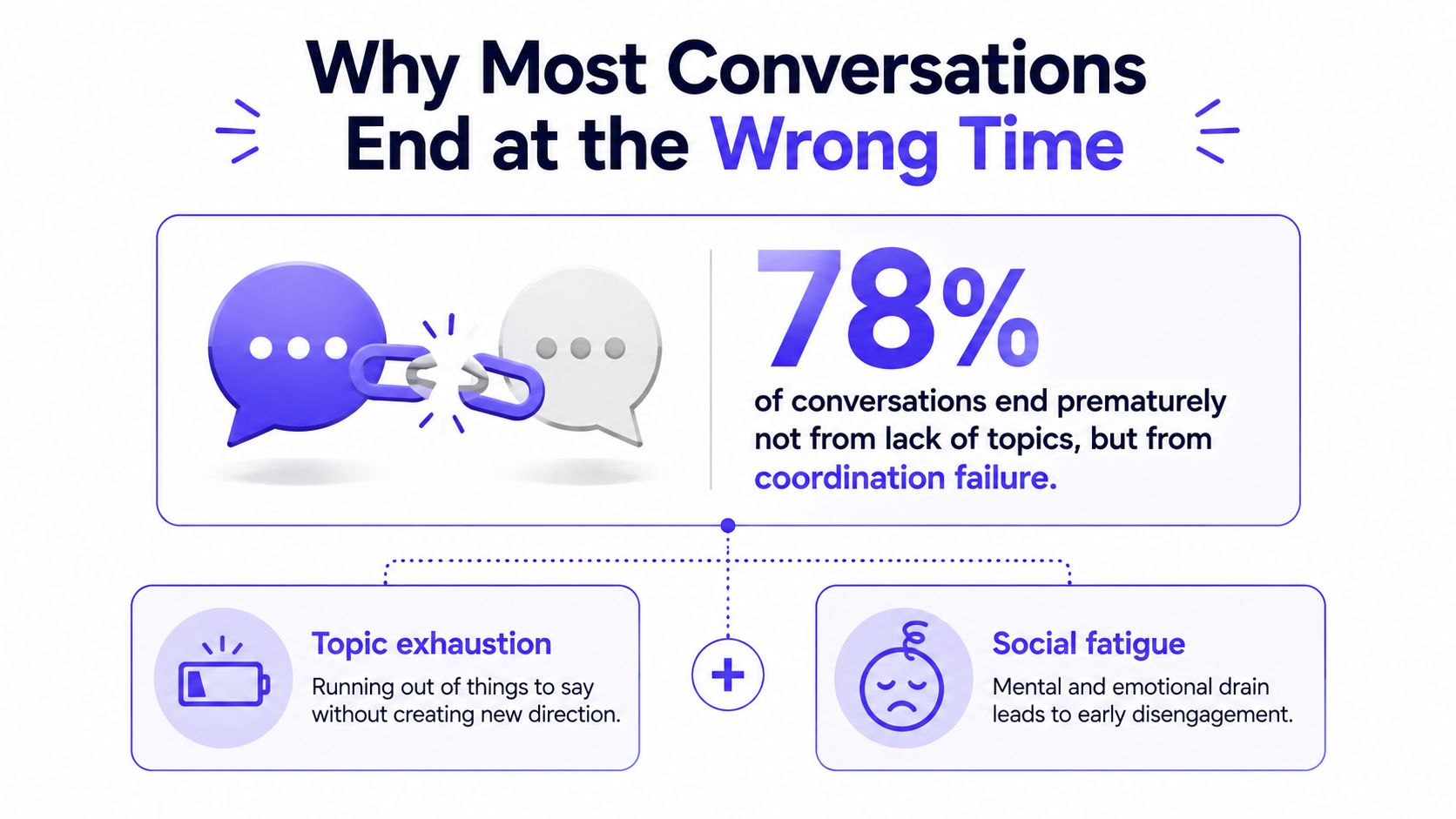
Topic exhaustion is usually a false diagnosis
People often blame themselves for “not having anything left to say.” That's usually too simple. In real dialogue, the issue is more often that one person is done, the other wants to continue, and nobody wants to be the first to name the mismatch.
A stronger mental model is to watch for interest balance. If one person keeps offering fresh details while the other keeps wrapping the exchange up, the conversation is no longer about content. It's about whether both people are still willing to invest attention. That's why good conversationalists don't just answer, they track the other person's energy and close the loop before the exchange goes flat.
Social fatigue creates premature exits
Sometimes the room is fine, but the people are tired. The Harvard data shows that conversations often end a bit before people want them to, and that small mismatch adds up in everyday life. When that happens, the instinct is to force more topic-switching, but that usually makes the interaction feel heavier, not better. Harvard's study summary is useful precisely because it shows that timing friction is normal.
The practical shift is simple. Stop asking, “What else can be said?” Start asking, “Has the other person's energy changed?” That question matters in sales calls, networking, manager check-ins, and even casual conversation because people don't remember every word. They remember whether the exchange felt synchronized.
For people who make clips, interviews, or short-form content, the same logic shows up in editing choices. A useful example is this guide on how to make podcast clips for TikTok, because strong cuts depend on knowing where a conversation has a natural turn or end point.
Conversational Threading to Keep Dialogue Moving
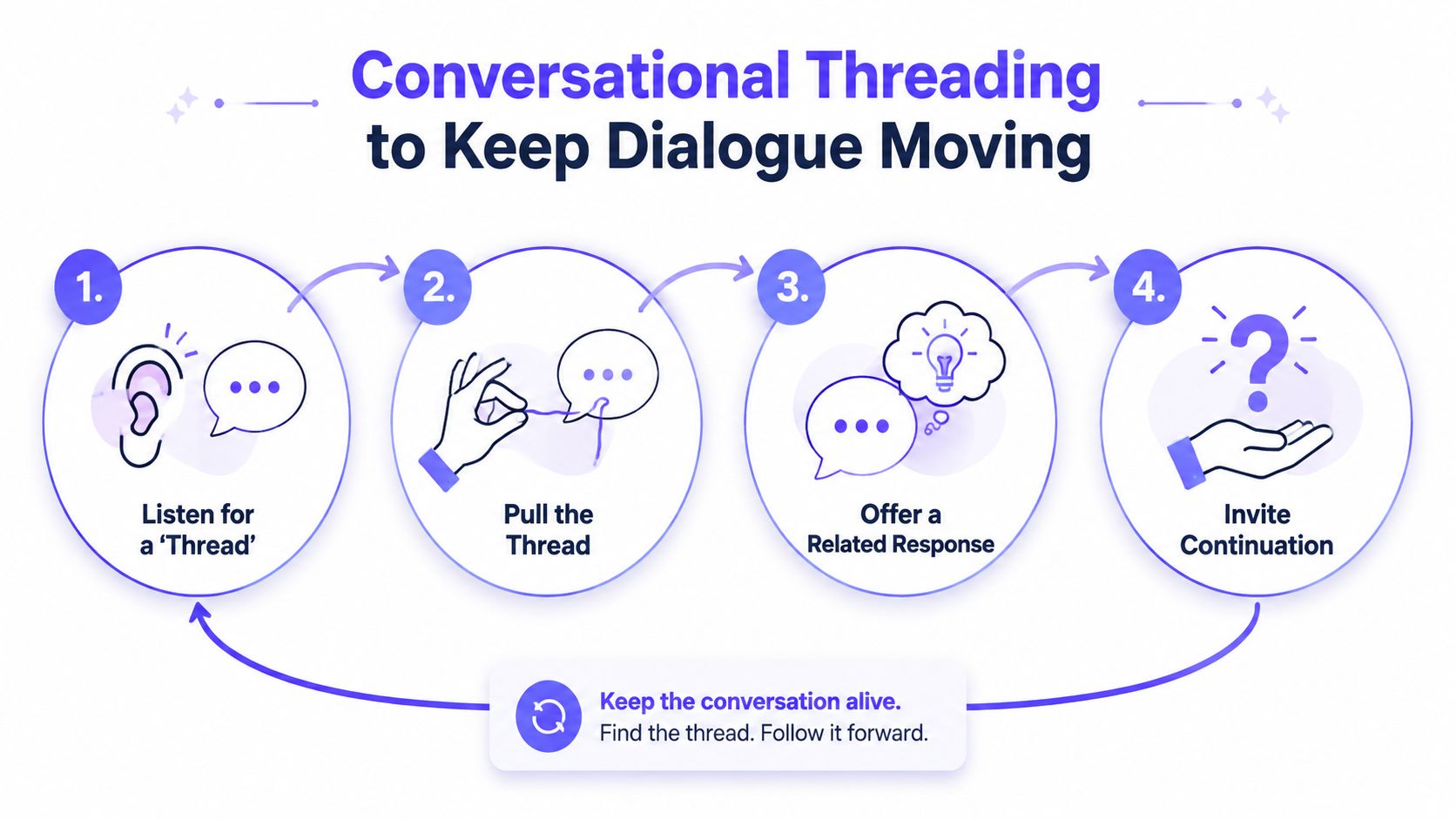
The most dependable way to keep a conversation alive is to thread the other person's last point into your next response. That means finding a concrete noun, detail, or implication in what they just said, then building a follow-up around that anchor instead of jumping to a new subject. The method prevents dead ends because it keeps the exchange tied to something the other person already cared enough to mention. Guidance on this approach also warns against over-rehearsing your own reply instead of tracking the speaker's intent, which is one of the fastest ways to stall a conversation. Practical threading advice gets this right.
The fastest version of threading
A usable sequence looks like this. Listen for the strongest content word, mirror it in a new question, then widen the lane with a second prompt that asks for explanation rather than a yes or no. That second prompt is what keeps the thread open.
A few examples make the pattern clearer:
- If someone says, “The rollout got messy,” follow with, “What part of the rollout caused the most confusion?”
- If someone says, “That client is very technical,” ask, “What does that change in the way you prep for the call?”
- If someone says, “The team is stretched,” respond with, “Where is the pressure showing up first?”
The point isn't to sound clever. It's to show the other person that their last point mattered.
Threading beats topic hopping
Random topic switches feel like loss of attention, even when the new subject is harmless. Threading creates continuity, which is what people usually mean when they say a conversation felt easy. The thread gives both people a shared object to work on, one turn at a time.
That matters in professional settings where scattered conversation kills momentum. It also matters in content settings, where editors, hosts, and repurposing teams often need to preserve conversational logic across platforms. A practical workflow for repackaging spoken material is to align the clip around a single thread, not around a vague theme. The BlitzReels resource on make podcast clips for TikTok is useful in that sense, because the clip cut should preserve the original turn-to-turn logic.
What usually breaks threading
The biggest failure is self-preparation. A speaker finishes, and the listener is already locked onto the response they wanted to give three sentences earlier. That's when people answer the wrong question, pull the conversation into themselves, or flatten a rich detail into a generic “That makes sense.”
Practical rule: if the other person gives you a specific noun, keep the noun alive for one more turn before you widen the topic.
That one habit changes the pace of the exchange. It makes the speaker feel heard, and it gives the conversation somewhere concrete to go next.
Active Listening and the Micro-Timing of Turn-Taking
Conversation sounds fluid because the timing is extremely tight. A 2022 review reports a median gap between turns of around 200 ms, less than 5% of the speech stream involves two or more simultaneous speakers, and an English telephone corpus found average turn durations of 1,680 ms with a median of 1,227 ms. The review makes clear that smooth dialogue depends on micro-timing, not just substance.
The practical lesson is uncomfortable for many people who think they listen well. Listening isn't just nodding, paraphrasing, or waiting for a pause. It's tracking pace, pressure, and the point at which the other person is handing over the floor. A speaker who slows down, drops volume, or finishes a sentence with a clean downward cadence is often yielding. A speaker who pauses mid-thought may still be building.
What to do in the first second after they finish
The best responses are usually short and responsive. A brief acknowledgment, a compact paraphrase, or a clarifying question keeps the rhythm intact. Long setup sentences create a visible gap, and visible gaps are what make conversations feel clumsy.
Use short verbal bridges:
- “Right, so the bottleneck was timing.”
- “That part sounds expensive in attention, not just effort.”
- “What happened after that?”
These responses don't steal the floor. They show that the listener is staying inside the speaker's rhythm.
Why timing matters more than polish
People often think a conversation gets awkward because the words were wrong. More often, the break happened because the response came too late, too early, or with the wrong amount of force. A slight delay can feel like hesitation. An immediate interruption can feel like impatience. A response that lands on beat feels like rapport.
That's why active listening has to stay observable. Watch the other person's tempo. Match the speed of their finish. Don't rush to fill silence that hasn't become silence yet. In audio work, this is similar to what repair tools try to fix after the fact, and the Isolate Audio repair guide is a useful reminder that even tiny distortions can change how clean a conversation sounds.
If the other person is still shaping the thought, let the thought finish. If they've already yielded, respond without building a speech.
That balance is a learnable skill. It's also one of the clearest markers of a person who can carry on a conversation without making it feel forced.
Handling Awkward Lulls and One-Sided Exchanges
A stalled exchange usually needs a reset, not a rescue mission. When the silence hangs, people start overcorrecting with interview-style questions, forced jokes, or a rapid switch to themselves. That rarely helps. A calmer move is to name something concrete in the shared environment, ask a broad open question, or suggest a fresh but low-pressure direction.
Consider a simple work-networking scenario. One person says, “It's been a packed quarter,” and then stops. The temptation is to fill the gap with a long personal story. A better move is, “What's taken the most energy lately?” That keeps the exchange open without turning it into a monologue.
When the exchange is all on one side
Not every one-sided conversation is the same. Sometimes the other person is distracted. Sometimes they're uncomfortable. Sometimes they're not skilled at reciprocal dialogue. Research-oriented conversation guidance emphasizes reciprocity, follow-up, and shared ground as the mechanism of good dialogue, which means imbalance is a real failure mode, not a moral judgment. The Psyche guide on meaningful conversations points to this gap clearly.
Signs of imbalance tend to be obvious. The other person gives short answers, never asks anything back, and lets your questions do all the work. At that point, the right move isn't to try harder forever. It's to decide whether the interaction is worth continuing.
How to exit without making it strange
The graceful exit preserves dignity on both sides. A direct but warm line works better than a sudden disappearance.
- “Good talking with you, I'm going to say hello to a few people before I head out.”
- “I'm going to grab another coffee, but I enjoyed this.”
- “Let's pick this up another time.”
Those exits are useful because they end the exchange without deception. They don't punish the other person, and they don't trap the listener in a failed effort to revive the moment.
For people trying to spot when they're carrying too much of the interaction themselves, this internal guide on monopolizing the conversation and how to stop it can be a practical mirror. The useful habit is not endless persistence. It's recognizing when the dialogue is no longer reciprocal and leaving cleanly.
Engineering High-Stakes Conversations with a Clear Framework
In sales calls, feedback meetings, and cross-functional disagreements, charisma isn't the control point. Structure is. A disciplined conversation workflow treats the exchange as an engineered process, with a purpose at the start and a summary at the end. Communication guidance from the University of Washington frames this as assess, plan, execute, close, and that sequence is practical because it forces the speaker to define the outcome before talking. The framework summary is refreshingly concrete.
The four phases that keep the meeting on track
The first phase is assessment. What's the context, who's in the room, and what tension already exists? The second phase is planning. What result matters here, and what would count as a useful next step?
The third phase is execution. That means talking, listening, clarifying, and redirecting tangents when they start to dominate. The fourth phase is closure. Summarize the shared understanding, state the next action, and make sure nobody leaves with a different version of the agreement.
Rehearsal is part of the conversation
The same guidance notes that rehearsal before the conversation can significantly improve the chance of reaching the intended result. That doesn't mean scripting every line. It means knowing the opening, the purpose, and the likely points of resistance before the call starts.
A few operational habits help in the room:
- Timebox the discussion so one issue doesn't absorb the entire meeting.
- Redirect tangents when they drift away from the goal.
- Stop dominant voices from taking over the conversation.
- Summarize before closing so the meeting ends with a shared next step.
These behaviors matter because the success measure isn't how much somebody spoke. It's whether the conversation produced clarity and action.
For teams that want a structured way to practice this kind of interaction, Overvue offers AI-powered roleplay conversations with virtual prospects, including live, unscripted sales conversations in real time, plus a screening interview tool with configured questions and recorded transcripts. That makes it easier to observe whether a rep can carry the conversation, not just sound polished. A related way to sharpen the same skill is using the Feynman Technique to explain the objective out loud before entering the call.
Navigating Difficult Conversations Across Differences and Conflict
Good conversation doesn't have to feel smooth. In fact, some of the most useful conversations are the ones that slow down, expose tension, and force both people to listen differently. Guidance on hard conversations emphasizes curiosity, norms, and bridge-building rather than performative ease, which is exactly the right frame when identity, disagreement, or emotional charge enters the room. The Berkeley Greater Good piece is a useful counterweight to all the advice that treats comfort as the main goal.
When a conversation hits a dead end, the worst move is to keep pushing for harmony. That often hides the actual issue. A better move is to acknowledge the point of agreement, name the difference without dramatizing it, and slow the pace enough to hear what the disagreement is really about.
Keep the conversation human when the topic gets hard
Difficult conversations need a different structure than casual small talk. They often require longer listening, shorter rebuttals, and a willingness to reset when the exchange starts to spiral. The goal isn't to win the frame. It's to preserve enough trust that the other person can keep talking.
A practical sequence looks like this:
- Acknowledge what's shared. Start with the part both people can stand on.
- State the difference plainly. Don't wrap the disagreement in soft vagueness.
- Ask what would make progress possible. That question shifts the exchange from debate to problem-solving.
- Pause when the limit is reached. Not every hard conversation should be forced to completion.
The last point matters most. Some conversations should be continued later, not intensified now. That's not avoidance. It's good judgment.
For sales teams, this matters in objection handling too. The most useful internal resource on handling objections in sales with proven strategies and scripts reinforces the same principle, objections aren't just resistance, they're a signal that the structure of the conversation needs to change.
If carrying on a conversation still feels harder than it should, Overvue helps teams practice the core mechanics, timing, follow-up, and next-step execution, in realistic AI roleplays that expose what people do under pressure. Visit Overvue to see how its conversation simulations and scoring can support sales hiring and training without relying on improvisation alone.