
A cold-call team can sit at an average 2.3% dial-to-meeting success rate while top-performing teams reach 6% to 10%, according to a 2026 outbound sales benchmark. That gap isn't explained by motivation alone. It usually reflects differences in list quality, connection strategy, opening language, objection handling, qualification, and the consistency of practice.
Effective cold calls training treats those differences as measurable production problems. Instead of handing reps a script and hoping confidence follows, sales leaders can identify where calls fail, isolate the behavior behind the failure, and build repeatable drills around it. The result is a training system tied to connect rates, conversations, meetings, and qualified pipeline.
Why Most Cold Call Training Fails to Move Metrics
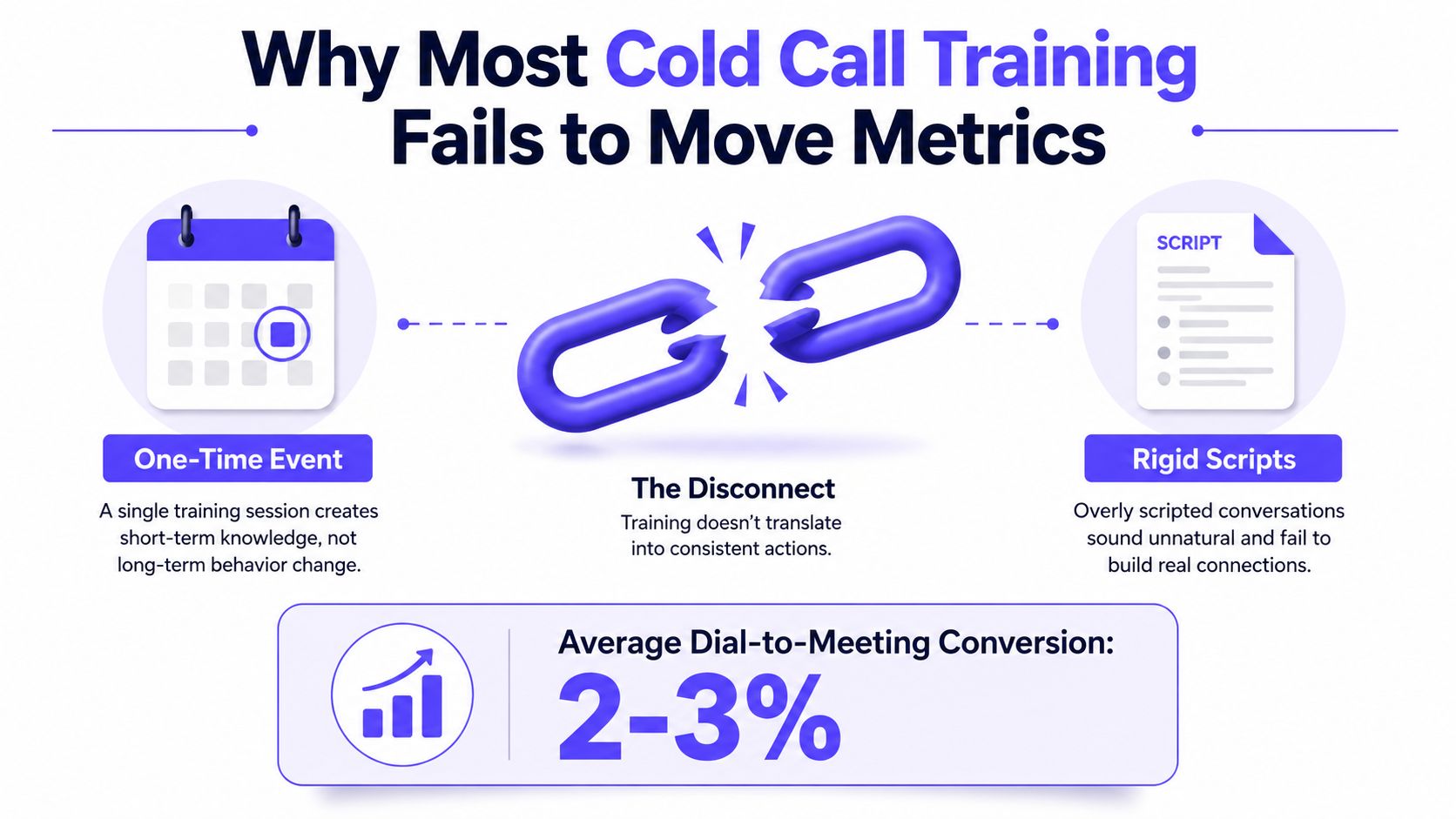
A cold call training program often begins and ends as an event. New hires attend a workshop, receive a script, complete friendly roleplays, and start dialing. Managers review calls only after performance falls, by which point weak conversations may already be affecting the pipeline.
The underlying problem is simple: a script is not a skill. Memorizing an opener can prevent a rep from freezing, but it does not prepare them for an interruption, a relevance challenge, a time objection, or a request for a clear reason to continue. Occasional roleplays produce the same gap when they lack the pressure, timing, and variation of live calls.
The benchmark cited earlier shows why training needs a production view. Average cold-call success is about 2.3%, while top teams reach 6% to 10%, and connect rates commonly range from 15% to 28%. Those figures point to two different operating problems. Too few prospects may answer, or reps may fail to turn live answers into meetings.
The difference between instruction and production control
Instruction describes what effective calling sounds like. Production control identifies where performance breaks, assigns a targeted intervention, and checks whether the result improves.
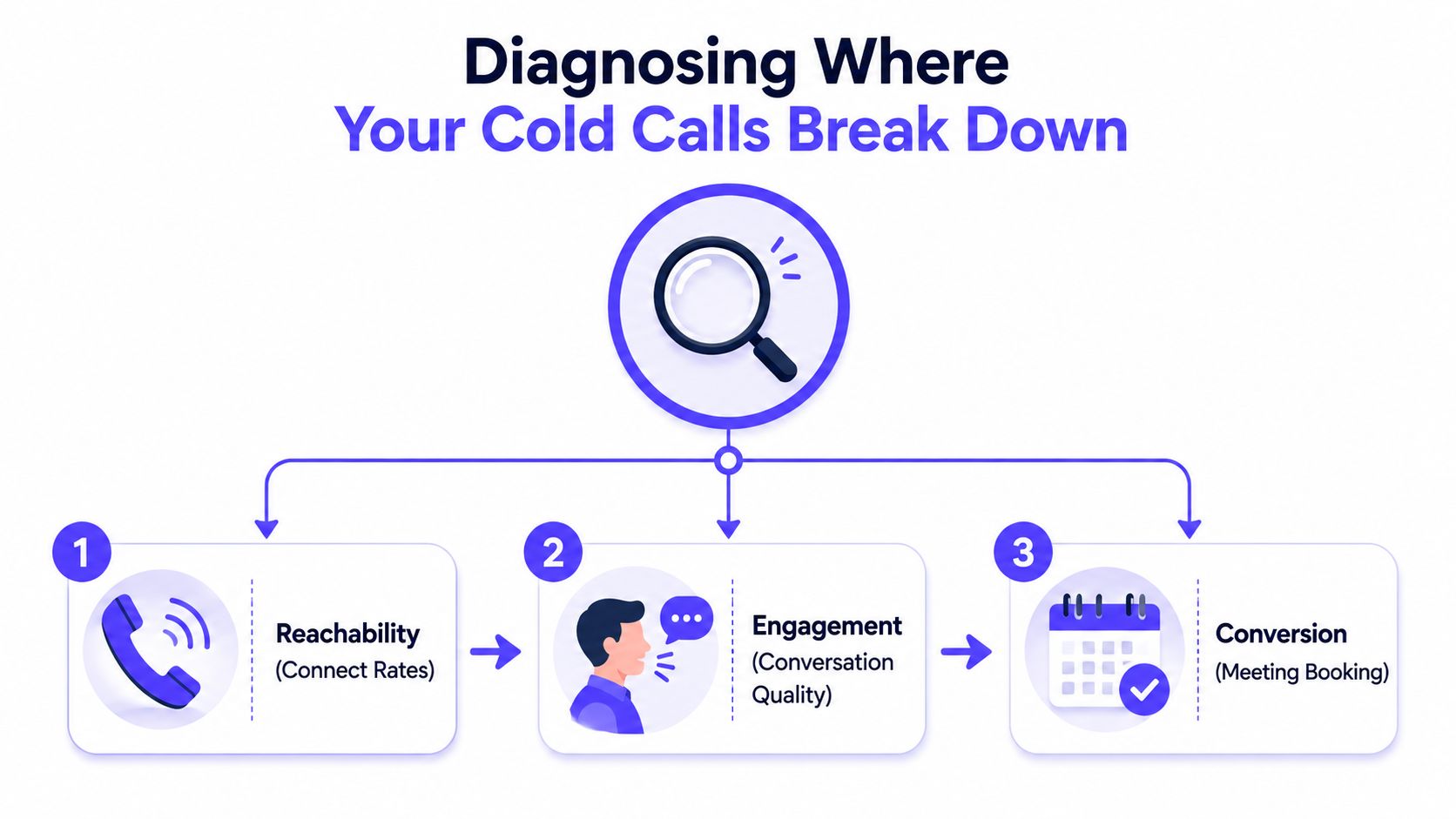
A useful cold calls training program separates the call into observable stages:
- Reachability: Does the list generate enough live connections?
- Engagement: Does the opener earn a real conversation?
- Progression: Can the rep move from the first response into discovery?
- Conversion: Does the rep establish a relevant next step?
- Qualification: Does the meeting represent a credible opportunity rather than calendar activity?
How to build sales skills that stick requires repeated exposure to one behavior, immediate feedback, and a defined standard for improvement. “Sound more confident” gives a rep little to practise. A useful observation identifies the moment, the behavior, and the replacement: after a prospect says they already have a provider, the rep accepts the objection instead of asking what the current process fails to address.
Why scripts and call reviews aren't enough
Generic scripts flatten differences between personas, industries, business conditions, and priorities. A finance leader, operations director, and technical buyer may raise the same objection for different reasons, so one response cannot serve all three.
Call reviews also become inconsistent when managers score against personal preferences. One rewards brevity, another rewards rapport, and a third focuses on product knowledge. Reps leave with conflicting instructions and no stable practice target.
The practical fix is a small scorecard of defined behaviors. Establish a baseline, select one behavior, practise it in context, review call evidence, and check whether the related downstream metric changes. That loop turns training from a calendar event into a measurable operating system.
Diagnosing Where Your Cold Calls Break Down
Before changing a script, identify the earliest measurable failure. A low meeting rate may result from inaccurate data, weak reachability, an ineffective opener, poor objection handling, or weak qualification. Each problem needs a different intervention. Treating them as one training issue wastes practice time and obscures the metric that should improve.
Ask one diagnostic question first: Where does the funnel stop?
Start with four operating metrics
Connect rate measures whether a dial reaches a live prospect. If it stays weak across the team, objection-handling practice addresses the wrong constraint. Inspect title accuracy, phone validity, calling windows, territory rules, and whether target accounts fit the ideal customer profile.
Conversation rate measures what happens after connection. Counting every live answer can hide calls where the rep delivers only a greeting before the prospect ends the call. Define a meaningful exchange, then compare results by persona, list source, and opener.
Meeting-set rate shows whether conversations progress to a scheduled next step. A weak result can indicate unclear relevance, weak qualification, or a rep who responds to objections without asking for a specific action.
Time-to-first-objection exposes early control problems. If prospects object before the rep explains the reason for calling, and reps regularly lose the call at that point, improve the opener before adding more objection scripts.
Use recordings to separate list, message, and skill problems
Review calls by outcome, not only the most dramatic recordings. Use the same questions for each sample:
- Before the conversation: Was the account a credible fit, and was the contact information usable?
- In the opening: Did the rep state the reason for calling quickly and connect it to a plausible business issue?
- After resistance: Did the rep acknowledge the response, ask a relevant follow-up, and restore direction?
- Before the close: Did the rep confirm fit and request a clear next step?
- After the meeting: Did the scheduled conversation meet the team's qualification standard?
Weak data creates a reachability problem. Generic messaging creates an engagement problem. Inconsistent execution creates a skill problem. That separation determines the intervention. Rewriting copy will not repair a bad list, and additional roleplay will not repair a poor targeting decision.
Rank interventions by the earliest repeatable break. If prospects rarely answer, improve data and connection strategy first. If they answer but leave during the opening, practise reason-for-call statements and early call control. If conversations continue but meetings remain scarce, focus on qualification and next-step execution.
Practical rule: Train the earliest repeatable failure before training the most visible objection.
Building Scripts That Start Conversations
A cold-call script should guide decisions during a live exchange. Reps need enough structure to stay relevant, with enough flexibility to respond to the person on the other end.
A strong opening usually has three parts: a concise reason for the call, a business hypothesis, and a question that lets the prospect confirm or correct the assumption. Long product descriptions and company credentials rarely earn that first response.
Replace permission seeking with relevant context
A weak opener sounds polite but gives the prospect an easy exit:
“Hi, this is Sam from a software company. Is now a bad time?”
The issue is not politeness. The line gives the prospect no reason to continue, and widely cited call-coaching findings associate the weak “Is now a bad time?” opener with a substantial reduction in meeting-booking odds, described as about 40% in HubSpot's summary of cold-calling research.
A stronger version establishes relevance before asking for effort:
“Sam calling from a software company. Teams with a distributed sales process often lose visibility when managers review calls manually. The reason for calling is to understand how your team handles that review today. How are reps currently assessed?”
The second version presents a testable hypothesis rather than claiming the prospect has a confirmed problem. That distinction protects credibility and gives the buyer a natural way to correct the rep.
Collaborative language positions the call as a joint diagnosis. Research on successful calls notes that a clear reason for calling and collaborative language support stronger conversations, while successful calls lasted roughly twice as long as unsuccessful ones, about 5:50 compared with 3:14.
Build modular components
A working script library should include interchangeable modules:
- Persona context: the operational issue commonly associated with the role.
- Reason for calling: one sentence explaining why this prospect received the call.
- Value hypothesis: a possible consequence or improvement, stated without pretending certainty.
- Discovery prompt: a question that tests the hypothesis.
- Objection bridge: a short response that turns resistance into useful context.
- Next-step ask: a specific action tied to what the prospect shared.
Reps should rehearse the sequence and decision points rather than memorize every word. Teams looking for a deeper framework can use this resource to create better sales scripts, then adapt the structure to real call recordings instead of copying generic language.
The transition into discovery matters as much as the opener. After a prospect answers, the rep should avoid launching into another product explanation. A question such as, “Where does that process create the most friction for managers?” keeps the conversation directed while showing that the rep is listening for operational detail.
More practical attention-getter hooks that convert can help teams build opening options, but each hook still needs a credible reason for the call. Curiosity without relevance creates another interruption. Review response rates and conversation outcomes by opener, then keep the versions that produce better-quality discovery rather than just longer calls.
Designing Roleplay Scenarios That Build Real Skills
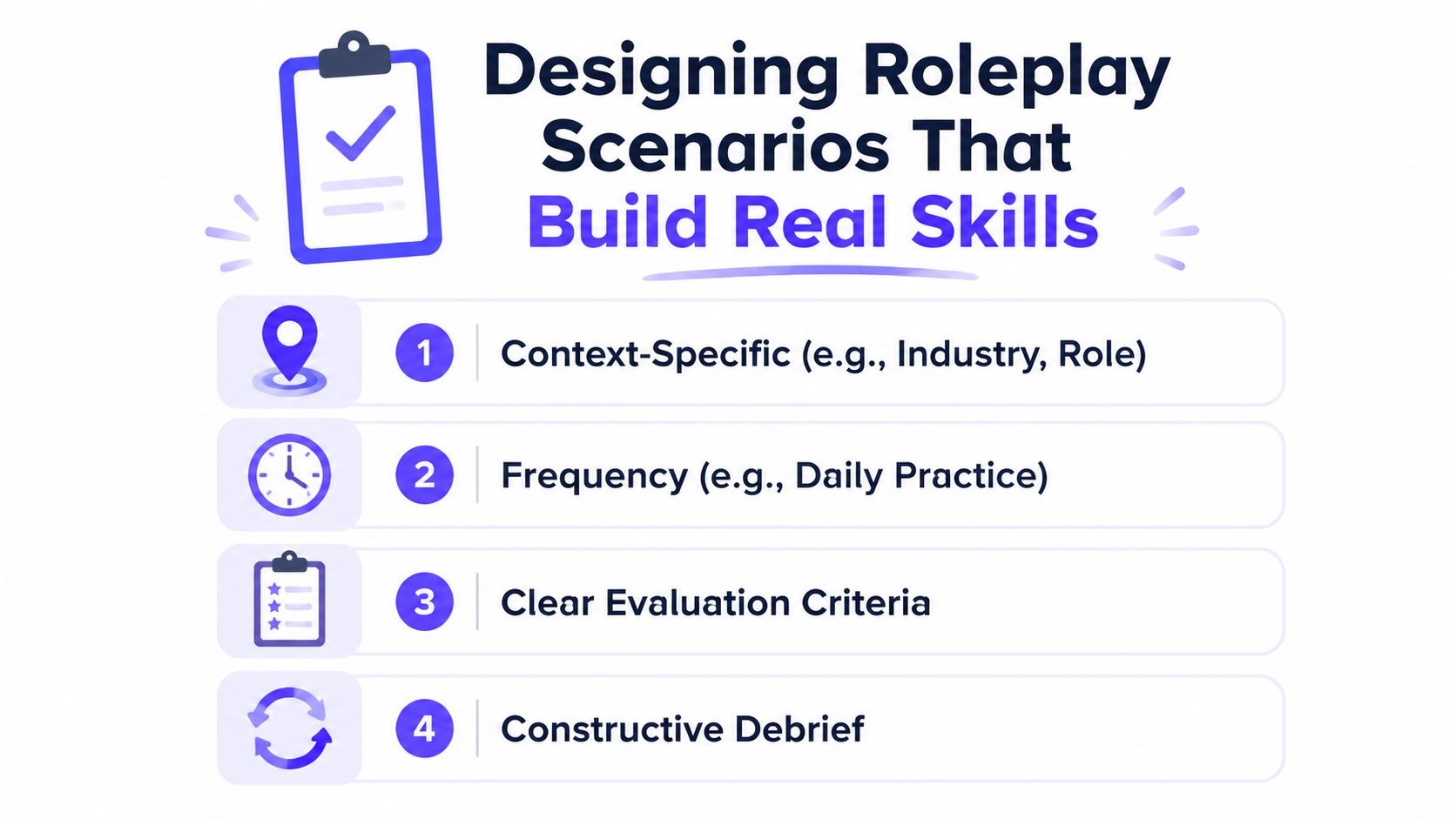
Roleplay produces weak results when a rep is told to “make a cold call.” Without a defined buyer, business context, objection, and success condition, the exercise measures improvisation instead of a specific selling behavior. A useful simulation recreates a moment found in real call recordings and gives the rep one skill to execute under pressure.
Begin with the prospect's context. Define the industry, role, likely priority, current approach, relevant competitor, and the information the buyer will disclose only after a strong question. Select one primary challenge, such as “not interested,” “no time,” or “we already have a vendor.” A fuller framework for designing, running, and scoring these simulations is available in our article on role-play for sales.
Build scenarios around call moments
A scenario can open with a prospect interrupting after the rep's first sentence. Another can require a response when an operations leader says the current provider works well. For advanced practice, add a second stakeholder, a competing internal priority, or a buyer who accepts the problem but declines to schedule time.
Each scenario needs a pass condition describing observable behavior rather than personality traits:
| Skill being tested | Observable standard |
|---|---|
| Reason for call | States one relevant business hypothesis without excessive product detail |
| Call control | Handles an interruption and returns to a useful question |
| Objection handling | Clarifies the objection instead of arguing with it |
| Qualification | Tests whether the problem, impact, and ownership are real |
| Next-step execution | Requests a defined next action connected to the conversation |
The scorecard should also list behaviors the rep must avoid. Examples include stacking several value claims, apologizing repeatedly, treating a reflex objection as final, or booking a meeting without confirming relevance.
Make feedback immediate and specific
Feedback works best through a short, repeatable sequence. The rep explains the intended move. The coach identifies the exact call moment, describes the observed behavior, and asks the rep to replay it with a narrower alternative.
“You need to be more assertive” gives the rep no usable adjustment. “When the prospect said they already had a vendor, you moved straight to a product comparison. Ask what the current vendor handles well and where the process still creates work” identifies the behavior to rehearse.
Peer roleplay helps develop empathy and live listening, but results vary by partner and manager time is limited. AI-powered simulations add consistent scoring, repeatable practice, and variation across buyer personas. Overvue provides live simulated sales conversations with AI buyers modeled on an organization's ideal customer profile, then scores objection handling, call control, responsiveness, and next-step execution.
Increase difficulty in stages:
- Foundation: Deliver a clear opener and reason-for-call statement.
- Resistance: Handle one early objection and ask a required follow-up question.
- Qualification: Elicit information that appears only after effective discovery.
- Complexity: Manage multiple objections, stakeholders, or deal-stage constraints.
- Transfer: Apply the skill on live calls and review the recording.
The goal is measurable behavior transfer. Reps should leave each exercise knowing what they changed, what standard they must meet, and how the behavior should appear in the next real conversation.
Why Daily Practice Beats Occasional Training Sessions
A team that practices only during onboarding treats cold calling as knowledge transfer. A team that practices frequently treats it as a performance discipline.
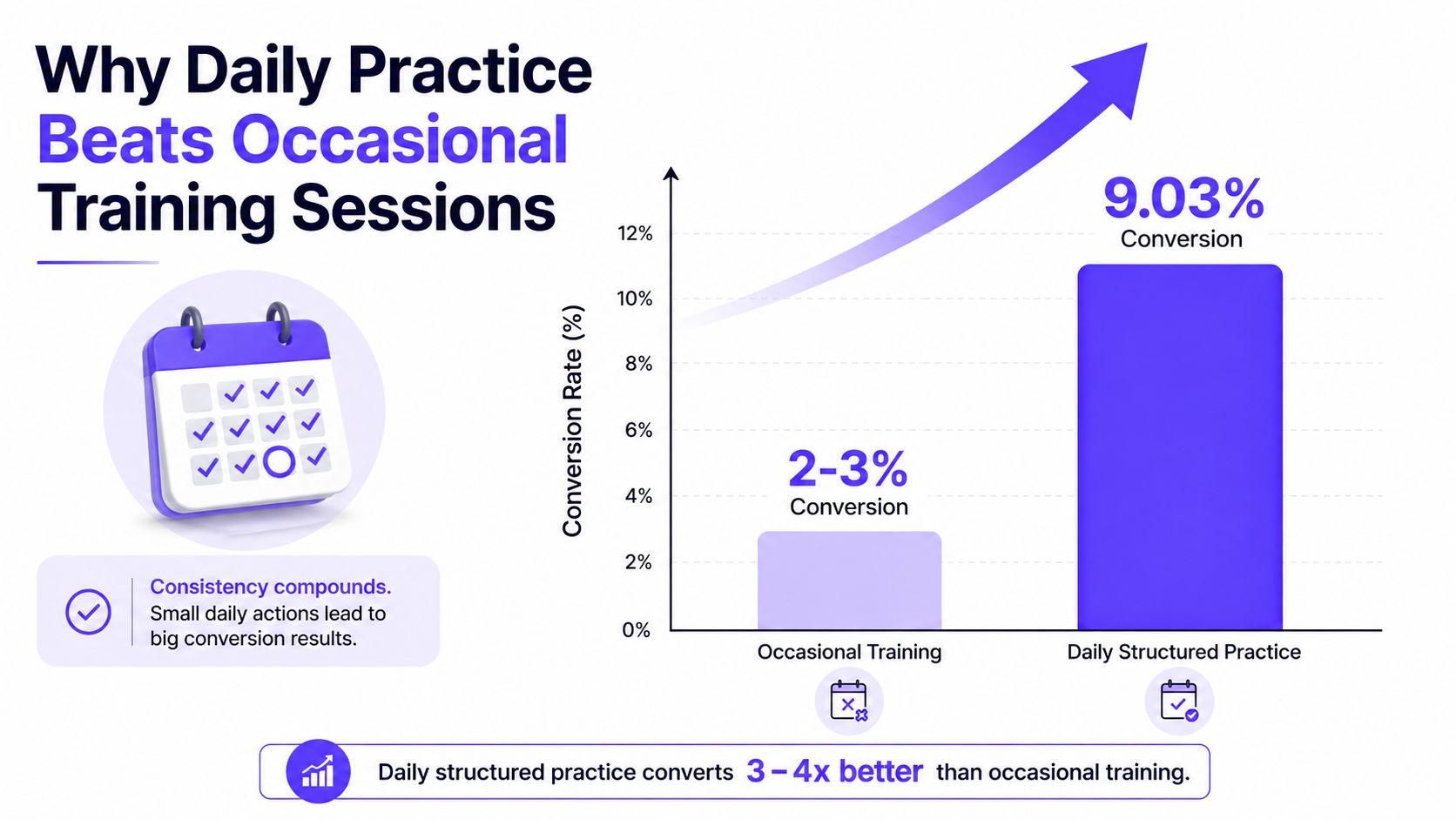
The available 2026 research supports that distinction. One sales research summary reports daily training associated with 9.03% cold-call conversion, compared with an industry average of 2.35%, while weekly training is associated with 3.54%. The same source reports training tiers ranging from 1.10% with no formal training to 4.64% with elite customized continuous training, although those figures should be treated as benchmark estimates rather than a guarantee for every team.
Keep practice short, focused, and connected to live work
Daily practice doesn't mean replacing calling hours with endless workshops. It means creating a dependable rehearsal loop that targets one behavior at a time.
A practical cadence can include:
- Opening drill: Reps deliver a reason-for-call statement for one persona, then revise it after quick feedback.
- Objection drill: Each rep responds to one realistic objection and asks a progression question.
- Recording review: The team examines a short call segment and labels the behavior that helped or blocked progress.
- Live application: Reps use the practiced behavior in current calls and mark the outcome.
- End-of-day reflection: Each rep records one moment to repeat and one moment to improve.
The drills should change as proficiency develops. New reps need structure and repetition. Experienced reps need variation, compressed preparation, difficult personas, and scenarios that force them to qualify rather than chase every meeting.
Consistency beats intensity when the skill depends on timing, language, and judgment.
Avoid the burnout trap
Daily practice fails when leaders turn every session into a public performance or rank reps on raw activity. A leaderboard can create energy, but it can also encourage shallow calls, premature meeting requests, and avoidance of difficult accounts.
Managers should reward process quality alongside outcomes. Useful signals include whether reps stated a clear reason for calling, handled the first objection without surrendering control, asked a relevant question, and documented qualification accurately. Team-only competitions can maintain engagement without making every mistake feel like a permanent label.
Peer coaching partnerships also extend manager capacity. One rep can listen for opening clarity while another tracks objection progression, then both compare notes against the same scorecard. Managers review patterns rather than trying to attend every practice call.
The central operating principle is simple: practice frequency creates more opportunities for feedback, and feedback gives reps a faster route from awareness to reliable execution.
Measuring What Improves from Training
Training decisions should start with a baseline, not a workshop calendar. Capture current connect rate, conversation quality, meeting-set rate, objection progression, and qualification before changing the program. Without that reference point, higher activity can look like better selling.
Build a measurement chain from drill to behavior to business outcome. Opener practice should show up in early conversation progression. Qualification practice should show up in meeting quality and later pipeline movement. Each exercise needs a defined signal that managers can score consistently.
Use a layered scorecard
A practical scorecard combines leading and lagging indicators:
- Reachability: Connect rate by list source, persona, and account segment.
- Engagement: Whether the rep earns a substantive exchange after connection.
- Conversation quality: Clear reason for calling, relevant questions, listening, and call control.
- Conversion: Objection-to-meeting progression and next-step clarity.
- Business value: Qualified meetings, pipeline creation, and eventual revenue attribution.
Call recordings show whether the target behaviors occurred. CRM data shows whether those behaviors transfer into live outcomes. Simulation analytics add repeatable practice data, particularly for new hires whose live results need time to stabilize.
Compare cohorts, not isolated wins
One strong week cannot establish that training worked. Compare pre-training and post-training performance across a defined group, while separating changes in territory, list quality, offer, seasonality, and manager coverage. The purpose is to test whether a repeatable intervention appears to move its intended metric, not to assign every improvement to training.
A useful review asks:
- Did the target behavior improve in scored calls?
- Did the related funnel stage improve afterward?
- Did meeting quality improve, or did reps just book more calendars?
- Which personas or objections still produce weak outcomes?
- Has performance plateaued because the drill is too easy, too broad, or disconnected from live work?
The outbound benchmark places typical B2B cold-call-to-meeting conversion around 2% to 3% and top performance around 6% to 10% or higher. Use that range for context, then judge the program against its own baseline, target segment, and qualification standard.
Measurement principle: A training metric matters only when it helps a manager decide what to practice next.
When performance stalls, adding content may not solve the problem. The program may need better scenarios, cleaner data, a sharper ICP, stronger manager calibration, or a drill aimed at the earliest remaining failure. A mature cold calls training program keeps this loop active, turning call evidence into practice priorities and practice results into business decisions.
Overvue gives sales teams a way to rehearse unscripted conversations with AI buyers modeled on their ideal customer profile, then score objection handling, call control, responsiveness, and next-step execution against consistent criteria. Visit Overvue to see how structured simulations can support daily cold calls training, onboarding, and measurable coaching.