

Last updated: March 2026
Hiring the wrong Sales Development Representative costs more than a missed quota. It burns pipeline, wastes ramp time, and erodes client trust, especially when you are placing reps on behalf of other companies. A structured SDR assessment replaces guesswork with data, giving you objective proof of a candidate's ability before they ever pick up the phone.
This guide walks you through the complete framework for building a modern SDR assessment process: the core competencies to measure, the metrics that actually predict quota attainment, and how AI-powered sales assessment tools are helping teams evaluate candidates at scale. Whether you run an in-house sales team or manage SDRs across multiple client accounts, you will learn how to identify top talent faster and with far less risk.
What Is an SDR Assessment?
An SDR assessment is a structured, performance-based evaluation designed to measure a candidate's ability to execute the fundamental tasks of a Sales Development Representative. Unlike traditional interviews that rely on self-reported experience, an assessment requires candidates to demonstrate skills in real-time scenarios: cold calling, email outreach, lead qualification, and objection handling.
By simulating the actual daily workflow, companies can identify high-potential talent based on measurable output rather than a polished resume. Think of it as a sales skills assessment test specifically designed for the SDR role, measuring the exact skills that drive pipeline generation. This matters even more for SDR management and outsourcing companies that need to vet candidates at volume before placing them with clients. When your reputation depends on the reps you deploy, a sales assessment test becomes the foundation of your quality control.
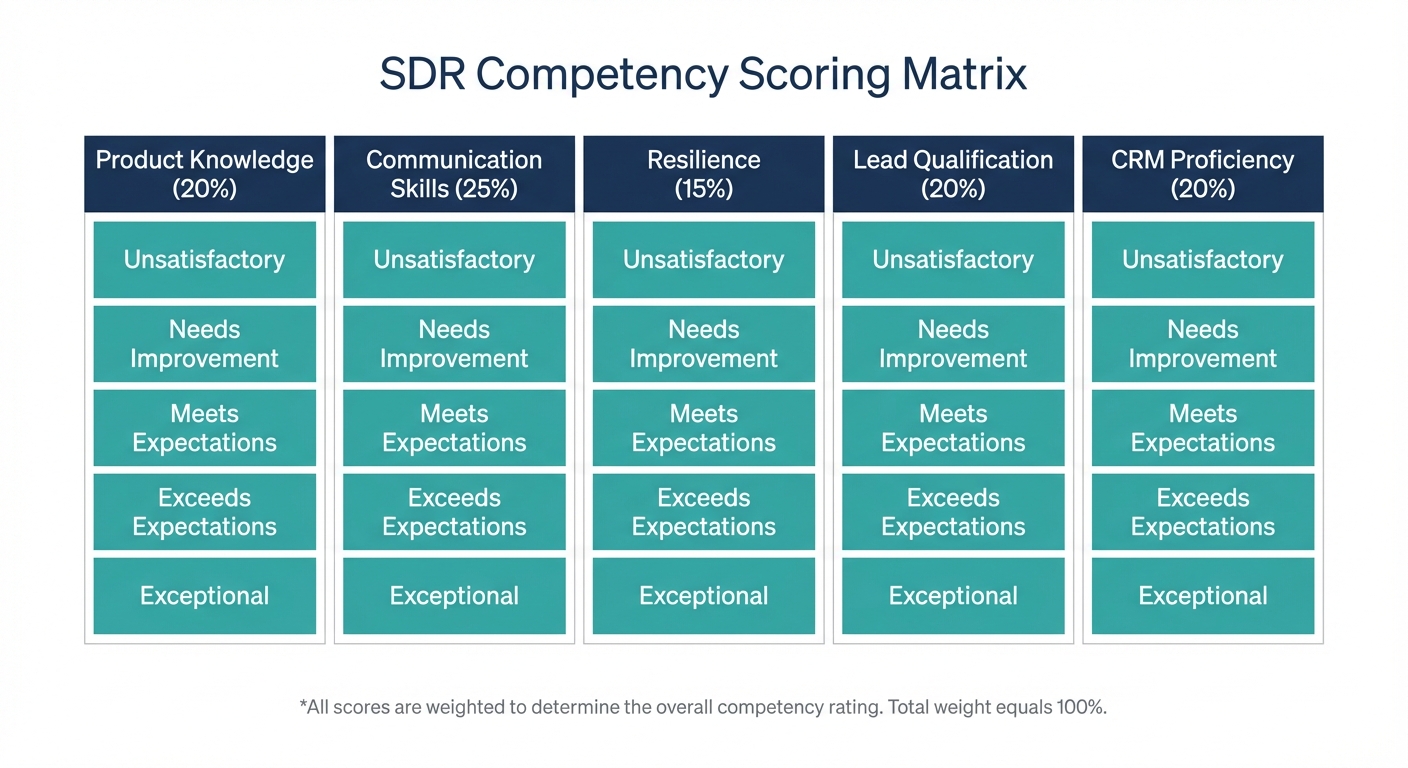
Core Competencies a Sales Skills Assessment Test Should Measure
The core of any SDR assessment must center on the three pillars of the role: prospecting, outreach, and lead qualification.
- Prospecting: Evaluate the candidate's ability to identify best-fit accounts, find relevant contacts, and prioritize based on intent signals. This goes beyond knowing how to use LinkedIn. You want to see research depth and strategic thinking.
- Outreach: Test effectiveness across multiple channels. Can they craft personalized emails that earn replies? Can they maintain energy and build rapport during cold calls? Multi-channel fluency is non-negotiable.
- Lead Qualification: Measure how well a candidate identifies pain points and applies frameworks like BANT or MEDDIC to ensure only high-quality opportunities reach Account Executives.
Beyond these three pillars, an effective sales skills assessment test should also capture:
- Communication clarity: Articulating value propositions concisely across written and verbal channels
- Resilience and grit: Handling rejection without losing energy or professionalism
- Coachability: Taking feedback during a roleplay and immediately applying it
- Research skills: Gathering deep prospect insights rather than relying on generic templates
- Time management: Balancing high-volume activity without sacrificing interaction quality
Why SDR Management Companies Need Structured Assessments
If you run an SDR outsourcing or management company, your entire business model depends on deploying reps who perform from day one. Your clients are paying for pipeline, not for ramp time. This creates a unique set of challenges that make structured SDR assessments essential:
Screening at Volume
SDR management firms typically hire and place far more reps than a single in-house team. You might be evaluating dozens of candidates per week across multiple client engagements. For software sales interview questions, consider... A standardized sales candidate assessment process ensures consistent quality without burning out your hiring managers.
English Proficiency Pre-Screening
For companies running nearshore or offshore SDR teams, verifying English communication skills is critical before a rep ever touches a client account. AI-driven assessment platforms can evaluate pronunciation, fluency, vocabulary range, and comprehension during simulated sales conversations, catching language gaps that a text-based resume would never reveal. This pre-screening step alone can save weeks of wasted training and protect client relationships.
Training Across Product Switches
SDR management companies frequently rotate reps between clients or onboard the same rep onto multiple products simultaneously. Each product has different buyer personas, objection sets, and value propositions. Traditional training methods cannot keep up with this pace. AI-powered sales training tools let reps practice realistic conversations with custom-built AI buyers for each specific product, ramping them on a new account in days rather than weeks. This flexibility is what separates scalable SDR operations from ones that collapse under client churn.
The Structure and Timing of a Modern SDR Assessment
A structured assessment ensures every candidate is evaluated against the same benchmarks, removing bias and providing a data-driven foundation for talent decisions.
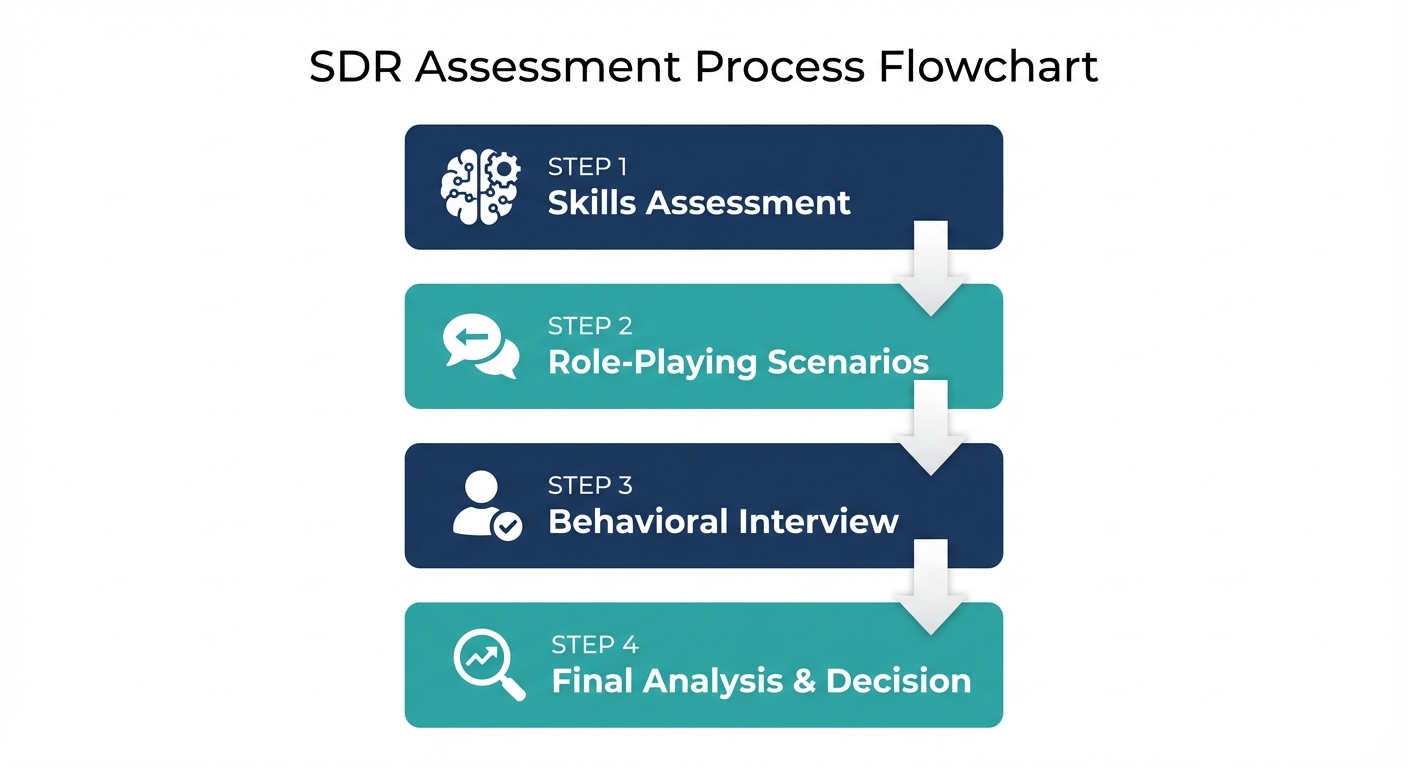
Recommended Assessment Flow
- Initial Screen: Automated pre-screening to filter for baseline qualifications, communication skills, and (where relevant) English language proficiency. This step alone can reduce your candidate pool by 40-60%, saving significant time downstream.
- Performance Simulation: The core of the SDR assessment. Candidates engage in AI-driven sales roleplay simulations, cold call practice scenarios, or email writing exercises that mirror the actual selling scenarios they will encounter.
- Scorecard Review: Structured evaluation using a consistent sales interview scorecard to compare candidates objectively across all competencies. This sales hiring assessment step ensures every evaluator is scoring against the same criteria.
- Cultural Fit: Final-stage interviews focused on alignment with company values, long-term career trajectory, and (for outsourced SDR teams) adaptability to working across different client environments.
Timing and Duration
Efficiency is critical in a competitive hiring market. If an assessment is too demanding, top-tier talent drops out. If it is too brief, you lack the depth to predict performance.
A balanced SDR assessment typically takes between 30 and 60 minutes. This window allows time for multiple roleplay scenarios, including objection handling and discovery, without causing candidate fatigue. AI-driven platforms let candidates complete these steps asynchronously, significantly reducing time-to-hire while maintaining evaluation quality.
Key Metrics for Scoring SDR Performance
To move beyond gut feeling, organizations must score candidates against specific behavioral benchmarks. The following metrics are essential:
- Lead Response Time: Speed of initial contact after a lead is assigned or trigger event occurs. High performers maintain rapid, consistent response cadences.
- Objection Handling Success Rate: The ability to navigate common pushbacks ("no budget," "not the right time") and pivot toward a meeting or next step.
- Research Depth: Quality of pre-outreach preparation. Look for evidence of prospect-specific analysis, not generic template usage.
- Tone Consistency: Maintaining a professional, empathetic demeanor throughout multi-touch sequences and high-pressure discovery calls.
Assessment Scores vs. Quota Attainment
Data from top-performing sales organizations shows a direct link between assessment scores and long-term production:
| Skill Area | Assessment Score | Avg. 6-Month Quota Attainment |
|---|---|---|
| Objection Handling | High (90%+) | 112% |
| Objection Handling | Low (<60%) | 64% |
| Research Depth | High (90%+) | 105% |
| Research Depth | Low (<60%) | 72% |
| Response Time | High (90%+) | 118% |
| Response Time | Low (<60%) | 55% |
| Tone & Professionalism | High (90%+) | 98% |
| Tone & Professionalism | Low (<60%) | 78% |
SDRs who demonstrate mastery in objection handling and research depth early on build higher-quality pipelines that convert into closed business. When you use an AI-driven sales assessment to benchmark these metrics, you eliminate human bias and ensure only candidates with the highest probability of hitting their numbers progress through your funnel.
Organizations using structured assessments typically see 40-60% higher retention rates, as reps who hit quota early stay engaged and grow within the company.
What Employers Look for in High-Potential SDR Candidates
While technical skills can be trained, the underlying traits that drive success in a high-rejection environment are often innate or deeply ingrained.
Process Understanding
High-potential SDRs treat sales as a science, not luck. Process understanding means recognizing that consistent outreach, structured follow-ups, and data-driven adjustments are the path to reliable quota attainment. Candidates who demonstrate this competency can manage their own pipeline without constant supervision, following playbooks and maintaining CRM hygiene for accurate forecasting.
Resilience and Grit
The SDR role involves more rejection than almost any other position in a sales organization. Resilience is the strongest predictor of SDR retention. Candidates who view rejection as a standard part of the workflow, not a personal failure, are the ones who maintain energy on their 50th cold call of the day. A well-designed sales personality test or sales talent assessment can help surface these traits before a hire is made.
Curiosity
Great SDRs do not recite scripts. They act as consultants, uncovering a prospect's true business challenges through thoughtful "why" and "how" questions. Curiosity leads to better discovery, higher-quality leads, and a pipeline filled with opportunities that actually close.
Common SDR Interview Questions and How to Evaluate Responses
Whether you are a candidate preparing for an assessment or a hiring manager designing one, these question categories cover the critical areas. Use the STAR method (Situation, Task, Action, Result) to structure both questions and responses, tying results to quantifiable sales metrics.
Tactical Sales Questions
These evaluate fundamental understanding of the sales development process:
- "How do you handle a prospect who says, 'I'm too busy, just send me an email'?" Look for call control. The candidate should acknowledge the prospect's time while delivering a concise value statement that earns a follow-up.
- "Walk me through your lead research process before making a cold call." Look for specific triggers (funding rounds, job changes, LinkedIn activity) and an explanation of how targeted research improved connect rates or meeting-booked ratios.
Resilience and Coachability Questions
- "Tell me about a time you missed your monthly quota. What did you do?" Strong candidates take ownership, analyze root causes, and describe specific pivots that improved results the following month. Red flag: blaming external factors.
- "What is the most difficult feedback you've received, and how did you implement it?" Look for concrete examples of behavior change, not vague platitudes about being open to feedback.
Motivation Questions
- "What motivates you to hit your numbers during a bad week?" Look for intrinsic drivers, competitive nature, or career progression goals tied to daily activity.
- "How do you manage your time to hit daily activity KPIs?" Look for a clear methodology: time-blocking, prioritizing prime calling hours, and batching administrative tasks.
For a deeper library of questions, see our complete guide to sales interview questions.
The Reverse Interview: Questions Candidates Should Ask
The assessment is not a one-way street. High-performing candidates evaluate whether your organization provides the environment for them to succeed:
- "What percentage of the current SDR team is hitting quota?" If attainment is consistently below 60-70%, it may indicate issues with lead quality, targets, or training.
- "What does the tech stack look like?" Candidates want modern tools: CRM, sequencing platforms, and AI-powered coaching and assessment software.
- "What is the typical timeline for promotion to AE?" Top SDRs are career-motivated. They look for a documented 12-18 month pathway based on performance milestones.
- "What does onboarding and ongoing training look like?" Beyond the initial assessment, candidates want to see commitment to continuous development.
- "How are territories and lead distributions handled?" This reveals fairness and whether reps have an equal playing field.
How AI-Powered Assessments Improve Sales Hiring
The integration of AI into sales hiring transforms the process from subjective evaluation to objective, data-driven decision-making. Advanced sales assessment tools capture performance metrics before a candidate ever speaks to a recruiter. By implementing realistic simulations, sales leaders can identify which candidates have the resilience and skill to succeed in the role.
Key advantages of AI-driven SDR assessments:
- Eliminates bias: Automated simulations evaluate every candidate against standardized benchmarks, focusing on skill and potential rather than background
- Scales effortlessly: Whether you are hiring 2 reps or 20, the assessment process remains consistent. This is especially valuable for SDR management companies running multiple client programs simultaneously
- Reduces recruiter burnout: Automating initial screening frees hiring teams to focus on engaging and closing high-potential talent
- Validates language skills: For global SDR teams, AI simulations naturally surface communication gaps, including English proficiency, accent clarity, and professional vocabulary
- Enables rapid product ramp: Reps can practice with custom AI buyers modeled on each client's ICP, accelerating onboarding when switching between products or accounts
Ready to see how AI-driven sales simulations can provide the objective data you need to hire high-potential SDRs? Try Overvue's sales assessment platform and evaluate candidates through realistic, unscripted conversations with AI-generated buyers. Whether you are running a single sales test for an in-house hire or deploying sales assessment tests across an entire outsourced SDR program, Overvue scales with your team.
SDR Assessment FAQs
Is it common to have a "sell me this" roleplay in an SDR assessment?
While the "sell me this pen" trope is a classic interview cliche, modern SDR assessments focus on realistic B2B scenarios. You are much more likely to encounter roleplays involving booking a meeting or qualifying a lead for a specific product. These simulations test your ability to uncover pain points and follow a discovery process rather than using high-pressure tactics.
How do I prepare for a cold call simulation?
Research the company's value proposition and target persona thoroughly before the session. Practice a concise opening statement focused on prospect problems, and prepare responses for common objections. Recording yourself during practice sessions helps identify filler words and refine your tone. AI-powered cold call practice tools can give you unlimited reps in a realistic, low-stakes environment.
What is the most important skill to demonstrate?
Coachability often outweighs pure sales technique. Hiring managers look for candidates who take feedback from a mock call and immediately apply it on the next attempt. Demonstrating adaptability shows long-term growth potential, even if your initial pitch is not perfect.
Do SDR assessments include a written component?
Many hiring teams include a written assignment to evaluate outreach email skills. These tasks measure research ability and the capacity to communicate value clearly without sounding like a generic template. Pay close attention to grammar and formatting, as these details reflect professionalism when representing a brand to potential clients.
How can I show grit during a sales interview?
Share specific examples of overcoming significant challenges. During simulations, maintaining a positive attitude after a difficult roleplay or pushing through a series of rejections demonstrates the mental toughness required for high-volume prospecting.