

Last updated: March 2026
Identifying and securing top-tier sales talent requires moving beyond gut feelings and resume parsing. Validated assessment tools provide the objective data needed to predict future performance accurately. This guide breaks down the leading platforms available in 2026, detailing how each one measures critical sales attributes, from core cognitive skills to resilience in the face of rejection.
You will gain a clear understanding of the scientific rigor behind each tool, learn the practical steps for seamless integration into your existing hiring workflow, and see the financial impact derived from reducing costly early turnover, which can often see an ROI within months.
By reviewing platforms designed for deep psychometric profiling alongside those specializing in scenario-based skills testing, you gain the framework to choose the precise evaluation method that matches your organization's specific hiring needs and development pipeline. Many companies also use a sales personality test to determine whether candidates are a natural fit for their team culture and selling environment before moving them to interview.
Summary: This guide covers the top sales assessment tools for 2026, including OMG, Predictive Index, Caliper, Criteria Corp, HighMatch, and Overvue, detailing each platform's methodology, key features, and how to use assessment data to build a predictive, bias-free hiring process that reduces turnover and improves ramp-up velocity.
Top-Rated Sales Assessment Tools for 2026
Selecting the right sales skills assessment tools is the difference between hiring a top producer and a candidate who simply "talks a good game." These platforms move beyond the resume to evaluate a candidate's actual sales DNA, behavioral tendencies, and cognitive ability.
Overview of Leading Platforms
The following platforms represent the gold standard for high-growth revenue teams in 2026. Each tool offers unique strengths tailored to different stages of the hiring and development cycle:
Comparison of Leading Sales Assessment Tools
Integrating your assessment platform with your Applicant Tracking System (ATS) is vital for maintaining a streamlined recruitment workflow. The table below compares the assessment focus and integration capabilities of the top market players.
| Tool Name | Assessment Type | ATS Integration |
|---|---|---|
| Objective Management Group | Sales-Specific Questionnaire | Yes |
| The Predictive Index | Behavioral & Cognitive | Yes |
| TestGorilla | Skills-Based Testing Library | Yes |
| Criteria Corp | Cognitive & Personality | Yes |
| HighMatch | Personality & Soft Skills | Yes |
| GrowthPlay | Sales Talent Strategy | Yes |
| Overvue | AI Roleplay & Simulation | Yes |
Unlike generic personality tests that measure broad character traits, these specialized sales assessment tools are designed to isolate the specific cognitive and behavioral markers that correlate directly with high-quota attainment and revenue growth.
1. Objective Management Group (OMG) — Best for Predictive Validity
Objective Management Group (OMG) is widely recognized as the industry pioneer in sales-specific assessments, boasting a 92% predictive validity rate. Unlike general sales personality tests like DiSC or Myers-Briggs, OMG was built specifically for sales and has been validated against the performance of over 2.3 million salespeople across 35,000 companies. Their methodology focuses on "Will to Sell" and "Sales DNA," providing a data-backed prediction of whether a candidate will sell, rather than just whether they can sell. This high degree of accuracy is substantiated by their strict adherence to EEOC guidelines and consistent correlation between assessment scores and actual quota attainment.
Key Sales Features
OMG's platform offers a comprehensive suite of tools designed for both hiring and talent development. Their Candidate Screening tool uses role-specific criteria to filter applicants, ensuring that only those with the grit and technical skills for your specific market reach the interview stage. For existing teams, the Sales Force Evaluation provides a top-down view of the organization's collective strengths and weaknesses, identifying "hidden" growth potential and coaching gaps. Additionally, their Sales Management Insights help leaders understand which managers are effectively coaching their teams and which are merely managing the pipeline.
The assessment evaluates 21 Core Sales Competencies categorized into three critical areas: Will to Sell (including Desire, Commitment, Outlook, and Responsibility), Sales DNA (which measures No Need for Approval, Staying in the Moment, Supportive Beliefs, Supportive Buying Process, Comfort Talking About Money, and Handling Rejection), and Tactical Selling Competencies (such as Hunting, Consultative Selling, Qualifying, Closing, Sales Process, CRM Savvy, and Social Selling). This granular breakdown allows sales leaders to see exactly where a salesperson's lack of technical skill is sabotaging their performance.
| Pros | Cons |
|---|---|
| High Predictive Accuracy: Documented 92% success rate in predicting sales performance. | Higher Price Point: Generally more expensive than entry-level sales assessment tools. |
| Sales-Specific: Not a repurposed personality test; measures actual sales behaviors and mindsets. | Dense Reporting: The reports are extremely detailed and may require a certified partner to fully interpret. |
| Customizable Criteria: Can be calibrated for specific roles, such as Hunter, Farmer, or Sales Manager. | Traditional Interface: The user experience is functional but lacks the modern AI-first feel of newer platforms. |
Target Audience
OMG is best suited for mid-market to enterprise-level organizations that prioritize long-term sales success and want to eliminate the high cost of a bad hire. It is particularly effective for sales leaders in high-stakes B2B industries (like SaaS, medical device, or industrial manufacturing) where the sales cycle is complex and the cost of turnover is significant. Companies looking for a rigorous, data-validated system to benchmark their entire sales force will find OMG to be the most robust option available.
2. The Predictive Index (PI) — Best for Behavioral Alignment
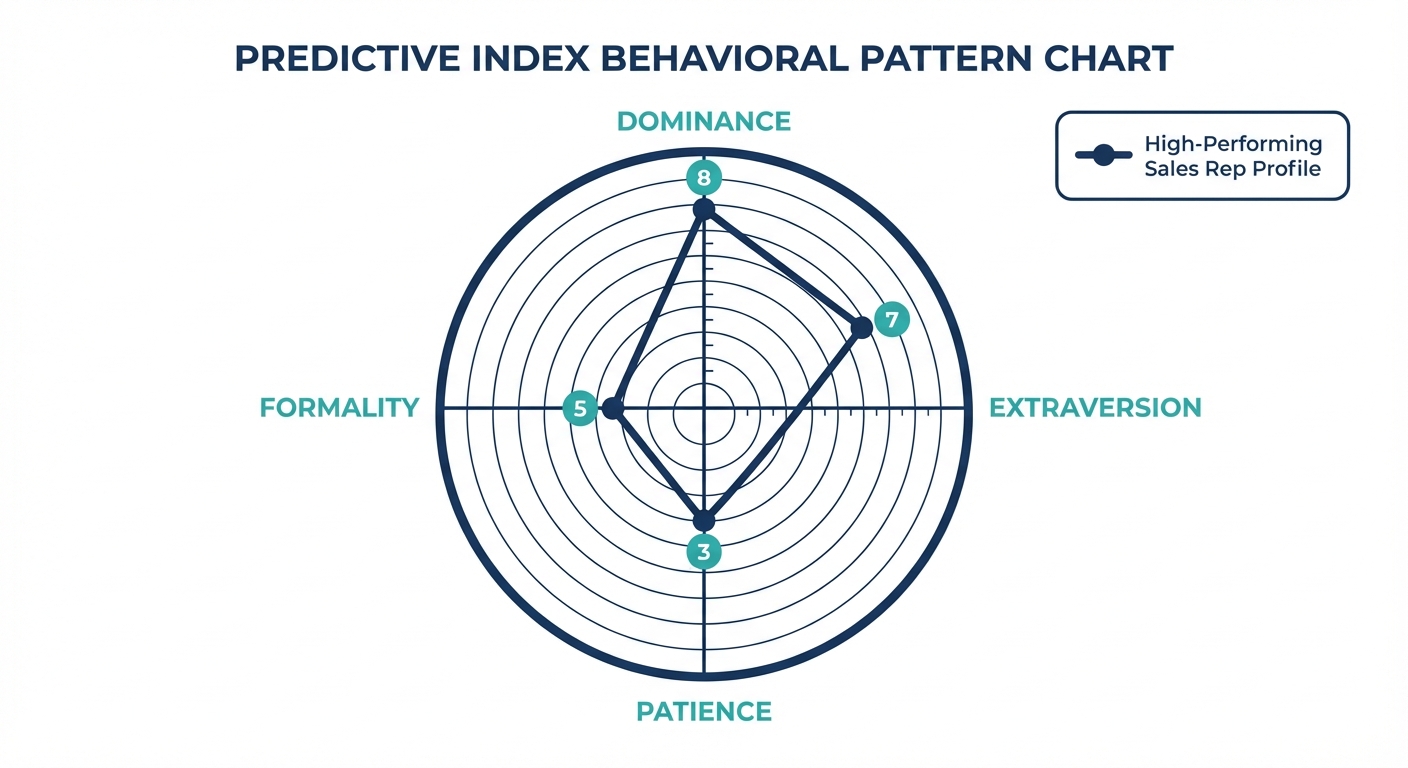
The Predictive Index (PI) is a staple in the world of sales assessment tools, specifically designed to measure the invisible traits that dictate how a salesperson will actually perform on the job. Rather than testing knowledge of sales techniques, PI focuses on behavioral fit to determine if a candidate's natural drives match the daily demands of their specific sales role.
Behavioral Methodology
The core of the PI platform is the Behavioral Assessment, a stimulus-response tool that measures four primary personality constructs:
By evaluating these four factors, PI creates a behavioral profile that is compared against a pre-defined Job Target. This objective data helps sales leaders look past a polished resume to see if a candidate possesses the proactive drive needed for cold calling or the methodical formality required for complex enterprise contract management. While PI handles the behavioral alignment, many teams pair it with AI sales assessment tests to evaluate real-world conversational skills and objection handling.
PI offers seamless connectivity with the most common recruitment platforms. These integrations allow sales managers to trigger assessments and view results directly within their existing workflows:
Sales Role Customization
One of PI's strongest features is its ability to define custom Job Targets for different sales archetypes. A high-performing SDR (Sales Development Representative) often requires high Dominance and low Patience to handle high-rejection prospecting. Conversely, an Account Manager may require a Protective profile with higher Formality and Patience to ensure long-term client retention.
By using the PI Job Assessment, hiring teams can create a scientifically validated ideal profile for any sales position, ensuring that every new hire is behaviorally hardwired for the specific KPIs they are expected to hit.

3. Caliper Profile — Best for Leadership Potential in Sales
The Caliper Profile is a legacy psychometric assessment that focuses on the intrinsic personality traits that drive long-term success in sales and management. Unlike tools that measure current skills, Caliper uncovers a candidate's natural tendencies and cognitive abilities, making it a premier choice for organizations looking to identify future sales leaders and high-potential hunters.
Psychometric Depth
The assessment provides a scientific deep dive into an individual's personality, using a proprietary validated model to predict how their natural behaviors will translate into a sales environment. It does not just look at whether a candidate can sell, but why they sell and how they will handle the psychological pressures of a high-stakes sales role.

The reporting and feedback system is designed for high-level decision-making. Hiring managers receive a comprehensive individual profile that includes a job match score, comparing the candidate's traits against established benchmarks for specific roles, such as Account Executive or Sales Manager. These reports also provide structured interview guides and developmental suggestions, helping managers tailor their coaching strategies from day one.
Core Psychometric Traits Measured
To understand a candidate's fit, Caliper measures over 20 distinct traits. In a sales context, the following are the most critical:
Implementation Timeline
The implementation of the Caliper Profile is relatively streamlined but requires thoughtful integration into the hiring workflow. Because it is a robust sales assessment tool, the questionnaire typically takes candidates 60 to 90 minutes to complete. Once the assessment is submitted, results are generally available within one business day. For enterprise clients, initial setup — including job benchmarking and platform training for HR teams — can be completed in one to two weeks.
4. Criteria Corp — Best for Cognitive and Aptitude Testing
Criteria Corp is a leader in the sales assessment tools space, specifically for organizations that prioritize cognitive ability and aptitude as the primary predictors of success. Unlike tools that rely solely on self-reported personality traits, Criteria focuses on raw problem-solving capability and learning speed, which are critical for fast-paced sales environments where product knowledge and market conditions change rapidly.
The HireSelect Platform
The HireSelect platform provides a centralized hub where hiring managers can administer a wide array of scientifically validated tests. A standout feature of the platform is its industry-leading game-based assessments. These assessments, such as the General Aptitude Mobile Evaluation (GAME), transform traditional aptitude tests into interactive, game-like challenges. Criteria helps reduce candidate anxiety while capturing high-fidelity data on cognitive processing, attention to detail, and memory.

To evaluate specific competencies required for complex sales roles, the platform offers several targeted modules:
Ease of Use
The candidate experience is a core strength of Criteria Corp's offering. The platform is designed to be mobile-first, allowing sales candidates to complete evaluations on their own schedule and on any device. This accessibility, combined with the engaging nature of their game-based modules, significantly lowers the drop-off rate typically seen with lengthy sales assessment tools. For the hiring team, results are delivered in clear, color-coded scorecards that provide immediate insights into a candidate's trainability and long-term potential without requiring a degree in industrial psychology.
5. HighMatch — Best for Customization and Candidate Experience
HighMatch is designed for organizations that need more than a one-size-fits-all approach to their hiring process. Its technical flexibility allows sales leaders to build custom assessment profiles that align with their specific sales methodology, tech stack, and company culture. Unlike rigid legacy platforms, HighMatch focuses on personalized assessments that measure the specific behaviors and cognitive traits that drive success in your unique environment.
Role-Specific Tailoring: Customizing SDR and AE Paths
The platform's greatest strength lies in its ability to distinguish between different sales functions. A high-performing SDR requires a vastly different psychological profile than a seasoned Account Executive (AE). HighMatch allows you to weight traits differently depending on the role:
By utilizing these tailored profiles, hiring managers can ensure they aren't just hiring good salespeople, but rather the right salesperson for that specific seat. While HighMatch provides deep behavioral data, many teams pair it with AI sales assessment tests to see how those traits translate into actual performance in a simulated sales environment.

Mobile-Friendly Candidate Experience
In a competitive labor market, candidate drop-off is a major risk. HighMatch mitigates this by offering a modern, friction-free experience that respects the candidate's time. Key features include:
Data Insights and Reporting
HighMatch stands out in its delivery of actionable data insights. Their reporting suite is built for busy sales managers, not just HR professionals or psychologists. Instead of dense technical language, the reports provide plain-language summaries of a candidate's strengths and potential watch-out areas.
The reports also include customized interview guides, which suggest specific questions based on the candidate's assessment results. This helps interviewers dig deeper into potential red flags or verify specific strengths, making the live interview far more effective.
How We Evaluated These Sales Assessment Platforms
To provide an objective ranking of the top sales assessment tools, our editorial team conducted a deep dive into the leading platforms currently used by high-growth sales organizations. Our goal was to identify solutions that move beyond surface-level traits to provide deep insights into a candidate's actual selling DNA.
Our Selection Criteria
We evaluated each platform based on four critical pillars to ensure they meet the demands of modern sales leaders:
The foundation of any elite sales team is unbiased data. Traditional interviewing methods are often riddled with unconscious bias, leading to culture-fit hires that fail to perform. By implementing standardized evaluation methods, organizations can strip away subjectivity and focus on the core competencies — such as objection handling, call control, and grit — that actually drive revenue. This commitment to data-driven transparency ensures that the most capable talent rises to the top, regardless of their background or resume formatting.
The Science of Selection: Validity, Reliability, and Data Consistency
To ensure sales assessment tools provide a meaningful ROI, they must be grounded in psychometric rigor. Hiring decisions based on gut feeling are notoriously prone to bias; scientific validation provides the objective framework necessary to forecast a candidate's future performance accurately. High-gravity selection processes should adhere to the SIOP Principles for the Validation and Use of Personnel Selection Procedures to ensure their evaluation tools are both legally defensible and statistically significant.
Predictive Validity and Sales Performance
Predictive validity measures the statistical relationship between an assessment score and future job performance, such as quota attainment or revenue generated. This relationship is typically expressed as a correlation coefficient (r). In the context of industrial-organizational psychology, a coefficient above 0.35 is considered very beneficial, while coefficients exceeding 0.50 are rare and highly effective.

Repeatability of Scores
Reliability refers to the consistency of a measure. For a sales assessment to be useful, it must demonstrate test-retest reliability, meaning a candidate would receive a similar score if they took the assessment multiple times under the same conditions. The stability of what is being measured varies across different psychological constructs:
For more information on implementing these metrics into your hiring workflow, explore how Overvue's AI-driven simulations capture high-validity performance data in real-world sales scenarios.
Key Competencies: What These Tools Actually Measure
Modern sales assessment tools have evolved beyond simple personality quizzes. They are designed to simulate the high-pressure environment of a sales floor, evaluating whether a candidate has the tactical ability to close deals and the mental fortitude to handle rejection. By using AI-driven sales assessment tests, companies can now see exactly how a candidate performs in real-world scenarios before they ever speak to a customer.
Core Sales Skills
While every industry has its nuances, the most effective tools focus on the non-negotiable mechanics of a sale. These are the skills that directly impact the pipeline and conversion rates:
Common Sales Competencies Checklist
Use this checklist to ensure your chosen assessment tool covers the essential pillars of sales success:
| Competency | What It Evaluates |
|---|---|
| Active Listening | Can the candidate pick up on subtle cues and repeat back pain points accurately? |
| Value Proposition | Does the candidate explain "why us" in a way that resonates with the prospect's specific needs? |
| Closing Ability | Does the candidate know when and how to ask for the business or the next step? |
| Call Control | Can the rep guide the conversation and keep it on track without losing the prospect? |
| Discovery Quality | How well does the candidate uncover the prospect's budget, authority, and timeline (BANT)? |

Behavioral Traits and Grit
Success in sales is often less about what someone knows and more about how they react to failure. Assessments measure behavioral traits like resilience and achievement orientation — often summarized as Grit.
Tools look for Recoverability, or how quickly a rep bounces back after a lost deal or a harsh rejection. High-performing reps typically display a high degree of internal locus of control, meaning they take responsibility for their outcomes rather than blaming the market, the product, or the leads.
Learning Agility
In an era of rapidly changing tech stacks and AI-enhanced workflows, learning agility is perhaps the most critical predictor of long-term success. This competency measures coachability: how quickly a candidate can take feedback from a manager (or an AI coach) and apply it to their next call.
Assessments that utilize roleplay simulations are particularly effective here. They can present a candidate with a challenge, provide instant feedback, and then ask the candidate to try again immediately. Those who adapt their approach in real-time demonstrate the agility needed to thrive in a modern, fast-moving sales organization.
Implementation: ATS Integration and Data Security
Workflow Integration
To maximize the efficiency of sales assessment tools, they must integrate seamlessly into your existing recruitment ecosystem. High-performance hiring teams typically connect these tools directly with their Applicant Tracking System (ATS) — such as Greenhouse, Lever, or Workday — to automate the delivery of assessments. When integrated, a candidate's test results and AI-generated insights automatically sync with their profile, allowing recruiters to filter and move top-tier talent through the pipeline without manual data entry or jumping between different platforms.

Data Security and Privacy Measures
Maintaining the integrity of candidate data is not just a best practice; it is a legal requirement. When evaluating vendors, ensure they implement the following privacy measures:
Optimizing Candidate Experience
The success of your hiring process depends heavily on candidate engagement. High-performing sales professionals are often passive candidates who may abandon a process if it feels cumbersome or overly time-consuming. To prevent candidate drop-off, aim for initial assessments with completion times between 15 and 25 minutes. For more complex AI sales roleplays, ensure the interface is mobile-friendly and provides the candidate with clear instructions. By respecting the candidate's time and providing a modern, tech-forward experience, you reinforce your brand as an innovative place to work.
The Business Case: ROI and Reducing Staff Turnover
Investing in sales assessment tools isn't just about streamlining the hiring process; it is a critical financial strategy. The cost of a bad sales hire is often estimated at 1.5x to 2x the rep's annual salary when factoring in recruitment costs, training, and — most importantly — lost opportunity revenue. By implementing data-driven screening, organizations can move from gut-feeling hiring to a predictable, high-yield recruitment model.
Predicting False Positives
The most dangerous candidate is the False Positive: the charismatic individual who interviews exceptionally well but lacks the actual technical skills to close deals. Traditional interviews prioritize rapport and storytelling, which can mask a lack of situational awareness or an inability to handle tough objections.
AI-powered platforms like Overvue mitigate this risk by forcing candidates to demonstrate their skills in real-world scenarios. Instead of describing how they handle rejection, candidates must navigate an AI-simulated roleplay. This reveals their true Sales DNA before they ever reach your payroll, ensuring you only hire those capable of performing under pressure.

To measure the true business impact of these tools, sales leaders should track the following metrics:
Identifying High-Potential Candidates
While assessments help weed out poor fits, their greatest value often lies in uncovering hidden gems. These are high-potential candidates who may lack a traditional pedigree or extensive industry experience but possess the raw traits — such as resilience, coachability, and curiosity — that correlate with long-term success.
By focusing on objective performance data rather than a resume's prestige, sales assessment tools allow talent leaders to diversify their pipeline. This data-centric approach ensures that every hire is backed by proof of capability, leading to a more stable, higher-performing sales organization with significantly lower turnover.
Decoding the Test: Common Question Formats and Scenarios
To select the right sales assessment tools, you must understand how these tests evaluate a candidate's mental agility and practical expertise. Most modern assessments move beyond simple personality quizzes, using a mix of formats to simulate the high-pressure environment of a sales floor.
Reasoning and Aptitude Tests
These sales aptitude tests measure cognitive ability, which is often the strongest predictor of long-term job performance. They evaluate how quickly a candidate can process new information and solve complex problems.
Situational Judgement Tests (SJT)
A Situational Judgement Test presents a hypothetical workplace scenario and asks the candidate to choose the most effective course of action. Unlike reasoning tests, there isn't always a mathematically correct answer; instead, responses are weighted based on the company's ideal sales behaviors.
For example, a scenario might involve a stalled deal where a prospect stops responding to emails. The candidate must rank several responses — ranging from calling the prospect's manager to sending a personalized value-add resource — to demonstrate their understanding of professional persistence and etiquette.
Skills-Based and Simulation Tasks
While traditional tests measure what a candidate knows, simulations measure what they can do. This is where AI sales assessment tests have revolutionized the hiring process.
By combining these formats, AI sales roleplay tools provide a comprehensive view of a candidate's potential, ensuring they possess both the intellectual capacity and the practical grit required to hit their targets.
Simulating Real-World Sales: Objections and Qualifications
It is the final week of the quarter. Your pipeline has a massive leak, your top-tier enterprise deal is stalling, and you are staring down a quarterly goal deficit. This isn't the time for a multiple-choice quiz. In the real world, sales success is determined by how well a candidate performs when the prospect is pushing back and the pressure is mounting.
Traditional sales assessment tools often fail because they don't capture the heat of a live interaction. To truly evaluate a salesperson, you must simulate the high-stakes environment where they actually operate.
Handling Tough Objections
When a prospect says, "Your competitor is 30% cheaper," or "We don't have the budget for this right now," does your candidate fold or pivot? Effective objection handling requires more than just memorizing a script; it requires active listening and the ability to find the underlying pain point.
AI-driven simulations provide a safe yet rigorous environment to test these skills. By using realistic personas, Overvue forces candidates to deal with reactive AI that doesn't just follow a linear path. If a candidate uses a weak rebuttal, the AI prospect pushes harder — just like a real-world buyer would. This ensures your hires have the grit to handle real-world objections rather than just reading from a playbook.

Qualifying Leads
One of the biggest drains on a sales team's efficiency is chasing leads that will never close. High-performing reps know how to distinguish between a tire kicker and a whale. A robust assessment should evaluate a candidate's mastery of qualification frameworks to ensure they are only filling the pipeline with qualified leads.
Look for candidates who can seamlessly weave these qualification frameworks into a natural conversation:
Operating Under Pressure
Sales is inherently stressful. Whether it's managing a quarterly goal deficit or navigating a hostile discovery call, resilience is key. High-stakes simulations test a candidate's call control — their ability to steer the conversation back to value when it starts to go off the rails.
Modern sales assessment tools measure metrics beyond just the final outcome:
Role-Specific Customization and Performance Benchmarking
To get the most out of sales assessment tools, organizations must move beyond generic testing. High-performing sales teams are built on role-specific data that distinguishes between different types of selling behaviors. Benchmarking allows you to compare candidates not just against a general standard, but against the specific DNA of your top performers.
SDR vs. Account Executive Profiles
The traits that make a successful Sales Development Representative (SDR) are often vastly different from those required for an Account Executive (AE). Effective sales candidate evaluation strategies prioritize different competencies depending on the position's primary objectives:
Using tailored profiles ensures you aren't disqualifying a potentially great closer just because they lack the specific prospecting temperament of an entry-level lead generator.
Essential Benchmarking Techniques
To ensure your sales assessment tools are accurate, implement the following benchmarking techniques:
Continuous Tracking
Benchmarking is not a one-time event. To maintain a high-quality talent pipeline, you must implement continuous tracking of your assessment data. This involves comparing a candidate's pre-hire assessment scores against their actual on-the-job performance (KPIs) after six to twelve months.
By closing the feedback loop between the hiring tool and actual revenue production, you can fine-tune your benchmarks to improve predictive validity. If your top-scoring candidates consistently struggle with ramp-up time, it is a signal to adjust your assessment parameters to better reflect the realities of the current market.
How To Prepare: Resources and Best Practices for Candidates
Approaching a sales assessment can feel intimidating, but it is actually a powerful opportunity to showcase your potential beyond what a static resume can offer. These tools are designed to identify your innate strengths and how you might perform in real-world scenarios. By preparing effectively, you can enter the assessment with confidence and demonstrate that you are the right fit for the role.
Reviewing Core Skills
Many sales assessment tools evaluate more than just your personality; they measure the cognitive and technical skills required to manage a high-performing sales pipeline. Focus your preparation on these key pillars:
Simulating Test Conditions
Performance anxiety is a common hurdle, but it can be managed by simulating the testing environment beforehand. Creating a familiar setting helps your brain focus on the questions rather than the pressure of the assessment.
Approaching Question Types
Understanding the why behind different question formats will help you provide the most relevant answers for the hiring team.

Bridging the Gap Between Assessment and AI Training
Traditional sales assessment tools often exist in a vacuum. A candidate takes a test, a manager reviews a PDF report, and the data is archived once the hiring decision is made. However, the true power of modern sales tech lies in the synergy between assessment data and AI-driven sales training. By treating the assessment as a baseline rather than a final grade, organizations can create a continuous feedback loop that accelerates time-to-productivity.
From Hiring to Onboarding
The transition from candidate to new hire is often where momentum stalls. When companies leverage AI-powered sales training, the onboarding process becomes an extension of the evaluation phase. Instead of a generic training manual, the new hire enters a personalized environment where the weaknesses identified during the hiring process are immediately addressed through targeted practice. This integration ensures that the predictive data gathered during the interview stage is actually used to mitigate risk and improve performance from day one.

How AI Simulators Use Assessment Scores
AI roleplay simulators transform static assessment results into interactive training modules. By ingesting the scores from a candidate's initial evaluation, these platforms customize the learning path in several ways:
Building a Data-Driven Sales Culture
The future of sales technology is moving toward a Single Source of Truth for talent. Building a data-driven culture means moving away from gut-feeling coaching and toward objective performance metrics that span the entire employee lifecycle.
By integrating assessment data into daily workflows, leadership can identify DNA gaps across the entire team, not just individual hires. This allows for macro-level training shifts — if the data shows a team-wide deficiency in closing techniques, the AI simulator can deploy a global training module to address it. In this new era of sales, the tools you use to hire are the same tools that will help you scale, refine, and eventually dominate your market.
Sales Assessment FAQs
Can sales assessments be faked by savvy candidates?
While no test is entirely immune to manipulation, modern sales assessments use consistency checks and forced-choice formats to flag socially desirable responding. Sophisticated tools measure response patterns that are difficult to maintain throughout a long questionnaire. Candidates attempting to game the system often produce contradictory data points that alert hiring managers to potential inauthenticity.
How long are the results of a sales assessment typically considered valid?
Generally, assessment results remain an accurate reflection of a candidate for 12 to 24 months. Behavioral traits tend to be stable over time, but skills and cognitive abilities can shift with significant experience or specialized training. If a candidate has undergone major career changes or professional development, re-testing after a year provides the most current data for decision-making.
What is the difference between a personality test and a sales skill assessment?
Personality tests evaluate broad traits like extroversion or openness, which are not always predictive of success in a specific sales role. In contrast, sales skill assessments focus on functional competencies such as objection handling, pipeline management, and closing techniques. Combining these approaches ensures you understand both who the person is and what they are actually capable of doing in a high-pressure environment.
Do these tools help in reducing unconscious bias during the hiring process?
These platforms provide objective data points that allow hiring teams to compare candidates based on merit rather than gut feeling or shared backgrounds. By standardizing the evaluation criteria, you minimize the influence of subjective factors that often lead to biased hiring. This data-centric approach ensures every applicant is measured against the same performance benchmarks.
Should existing employees be required to take the same assessments as new hires?
Assessing current team members helps establish high-performance benchmarks for future recruiting efforts. Using the same tools across the board allows leadership to identify skill gaps and tailor professional development programs for existing staff. This alignment ensures that the entire organization is working toward the same standard of excellence while preparing for the next phase of growth.
Elevate Your Hiring Precision
Modern sales environments require more than just a resume to identify top performers. By leveraging sales candidate evaluation strategies powered by AI, you can move beyond static questions and see how applicants perform in dynamic, life-like scenarios. This shift toward immersive testing ensures your next hire has the actual skills needed to hit their quota from day one.
Ready to see how AI-powered assessment can transform your hiring process? Try Overvue free and start evaluating candidates the way top sales organizations do.