
The average account executive ramp time reached 5.7 months in 2026, up 32% from 4.3 months in 2020, according to sales ramp time benchmarks. That change reframes the ramp up period. It isn't merely the time required to complete training or close a first deal. It is the time a company must carry partially productive capacity before a new hire contributes consistently to the revenue plan.
For revenue leaders, that distinction matters. A longer ramp changes hiring forecasts, territory coverage, quota allocation, manager capacity, and pipeline expectations. A 30/60/90-day checklist may organize onboarding, but it can't tell finance when a cohort will become dependable capacity.
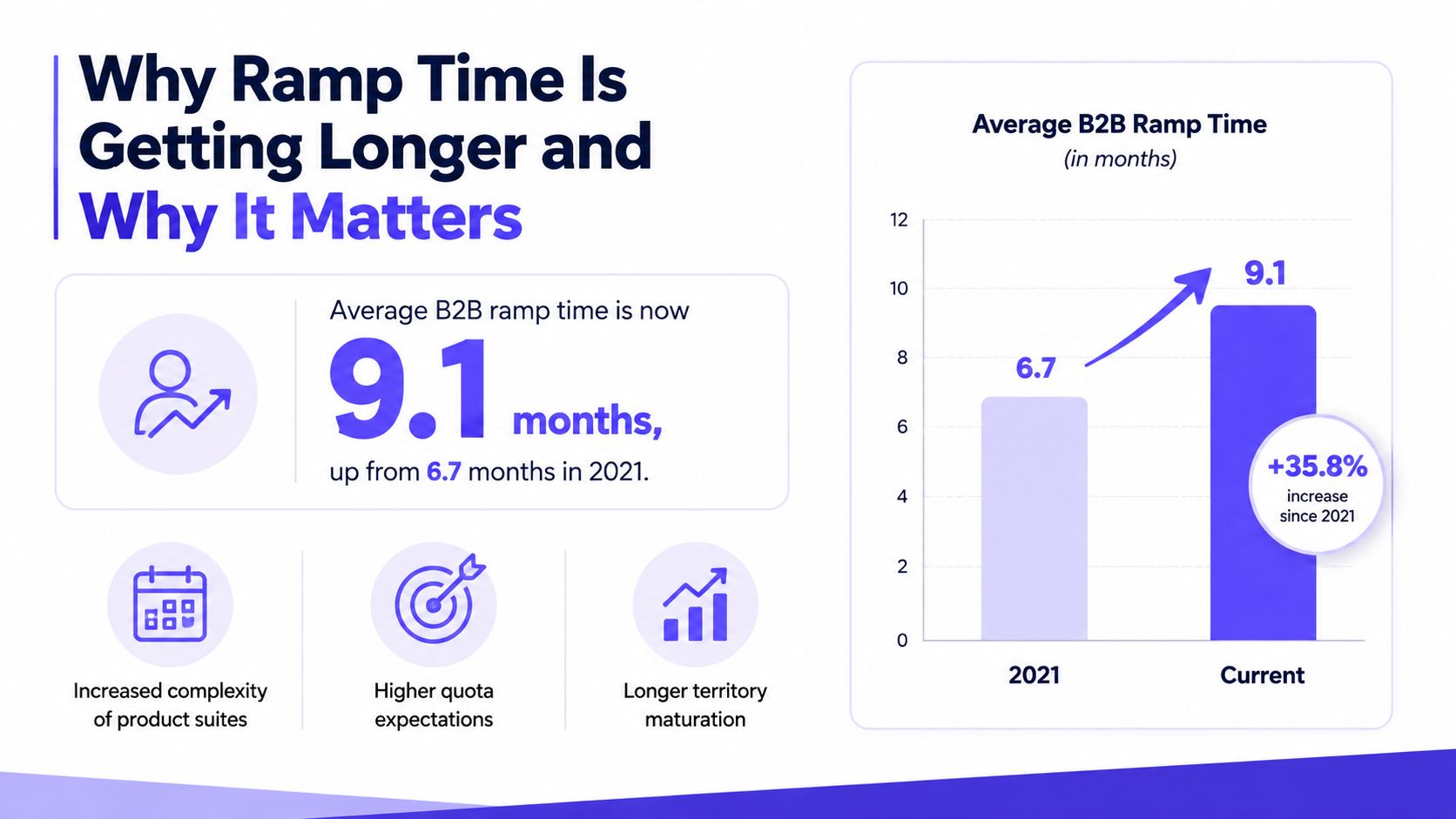
Why Ramp Time Is Getting Longer and Why It Matters
Sales teams are operating with more complicated motions than they used to. Enterprise deals involve more stakeholders, more technical validation, longer procurement processes, and greater scrutiny from buyers. Those conditions make the sales ramp up period materially different from the onboarding experience of an SDR working a tightly defined outbound motion.
The benchmark spread is substantial. SDRs may reach useful productivity within a few months, while enterprise AEs can require 6 to 12 months, or even 9 to 15 months on complex deals, according to the sales ramp time benchmark summary. Treating every hire as though the same calendar plan applies creates bad forecasts and unfair performance judgments.
The capacity cost of a longer ramp
A new rep consumes recruiting effort, manager attention, enablement resources, and territory capacity before reaching full output. If leadership assumes immediate quota contribution, the annual plan will overstate available selling capacity. That overstatement then appears as a pipeline problem, a hiring problem, or an execution problem later in the year.
The more useful question is not, “How quickly can this person finish onboarding?” It is, “When will this cohort produce reliable output that finance can include in a forecast?”
Several forces commonly extend the curve:
- Product complexity: Reps need more time to understand technical value, packaging, implementation, and competitive positioning.
- Buying committee breadth: More participants create more discovery paths and more opportunities for stalled deals.
- Procurement friction: Security, legal, finance, and vendor reviews delay the feedback new reps need to develop judgment.
- Territory maturation: A rep may inherit accounts with weak awareness, incomplete data, or limited active demand.
Operating rule: Treat ramp as unproductive capacity that must be modeled, not as an onboarding inconvenience that disappears after the first month.
The benchmark trend also creates a strategic choice. Teams can invest in narrower role scope, better practice, and sharper coaching to compress the curve. They can also accept a longer curve and redesign quotas, territories, and hiring plans around the market's actual buying motion. Neither choice works if leaders continue to plan from a generic calendar.
Defining Ramp Up Period as Sustained Productivity
A practical definition of ramp-up comes from software engineering research. New-hire ramp-up is the time required to reach the median productivity level of established team members, using observable work signals rather than a subjective feeling that onboarding is complete. The research on measuring productivity among new software engineers helped formalize ramp-up as a measurable time-to-productivity concept.
Sales leaders can apply the same logic. A rep isn't fully ramped because a first deal closed, a first meeting occurred, or a manager marked every training module complete. Those events are useful signals, but each can happen before the rep can repeatedly create pipeline, manage a territory, handle objections, and forecast accurately.
A stronger measurement standard
A more durable definition is the first period in which a rep reaches a specified attainment threshold and holds it for two consecutive periods, as described in guidance on sales onboarding ramp time. The exact threshold should reflect the role and sales motion. The important feature is continuity.
A useful ramp curve combines lagging and leading indicators:
- Time to first meeting shows whether the rep can generate initial engagement.
- Time to first sales-qualified opportunity tests discovery, qualification, and account selection.
- Time to first win confirms that the rep can move an opportunity through the buying process.
- Sustained attainment determines whether performance is repeatable rather than fortunate.
A first win can overstate readiness if the deal was already well advanced or unusually simple. Conversely, a rep may be developing correctly while working through a long enterprise cycle. Managers should read the full sequence instead of allowing one early event to define the employee's trajectory.
A structured sales onboarding checklist can help standardize the inputs, but the checklist shouldn't become the measurement system. Teams also need a new hire retention checklist that outlines the conditions supporting sustained performance, including clarity, manager support, and early feedback.
Role-Specific Ramp Benchmarks Across Sales Motions
A single average obscures the operating reality of sales teams. The sales ramp benchmarks by segment show why SDRs, SMB AEs, mid-market AEs, and enterprise AEs should receive different expectations.
| Role | Typical Ramp Time | Key Drivers |
|---|---|---|
| SDR | About 30 to 90 days, or roughly 3.2 months on average | Prospecting repetition, messaging discipline, meeting qualification |
| SMB AE | Roughly 3 to 4 months | Shorter cycles, narrower stakeholder groups, simpler deal structures |
| Mid-market AE | About 4 to 6 months | More complex discovery, broader account coverage, longer evaluation |
| Enterprise AE | About 6 to 12 months, with complex deals sometimes requiring 9 to 15 months | Multi-stakeholder buying, technical validation, procurement, strategic territory development |
These ranges are operating references, not promises. The sales ramp-up framework also reports an overall AE average of 5.7 months, while role-specific ranges remain wide. A manager should therefore compare a new hire with the correct cohort, not with a company-wide average.
Why the role changes the curve
An SDR typically receives faster feedback. Calls, replies, meetings, and qualification outcomes create repeated learning cycles. That doesn't make the role easy, but it makes performance patterns visible sooner.
An SMB AE may need to master discovery, demonstration, negotiation, and closing, yet the buying process often involves fewer participants and less procedural friction. Mid-market and enterprise reps face a different learning burden. They must develop account strategy, coordinate internal specialists, identify power structures, and maintain momentum across a longer opportunity lifecycle.
Enterprise ramp time can also reflect territory development rather than only skill acquisition. A rep may understand the product and sales process while still needing time to establish relationships and uncover active initiatives inside assigned accounts. Penalizing that rep against an SDR benchmark confuses market conditions with individual performance.
Managerial test: If the rep's role, sales cycle, buyer group, and territory economics differ, the ramp benchmark should differ too.
Leaders should document a range for each motion, define the evidence required at each stage, and identify the point at which sustained productivity becomes expected. False precision creates false confidence. A range paired with clear behavioral and attainment signals supports better coaching and more credible forecasting.
Factors That Extend or Compress Ramp Time
Role is only the starting point. Two teams can hire people into the same title and produce very different ramp curves because the surrounding sales system either removes friction or adds it.
Product depth is one of the clearest variables. A rep selling a focused product can build fluency through repeated conversations. A rep selling a broad platform must connect multiple use cases, personas, integrations, implementation concerns, and competitive alternatives. The second motion demands more than product memorization. It requires judgment about which value story fits which buyer.
Diagnose the system before blaming the rep
A slow ramp may originate in the operating environment rather than the employee. The most common sources of drag include:
- Unclear ICP: Reps spend practice time learning which accounts matter instead of learning how to sell to them.
- Weak territory design: A territory with poor data or limited demand makes activity look like underperformance.
- Inconsistent qualification: Managers give conflicting answers about what counts as a real opportunity.
- Thin coaching: Training occurs at launch, then feedback becomes occasional and reactive.
- Misaligned compensation: The plan rewards behavior that conflicts with the desired sales motion.
- Poor enablement access: Reps can't quickly find approved messaging, discovery guidance, competitive context, or proof points.
Market maturity also changes the learning environment. In an established category, buyers may understand the problem and recognize familiar evaluation criteria. In a newer market, reps must teach the category while selling the product, which creates more demanding conversations and less predictable feedback.
Manager support compresses ramp when it focuses on observable behavior. Reviewing call control, discovery quality, objection handling, and next-step discipline is more useful than asking whether a rep “feels comfortable.” Peer coaching adds another practical layer by showing how experienced sellers handle the exact situations that training materials tend to simplify.
The right intervention depends on the bottleneck. More product training won't fix an unfair territory. More leads won't fix unclear qualification. More call reviews won't fix a compensation plan that rewards premature closing. Ramp improves when leadership identifies the constraint and removes it directly.
Staged Quota Models and Leading Indicators
Binary ramp plans create unnecessary noise. A rep is either “at quota” or “not at quota,” even though capability develops through stages and enterprise opportunities may take months to mature.
One practical staged sales ramp model moves expectations from 25% of goal in month 1, to 50% in months 2 and 3, 75% in months 4 and 5, and 100% from month 6 onward. This model gives managers a way to evaluate progress without pretending that a new hire becomes fully productive on a fixed date.
Match the model to the motion
SDR teams may use a shorter sequence, with approximately four weeks at 25%, another four weeks at 50%, and a final four weeks at fully tenured expectations, according to the same sales ramp quota guidance. The exact schedule should reflect lead volume, messaging complexity, and the amount of live practice available.
Managers should place these stages in the CRM and compensation plan, then review both attainment and the activity that produces it. Useful leading indicators include:
- First meeting quality: Not only whether a meeting occurred, but whether the rep reached the intended buyer and established a relevant problem.
- First SQO: This tests whether the rep can identify real buying potential rather than just create activity.
- Pipeline progression: Opportunities should advance through defined stages with evidence, not optimism.
- Deal velocity: A stalled pipeline may reveal weak next steps, poor qualification, or a market constraint.
- Attainment consistency: Repeated performance is more informative than one unusually strong month.
A staged model doesn't lower standards. It makes standards more diagnostic. A rep who misses quota but improves opportunity quality and progression may need targeted coaching. A rep who closes one early deal but produces no repeatable pipeline may need a deeper intervention.
Forecasting principle: Read quota attainment together with pipeline creation, stage movement, and consistency. Any single metric can mislead.
AI Roleplay Simulations as the Highest-Leverage Ramp Accelerator
Traditional onboarding depends heavily on shadowing, classroom instruction, and manager-led roleplay. Those methods can help, but they vary by coach, consume manager time, and often expose the new rep to too few realistic situations.
AI roleplay simulations address the practice bottleneck directly. A system can present a buyer modeled on the company's ICP, including role, business context, pains, objections, competitors, and technology environment. The rep can repeat scenarios before risking live pipeline, while the team evaluates the same selling behaviors across every practice session.
Practice the moments that determine readiness
The highest-value scenarios aren't generic conversations. They mirror the points where new sellers lose control:
- Discovery: The buyer gives incomplete answers, forcing the rep to investigate rather than recite a script.
- Objection handling: The buyer challenges price, timing, implementation effort, or differentiation.
- Call control: The rep must maintain direction without becoming confrontational.
- Next-step execution: The conversation ends with a specific, buyer-supported action.
- Competitive pressure: The buyer introduces an incumbent or alternative approach.
A platform such as Overvue provides AI buyer simulations, standardized scenarios, automated scoring against criteria such as objection handling and next-step execution, and repeatable practice for new hires. Teams evaluating adjacent AI sales workflows can also review this EmailScout resource for sales teams for additional context on sales-assistance tools.
The practical advantage is consistency. A manager-led roleplay may be insightful, but the scenario can change with the manager's mood, experience, or assumptions. Standardized simulations create comparable evidence for hiring assessments and onboarding, while managers can spend live coaching time on the specific behavior that needs attention.
AI practice also supports distributed teams and multiple languages without requiring everyone to attend the same session. It doesn't replace manager judgment. It gives managers better observations before a rep enters a consequential buyer conversation. Teams can use role-playing for sales design, run, and scoring to connect scenarios with the behaviors expected in live selling.
Redesigning Quotas and Territories Around Realistic Ramp
Shorter ramp isn't always the correct objective. If the sales motion requires long relationship development, technical validation, and procurement work, forcing a compressed timeline can produce shallow qualification, bad discounts, and unreliable forecasts.
The better decision begins with cohort data. Revenue operations should join HRIS start dates with CRM attainment records and calculate when groups reach meaningful productivity levels, including time to 50% and 100% productivity. Recent ramp statistics and planning guidance recommend measuring cohorts rather than relying on individual outliers, especially as complex enterprise motions continue to lengthen.
Choose acceleration or redesign
Acceleration makes sense when the delay comes from preventable friction, such as poor practice, unclear messaging, weak manager coaching, or inconsistent process. Structural redesign makes more sense when the delay reflects the market itself.
That redesign may include:
- Quota progression: Set expectations that reflect capability development rather than immediate full production.
- Territory allocation: Give new reps accounts that provide a realistic path to learning and pipeline creation.
- Hiring cadence: Stagger starts so managers and enablement teams can support each cohort properly.
- Role scope: Narrow responsibilities early, then expand them as the rep demonstrates repeatable execution.
- Capacity planning: Model partial productivity explicitly instead of counting every hire as full quota capacity.
Leaders working in regulated financial services may also benefit from reviewing quota types for BFSI leaders when deciding whether revenue, activity, account, or milestone-based measures fit the motion. A structured pre-hire assessment guide can help distinguish a hiring-quality issue from an onboarding-quality issue before the ramp plan begins.
Overvue gives revenue teams a repeatable way to assess selling behavior before hiring and practice realistic buyer conversations during onboarding, with AI scenarios and criteria-based scoring tied to the team's ICP. Visit Overvue to evaluate whether simulated practice can make the ramp up period more measurable and easier to forecast.