

Last updated: March 2026
Mastering the art of the software sales interview is crucial for building a revenue engine that scales, demanding more rigor than standard hiring processes. You need a systematic approach to uncover candidates who possess the unique blend of technical empathy, complex stakeholder navigation, and proven process adherence required for modern SaaS roles.
This guide details how to effectively verify past successes through hard metrics, assess proficiency in established sales methodologies like MEDDIC, and probe for the intangible qualities such as resilience and coachability that separate top performers from the rest. We will show you how to transition from anecdotal evidence to objective evaluation, including leveraging modern AI-powered sales assessment tools like Overvue to simulate real selling situations and accurately predict on-the-job performance. By applying these focused strategies, you will gain the confidence to identify and secure the exact sales talent your organization needs to hit ambitious growth targets.
Essential Competencies in the Software Sales Interview
Why SaaS Sales Require a Specialized Interview Approach
Standard interview questions often fail in a software sales interview because they prioritize personality over the specific, high-level problem-solving skills required for complex deal cycles. When candidates rely on rehearsed narratives, managers lose the ability to see how a seller actually navigates a multi-stakeholder environment. Harvard Business Review research on effective sales hiring emphasizes that traditional methods are poor predictors of success compared to competency-based evaluations.

Technical Literacy vs. Sales Acumen
The most common hiring mistake is over-indexing on one of two traits: technical literacy or sales acumen. While they are often treated as interchangeable, they serve distinct functions in the sales process:
A top-tier candidate must sit at the intersection of both. Without technical literacy, a seller is viewed as a "folder-carrier" who must defer every question to a Sales Engineer. Without sales acumen, the seller becomes a product specialist who focuses on features rather than the economic impact of the solution.
5 Core SaaS Competencies
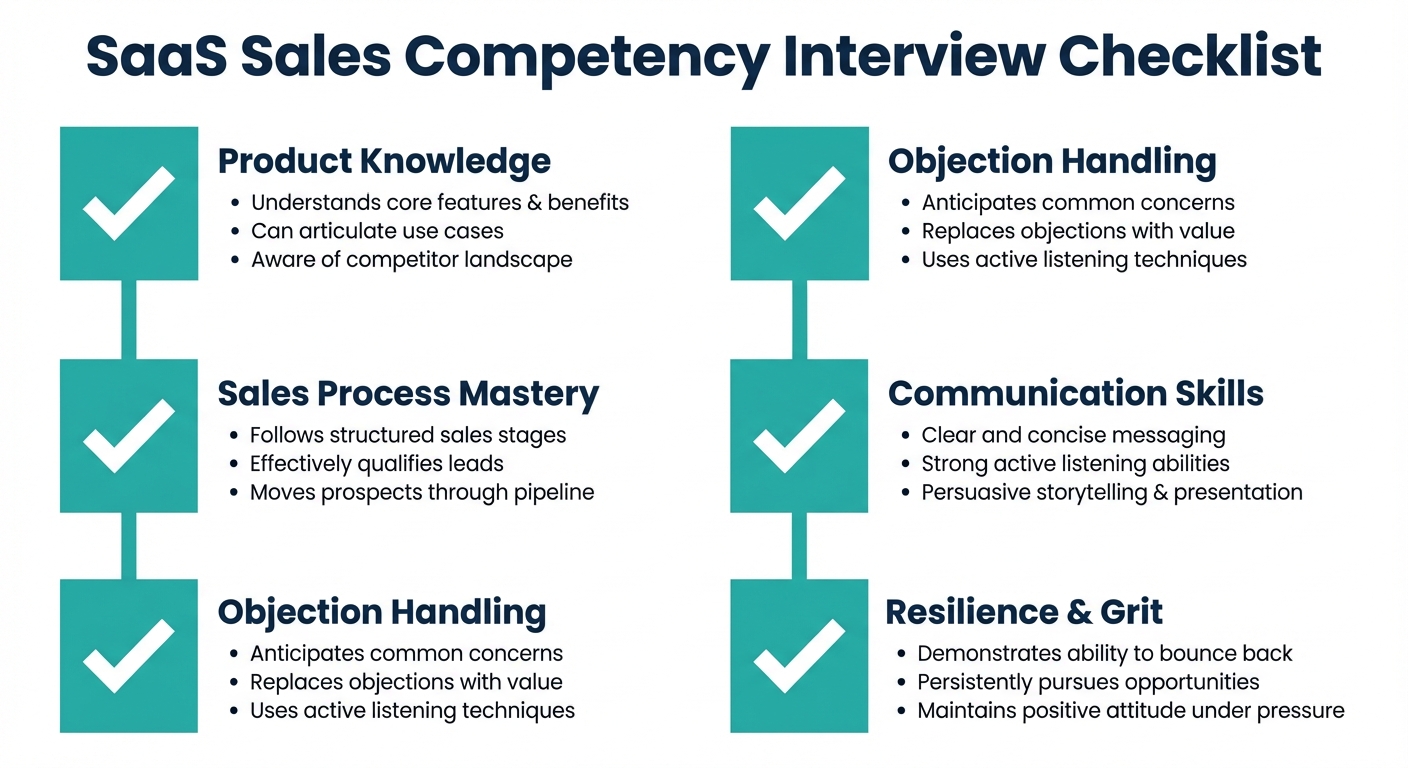
To build a high-performing team, your interview process should objectively score candidates against these five pillars:
Evaluating Experience and Proven Results with Data
In a software sales interview, performance claims are only as strong as the data supporting them. Consider a sales personality test to supplement your findings. While many candidates can speak eloquently about their "passion for sales," elite hiring managers look for quantifiable metrics and a clear understanding of the mechanics behind the revenue. Evaluating results requires a dual-focus approach: verifying the raw numbers and unpacking the complexity of how those numbers were achieved.
Quantifying Success: Quota and Attainment
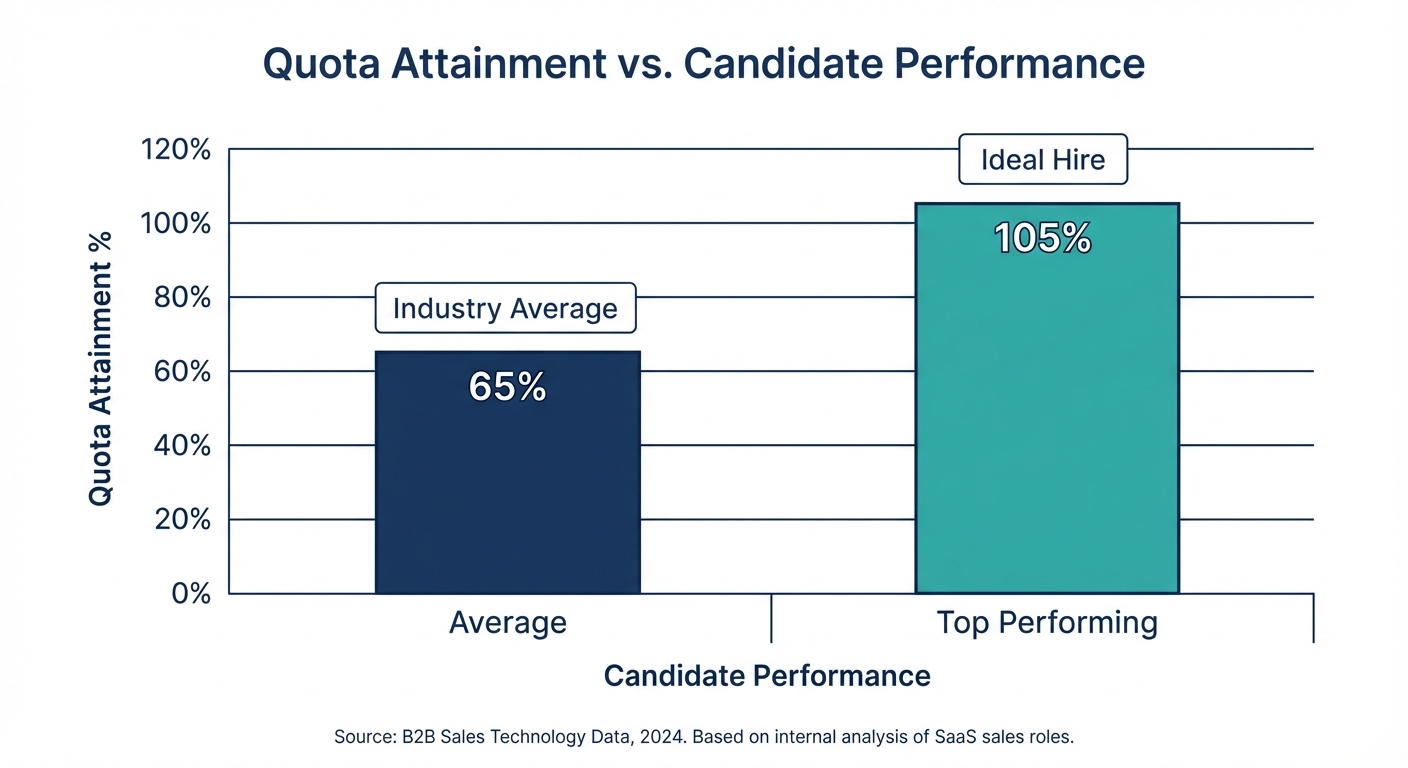
A candidate's past performance is the best predictor of future success, but "hitting quota" is a relative term. To accurately assess a candidate, you must verify the context of their achievements. Consider a sales skills assessment. Recent industry benchmarks from RepVue indicate that average SaaS quota attainment hovered around 43.14% in late 2024, meaning a candidate who consistently hits 80–90% may actually be in the top decile of their previous organization.
Use the following checklist to audit the data points provided during the interview:
-
-
-
-
-
-
Understanding Deal Complexity
Numbers alone don't tell the whole story. A $50k deal closed with a single stakeholder is fundamentally different from a $50k deal involving a legal review, IT security audit, and CFO sign-off. To evaluate how a candidate handles these complexities, use the STAR method to keep their responses focused on the framework rather than long-winded anecdotes.
The STAR Method Framework
By applying this framework, you can determine if a candidate's success was a result of a repeatable sales process or simply a "bluebird" deal. For roles requiring deep psychological resilience, consider pairing this data-heavy review with a sales personality assessment to see if their natural traits align with the high-pressure demands of your specific sales cycle.
Assessing Sales Strategy and Process Proficiency
A candidate's ability to articulate a structured sales process is the single greatest predictor of their long-term consistency. In a software sales interview, you aren't just looking for someone who can "wing it" on a call; you are looking for a professional who follows a repeatable framework to move deals through the funnel.
Prospecting and Pipeline Management
Effective prospecting requires a balance of high-volume activity and high-value research. Candidates should demonstrate a clear understanding of how they manage their daily "engine" to ensure the pipeline never runs dry. Use the following prospecting flow steps to evaluate their methodology:

Navigating Methodologies: From MEDDIC to Challenger
The "how" of a sale often depends on the complexity of the product and the size of the target organization. A seasoned rep should be fluent in at least one major methodology. For a comprehensive look at building these frameworks, refer to the HubSpot Sales Process Guide.
The table below outlines the three most common frameworks used in modern software sales:
| Methodology | Core Focus | Best Used For |
|---|---|---|
| MEDDIC | Qualification and identifying the "Champion" and "Economic Buyer." | Enterprise SaaS with long cycles and multiple stakeholders. |
| Challenger | Teaching the prospect, tailoring the message, and taking control of the sale. | Disruptive technologies that require a shift in the prospect's mindset. |
| SPIN Selling | Using specific question types (Situation, Problem, Implication, Need-payoff). | Discovery-heavy sales where uncovering latent pain is critical. |
Advanced Objection Handling
Top-tier sales talent views objections as requests for more information, not as a "no." During the interview, look for candidates who use an instructional approach to de-escalate tension and pivot back to value.
Implement these If/Then scenarios to test their real-time proficiency:
to simulate these exact scenarios and see how candidates perform under pressure.
By focusing on these structural elements, you can separate the "order takers" from the true sales professionals who can drive revenue in any market condition.
Behavioral and Situational Questions for SaaS Success
While resumes prove what a candidate has done, behavioral questions reveal how they did it and whether they can replicate that success in your specific environment. In a software sales interview, these questions act as a litmus test for the two most critical indicators of long-term success: coachability and resilience.
Before diving deep, start with a quick filter: "Why software sales?"
In SaaS, this shouldn't be a deep-dive conversation, but a qualifier. Ideal responses should move beyond "it's a high-growth industry" and acknowledge the unique challenges of the sector: long sales cycles, multi-stakeholder complexity, and the need for constant product iteration. If they don't understand that SaaS is about selling a continuous partnership rather than a one-time transaction, they may struggle with the post-sale alignment required in modern tech roles.
Gauging Coachability and Resilience
Coachability is often the hardest trait to measure because candidates are trained to say they "love feedback." To find the truth, you must move into specific, high-pressure scenarios.
Situation: The Missed Quota
The Question: "Tell me about a quarter where you missed your number. Walk me through your post-mortem process."
Ideal Response: The candidate takes full ownership without blaming the product or the leads. They should describe a specific data-driven analysis of their pipeline, identify exactly where the gap occurred (e.g., top-of-funnel volume vs. late-stage conversion), and explain the concrete changes they made to their workflow the following month.
Situation: The "Hard" Coaching Moment
The Question: "Describe a time a manager gave you feedback that you initially disagreed with. How did you handle the conversation and the implementation?"
Ideal Response: Look for a "low ego" approach. The candidate should demonstrate active listening and a willingness to test the manager's suggestion as an experiment. They should focus on the outcome of the change rather than the friction of the disagreement.

Research Habits and Client Interaction
SaaS sales are rarely a straight line. Success requires a candidate who can navigate multi-threaded deals and perform deep discovery before they ever pick up the phone.
Situation: High-Stakes Stakeholder Preparation
The Question: "You have a discovery call with a C-suite executive at a Fortune 500 company. Walk me through your first 30 minutes of research."
Ideal Response: The candidate should mention looking beyond LinkedIn. They should check annual reports (10-Ks) for company goals, listen to recent earnings calls for "pain points," and map out the buying committee. This proves they understand that in software, you aren't just selling to one person; you are solving a business problem for an entire organization.
Situation: Navigating a "Stalled" Deal
The Question: "A champion has gone dark after a successful demo. The contract is with legal, but communication has stopped. What is your next move?"
Ideal Response: A top-tier candidate suggests multi-threading. Instead of just "checking in," they might reach out to another stakeholder (like Finance or IT) with value-added content or leverage their executive team to do a peer-to-peer reach-out. This shows strategic persistence rather than passive waiting.
To see how candidates handle these situations in real-time, many teams are now moving toward AI sales assessments that use sales roleplay to simulate these exact stressors. This allows you to measure their natural instincts before they ever join a live prospect call.
Modernizing the Interview with AI Sales Assessments
Traditional manual roleplays are often the most stressful part of a software sales interview, yet they are frequently the most flawed. Relying on a hiring manager to play the role of a prospect introduces subjective bias, inconsistent difficulty levels, and a lack of standardized scoring. To truly identify top-tier talent, forward-thinking organizations are moving toward an AI sales assessment platform to digitize and objectify the evaluation process.
Using AI Roleplays to Evaluate Real-Time Performance
The transition from manual roleplays to AI-driven simulations allows sales leaders to evaluate a candidate's real-time performance without the interference of human bias. In a simulated environment, every candidate faces the exact same persona, objection set, and market scenario. This ensures a level playing field where decisions are based on data — such as sentiment analysis, talk-to-listen ratios, and objection handling effectiveness — rather than a "gut feeling."
By using AI sales assessments, companies can identify which candidates possess the innate soft skills and technical proficiency required to excel in a high-pressure SaaS environment.
How to Run a Successful AI Sales Simulation:
The 90-Day Readiness Check
The ultimate goal of any software sales interview is not just to hire a candidate, but to ensure they can contribute to revenue as quickly as possible. The 90-Day Readiness Check is a tangible benefit of AI assessments, providing a clear roadmap for a new hire's first three months.
Instead of waiting until the end of a probationary period to see if a rep is a "culture fit," AI simulations provide a predictive baseline of their performance. This data allows sales enablement teams to tailor training to the specific gaps identified during the interview process, significantly compressing the ramp-up time.
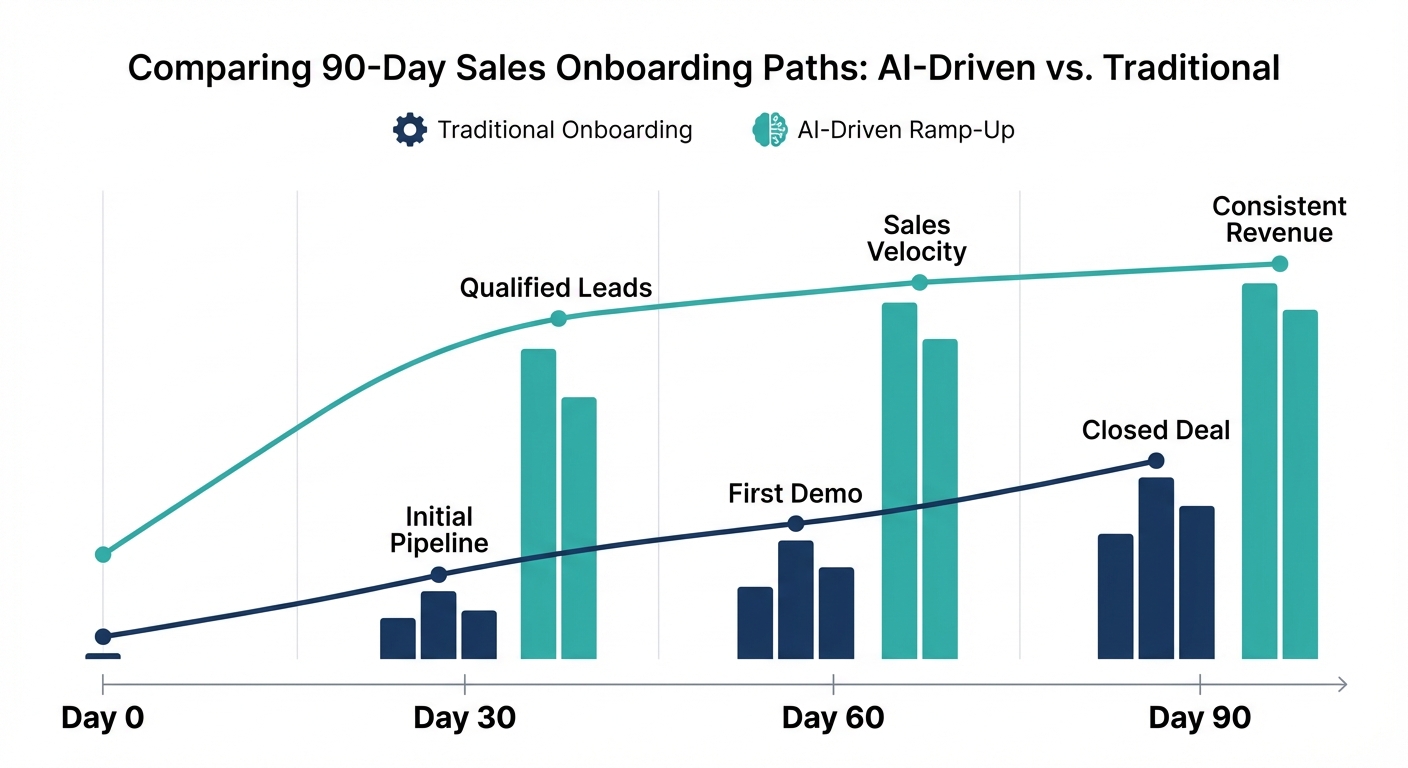
By the end of the 90-day cycle, the readiness check ensures that the rep has not only mastered the product knowledge but can also navigate complex sales conversations with the consistency and confidence required for long-term success.
What Top Candidates Ask Their Interviewers
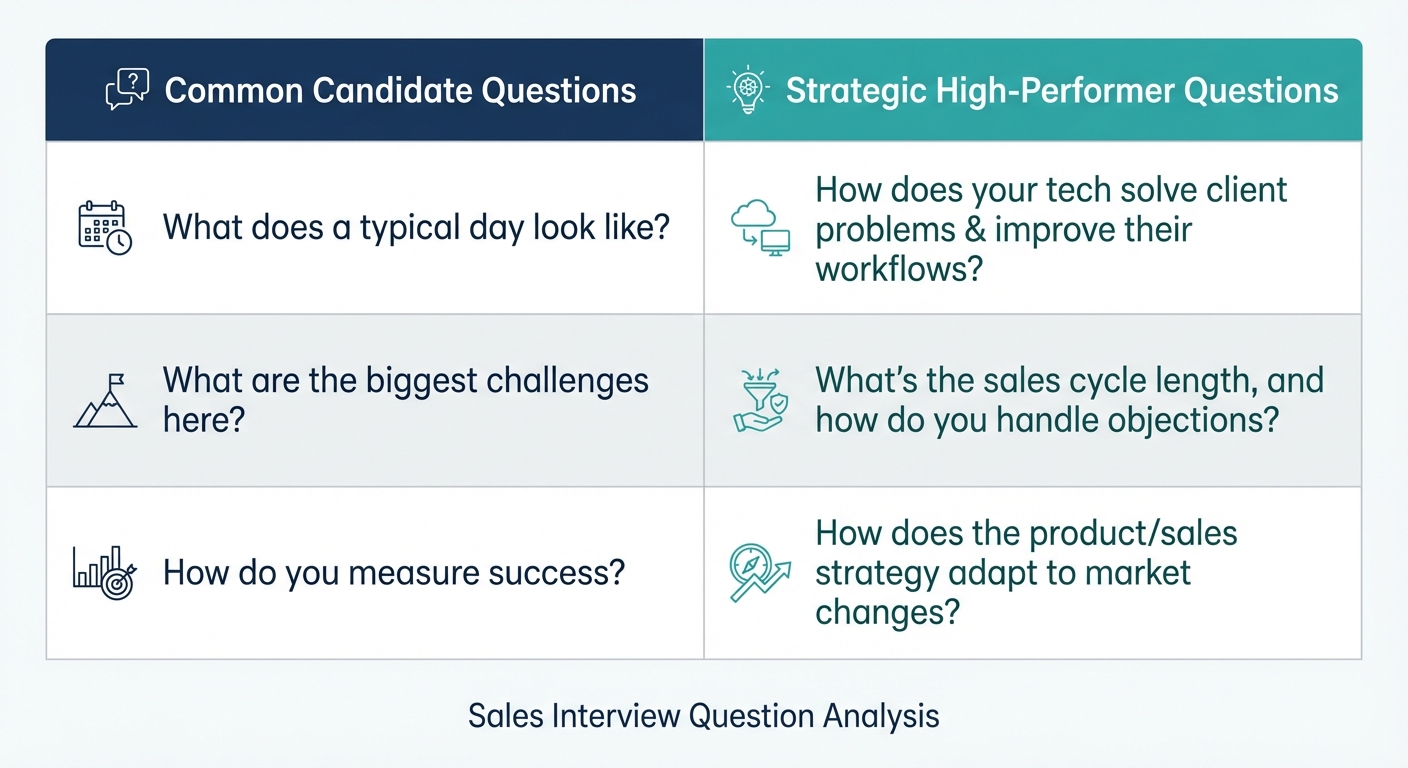
The software sales interview is a two-way evaluation. While you are assessing a candidate's fit, the most strategic applicants are simultaneously auditing your infrastructure, sales culture, and support systems. Identifying these "Green Flag" questions allows you to spot high-level thinkers who prioritize long-term performance over short-term wins.
Evaluating the Sales Environment and Infrastructure
Top-tier candidates know that their success is partially dependent on the tools and data visibility provided by the organization. They will ask questions that probe the health of your sales ecosystem:
Collaboration and Support Systems
In modern SaaS, sales is a team sport. Strategic candidates look for signs of sales and marketing alignment and a robust post-sale transition process:
By looking for these specific inquiries, hiring managers can distinguish between someone looking for any job and a strategic partner who will contribute to the company's operational maturity.
Aligning Hiring Strategy with Sales Performance Training
Connecting the recruitment process to ongoing development is essential for building a high-performing revenue team. When the interview is treated as the baseline assessment of a rep's skills, it sets the stage for continuous growth.
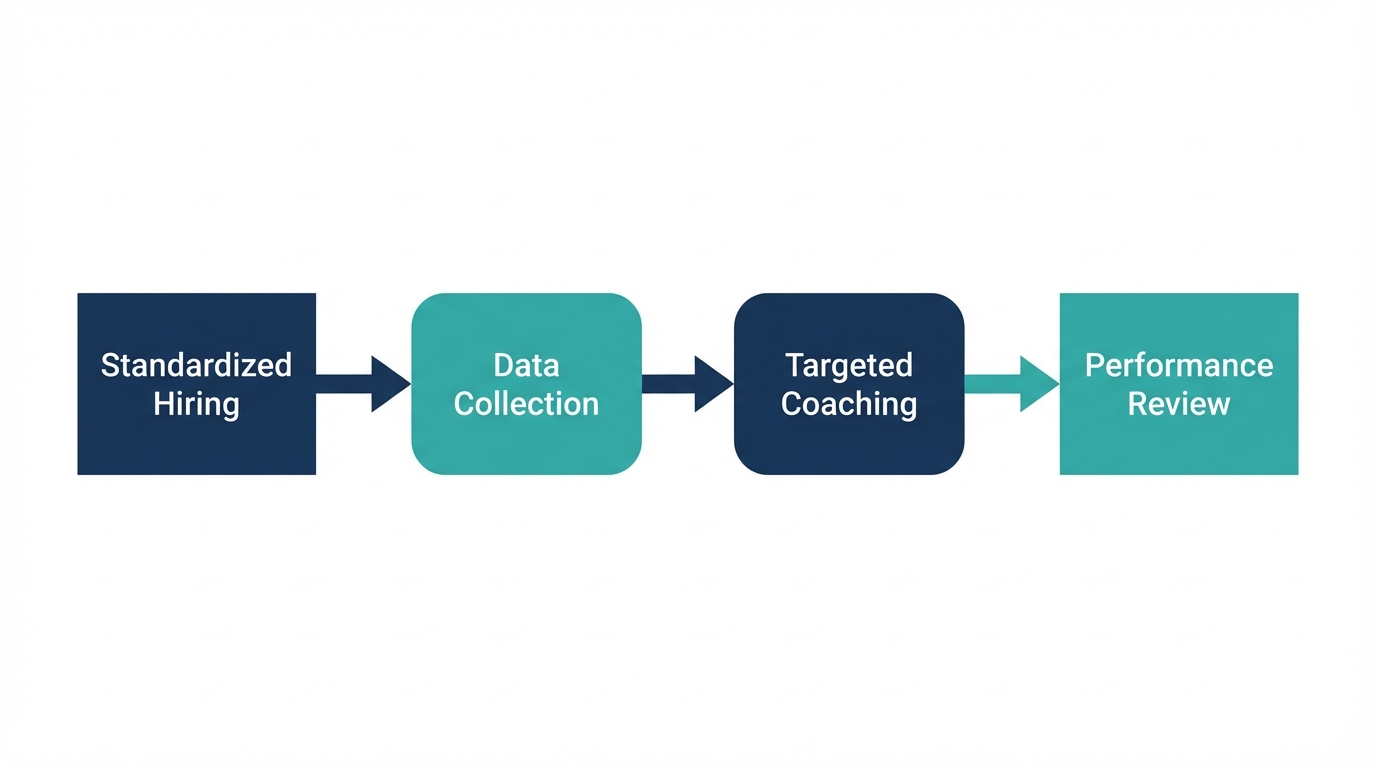
Building a Feedback Loop Between Hiring and Coaching
Effective sales organizations view the initial assessment as more than just a gatekeeper — it is the first step in a unified data cycle that informs how a new hire should be managed.
When every candidate is evaluated using a sales personality assessment and standardized rubrics, it creates clean data. This structured information allows leadership to identify specific skill gaps before the rep starts their first day.
Managers can then use these initial results to design targeted coaching tracks. If a candidate showed high empathy but struggled with closing during the roleplay, their onboarding can focus specifically on late-stage negotiation.
This feedback loop ensures that training is never generic or "one-size-fits-all." Instead, it becomes a data-driven extension of the hiring process that addresses individual needs immediately.
The Long-Term Impact of Standardized Evaluation
Using consistent criteria across the hiring team builds a foundation of measurable performance benchmarks. When every rep is hired against the same standards, the entire department moves toward a common goal.
This alignment makes it significantly easier to scale sales development programs. Leadership can look at aggregate interview data to see if the entire team needs help with specific areas like objection handling and tonality.
Standardization also leads to a much faster ramp-up time for new hires. Because their weaknesses were identified during the interview, they do not have to wait months for a manager to notice a performance issue.
Over time, this strategy creates a predictable revenue engine. By linking the interview directly to performance training, organizations turn hiring from a gamble into a repeatable science.
Software Sales Interviewing FAQs
How do you tell if a sales candidate is actually coachable during an interview?
The most effective way to test coachability is by providing real-time feedback during a roleplay exercise. Give the candidate a specific, actionable correction and ask them to repeat the scenario immediately. A coachable candidate will listen without becoming defensive and attempt to incorporate the feedback in their second try. This ability to adapt on the fly is a strong indicator of how they will respond to your internal sales management once they join the team.
What is the most important metric to verify in a software sales candidate's background?
Quota attainment is the primary metric to verify, as it provides context for their raw revenue numbers. A candidate who brought in one million dollars against a two million dollar quota is often a riskier hire than someone who hit five hundred thousand dollars against a four hundred thousand dollar target. Ask for a breakdown of their performance over the last four to eight quarters to ensure their success is a repeatable pattern rather than the result of a single lucky deal.
How can AI roleplay tools reduce bias in the sales hiring process?
AI roleplay tools remove the human element of subjectivity by presenting every candidate with the same customer challenges and objections. These platforms record and analyze specific behaviors such as tone, pace, and the inclusion of key value propositions. Because the software evaluates performance against a fixed set of criteria, it eliminates the unconscious biases that often cloud a manager's judgment during face-to-face interactions. This ensures that every hire is based on demonstrated skill and potential.
What are the red flags to look for when a candidate describes a lost deal?
A major red flag is the tendency to blame external factors like product limitations or pricing for a lost opportunity. High-level software sales require extreme ownership and the ability to navigate internal roadblocks. If a candidate cannot explain the specific reasons why they lost to a competitor or what they would change about their approach in hindsight, they likely lack the self-awareness needed for continuous improvement. Securing long-term success in SaaS starts with hiring individuals who can turn every failure into a strategic lesson for the future.
Elevate Your Hiring Standards
Ready to transform your sales hiring? Use Overvue.ai to run simulated roleplay interviews and identify top software sales talent before you hire. By integrating an AI sales assessment platform into your workflow, you can move beyond subjective impressions and rely on objective data to build your dream team.