
An adverse impact is a neutral employment practice that disproportionately screens out a protected group. The EEOC's practical screening tool is the four-fifths rule, which uses an 80% selection-rate ratio to flag possible disparity.
A sales hiring funnel can look consistent from the hiring manager's seat while producing very different outcomes for candidates. Every applicant may receive the same application form, automated questionnaire, AI roleplay, and structured interview, yet one group can disappear at a particular step. That's why understanding what is an adverse impact requires more than checking whether everyone received identical treatment.
Adverse impact focuses on results, not assumed motives. A neutral-looking test, cutoff, interview question, or algorithm may create a disproportionate barrier even when nobody designed it to exclude a protected group. The practical challenge is to identify where the disparity begins, determine whether the selection device is job-related, and preserve evidence supporting the decision.
A Hiring Scenario That Brings the Concept to Life
A software company is hiring a new group of sales development representatives. To process applications consistently, the recruiting team adds an AI-powered sales assessment. Every candidate completes the same asynchronous buyer conversation, responds to objections, and receives an automated score based on a shared rubric.
At first, the process appears orderly. Candidates receive the same scenario, and interviewers no longer score roleplays according to personal preference. The recruiting analyst then compares advancement rates by sex. The assessment filters out half of the female candidates, while 80% of the male candidates advance.
That result does not prove discriminatory intent. No hiring manager told the system to reject women, and the vendor did not promote a discriminatory feature. The model might react differently to speech patterns, response timing, familiarity with the scenario, or a rubric that favors one communication style. The outcome still requires investigation because one neutral-looking step is producing different results for different groups.
The plain-language definition
Adverse impact means that a seemingly neutral employment practice disproportionately excludes people in a protected group. The practice might be an application question, knockout item, AI score, interview cutoff, or offer approval rule. Analysts examine where selection rates separate, then ask whether the practice is related to the job and can be defended under applicable law.
A useful analogy is a funnel with the same opening for everyone. If one filter is narrower for a particular group, that group will emerge from the funnel less often, even though every candidate entered through the same opening. Equal instructions and identical screens do not establish equal selection outcomes.
That distinction matters for recruiters and sales leaders. Standardization can reduce variation between interviewers, but it cannot by itself show that a test or threshold measures sales performance fairly. A consistent barrier can still screen out one group at a higher rate.
For recruiters scaling headcount, the practical task is to record subgroup results at each hiring stage, from application review through offer approval. Teams can examine assessment design, candidate instructions, and score thresholds with Overvue's resources for hiring teams.
Practical rule: Equal treatment gives candidates the same process. Fair selection requires that process to be job-related and defensible when outcomes differ.
The four-fifths rule is an initial screen, not a verdict. A group's selection rate below 80% of the highest group's rate generally signals possible adverse impact. In a small AI-driven funnel, analysts should also examine the number of candidates at each step and the pattern across stages before drawing a conclusion.
How Adverse Impact Became a Legal Standard
The modern framework began with Griggs v. Duke Power Co., decided by the Supreme Court in 1971. The case established that an employment practice can be discriminatory without discriminatory intent when it disproportionately screens out a protected group and isn't related to successful job performance. That reasoning changed the employer's task. A neutral appearance was no longer enough.
Before that shift, a company could focus heavily on whether decision-makers held biased attitudes. Griggs placed greater attention on the effects of tests, diploma requirements, and other selection devices. If a requirement excluded protected applicants, the employer needed to show that the requirement measured something relevant to the work.
The principle became especially important in sales hiring. A college credential, a timed cognitive exercise, an interview score, or an AI-generated communication rating may look objective. Under a disparate-impact analysis, the important question is whether the device predicts or reflects the capabilities required for the sales job.
From court decision to operating guidance
The Uniform Guidelines on Employee Selection Procedures, issued in 1978, gave employers and enforcement agencies a practical framework for evaluating selection procedures. The EEOC's guidance describes the four-fifths rule as a screening tool for identifying serious differences in hiring, promotion, and other selection outcomes. It isn't a legal definition, and not every difference automatically establishes unlawful discrimination.
Congress later codified disparate-impact theory through the Civil Rights Act amendments of 1991. The legal framework therefore moved from a courtroom principle into a continuing compliance responsibility. Employers now need records that show not only who advanced, but also how each selection device affected different groups.
The same logic applies when a paper test becomes an automated assessment. Software can accelerate a decision, but automation doesn't remove the employer's responsibility to understand what the system measures, how it scores candidates, and whether the outcome differs across protected groups. Teams seeking practical ways to mitigate hiring bias for tech recruiters should treat the algorithm as a selection procedure that requires review, not as a neutral authority.
The legal question follows the employment practice, whether the practice is a handwritten test, a structured interview, or an automated score.
Measuring Adverse Impact With the Four-Fifths Rule
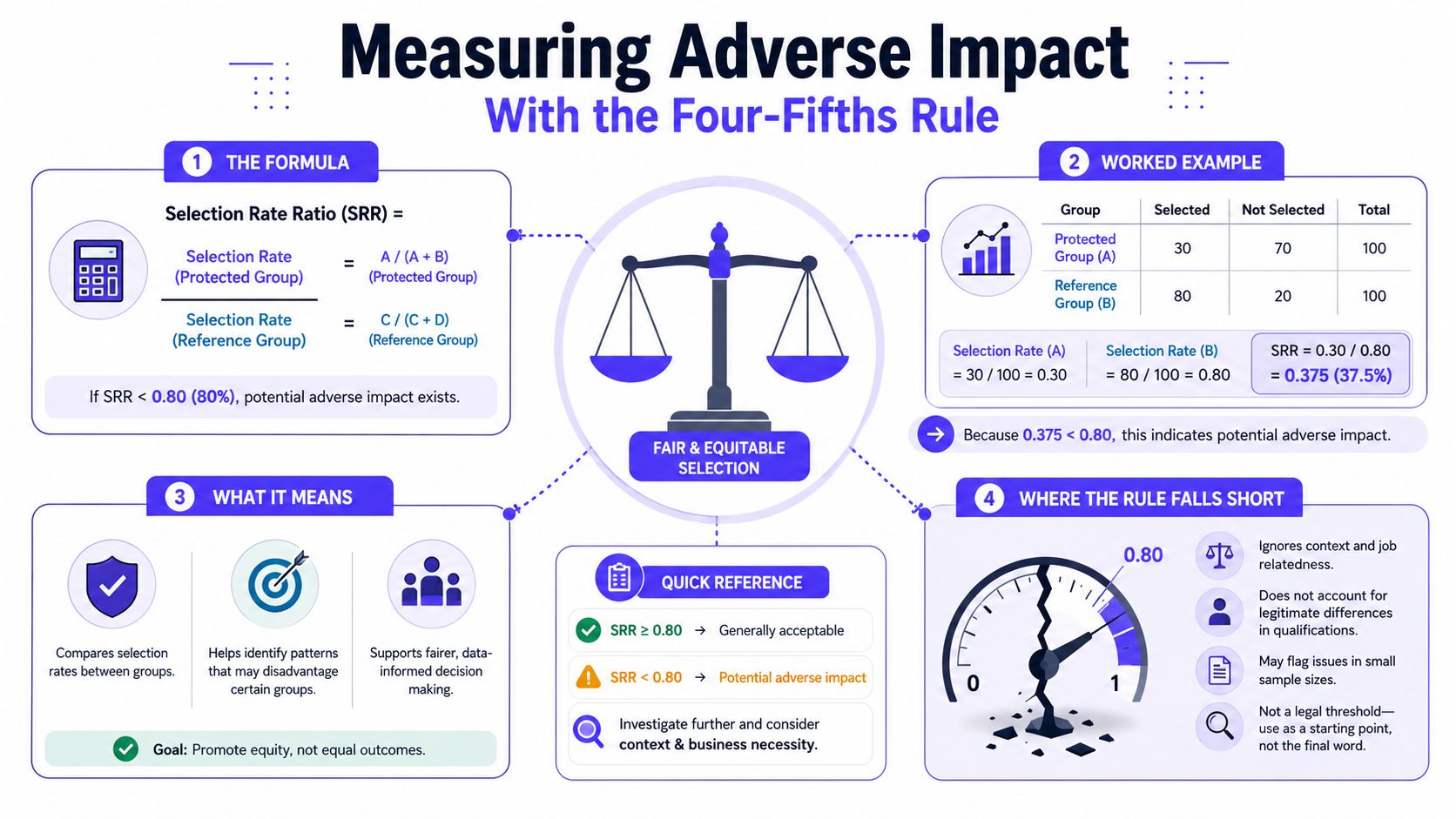
A sales hiring funnel can look balanced at the application stage and diverge at an automated screen. The four-fifths calculation helps locate that divergence by comparing selection rates, not raw applicant counts. For each group, calculate the percentage that passes the same stage. Identify the group with the highest rate, then divide each lower rate by that benchmark.
Suppose a company advances 50% of male applicants and 40% of female applicants to interviews:
40% ÷ 50% = 0.80
The result reaches the four-fifths threshold. If the female rate drops to 38% while the male rate remains 50%, the calculation changes:
38% ÷ 50% = 0.76
Because the result falls below 80%, the assessment warrants closer review. The four-fifths benchmark is a screening tool for identifying a disparity, not an automatic finding of illegal discrimination.
What the ratio can and cannot tell a team
A ratio shows a pattern, not its cause. The difference could reflect scenario design, a score cutoff, inconsistent instructions, a technical failure, a legitimate job requirement, or random variation in a small applicant group. The calculation also cannot show that one selection procedure caused the entire gap.
For example, a ratio of 0.80 may still require documentation if only a small number of candidates reached the stage. A hiring manager should record the eligible pool, the selection decision, the scoring rules, and any process changes before concluding that the result is stable. The EEOC's discrimination guidance describes adverse impact analysis as an examination of selection rates and the effect of each selection procedure. The four-fifths rule remains a guideline within that review.
Small, uneven groups make simple ratios unstable. Automated sales funnels can also include remote applications, asynchronous screens, assessments, interviews, and offers. An acceptable overall funnel ratio may conceal a substantial disparity at one stage because later decisions remove or add candidates in ways that obscure the earlier effect.
Use the calculation as a diagnostic trigger
For every stage, record:
- The eligible population: Define who entered that stage. Do not compare unrelated candidate pools.
- The selection event: State whether “selected” means invited, passed, interviewed, or offered.
- The group rates: Apply the same denominator method to each protected group.
- The comparison group: Use the highest selection rate as the benchmark.
- The context: Note sample-size limits, process changes, score thresholds, and unusual recruiting sources.
The calculation should start an investigation. Preserve the underlying records, inspect how scores affected advancement, and determine whether the procedure has validation evidence.
The Validation Requirement That Follows a Disparity
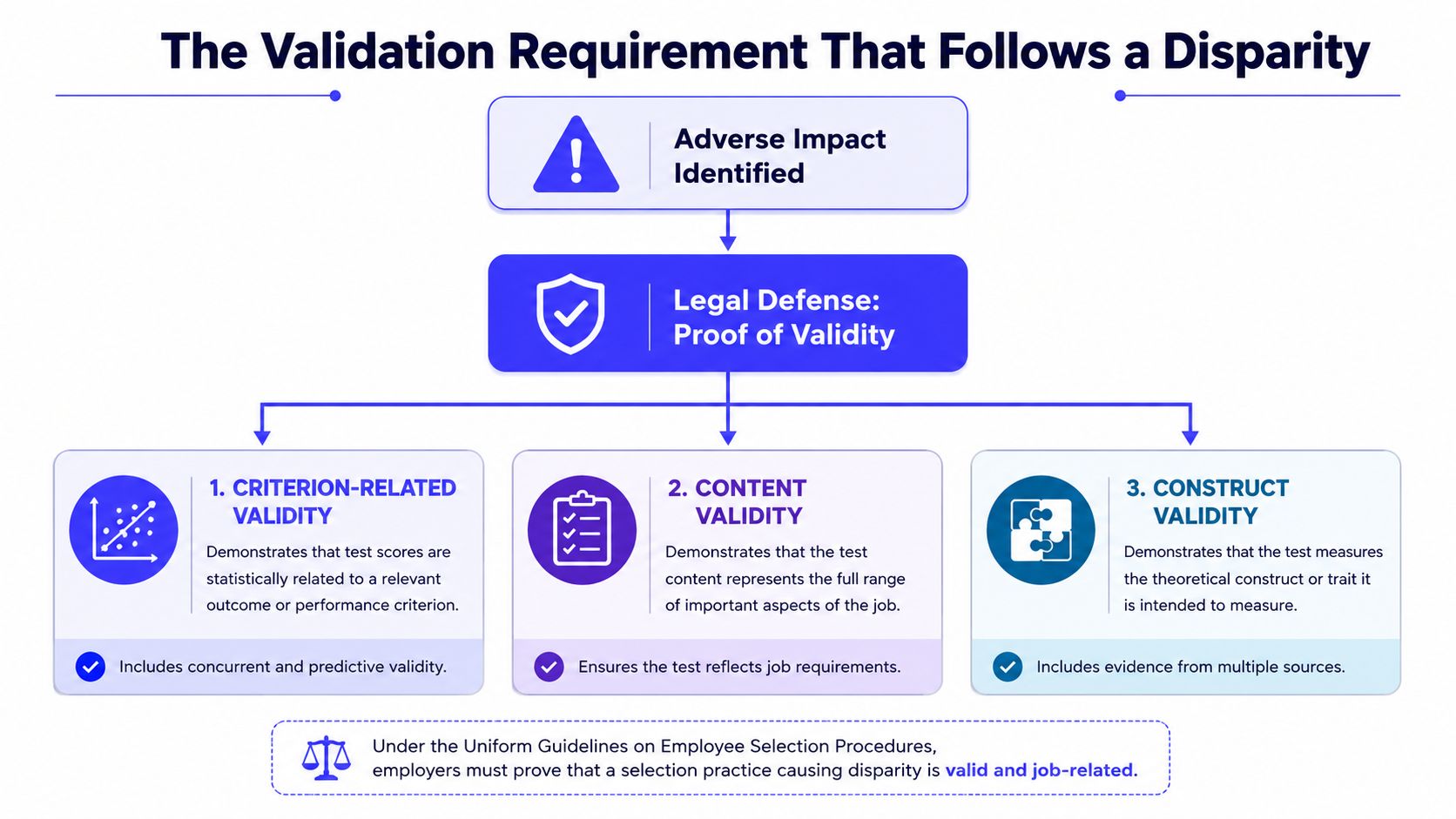
Once a selection procedure shows adverse impact, the employer needs more than a business preference to defend it. Under the Uniform Guidelines, a procedure with adverse impact is generally presumed discriminatory unless the employer can support it with validation evidence, or establish that validation isn't technically feasible and that continued use remains lawful. The applicable federal regulation describes three principal validation approaches: criterion-related validity, content validity, and construct validity.
Criterion-related validity
Criterion-related validity asks whether assessment results predict a meaningful outcome on the job. For a sales assessment, that could involve examining whether observed behaviors or scores relate to successful performance indicators selected by the employer. The evidence must connect the assessment to the actual requirements of the sales role, not merely to a manager's impression that high scorers “seem strong.”
A credible review defines the relevant job criteria first. It then examines whether the assessment score or component predicts those criteria consistently enough to support the hiring decision. If the assessment rewards fast answers but the role depends more heavily on discovery quality and accurate next-step execution, speed alone may be a weak defense.
Content validity
Content validity examines whether the assessment directly represents the work candidates will perform. A realistic sales roleplay can have stronger content relevance when it reflects the company's buyer, product context, common objections, and expected conversation flow.
That doesn't mean realism automatically proves validity. The scenario should reflect essential job behaviors, and the scoring rubric should evaluate those behaviors rather than style preferences. A rubric focused on objection handling, call control, responsiveness, and next-step execution is easier to explain than an undefined score for “executive presence.”
Construct validity
Construct validity asks whether the tool measures the underlying capability it claims to measure. If a vendor says an assessment measures consultative selling, the employer needs to understand what that construct means and whether the exercise captures it.
A tool can produce highly consistent scores while measuring the wrong trait. For example, an assessment may reward familiarity with a particular sales script instead of the ability to diagnose customer needs. The employer's documentation should therefore connect the construct, the assessment behavior, the scoring method, and the sales job.
The Uniform Guidelines regulation supports the cause-and-effect logic. If a score cutoff disproportionately excludes a protected group, the employer needs job-related evidence that the assessed behavior predicts or represents successful performance.
Evidence beats convenience. “The team has always used this assessment” isn't validation. A documented connection to the work is far stronger.
The same standard applies to borrowed interview questions, personality screens, automated speech analysis, and roleplay scoring. A well-designed pre-hire assessment guide can help teams think through job relevance, but each employer still needs records showing how its own role and process support the selection decision.
Mapping Adverse Impact Across Every Hiring Stage
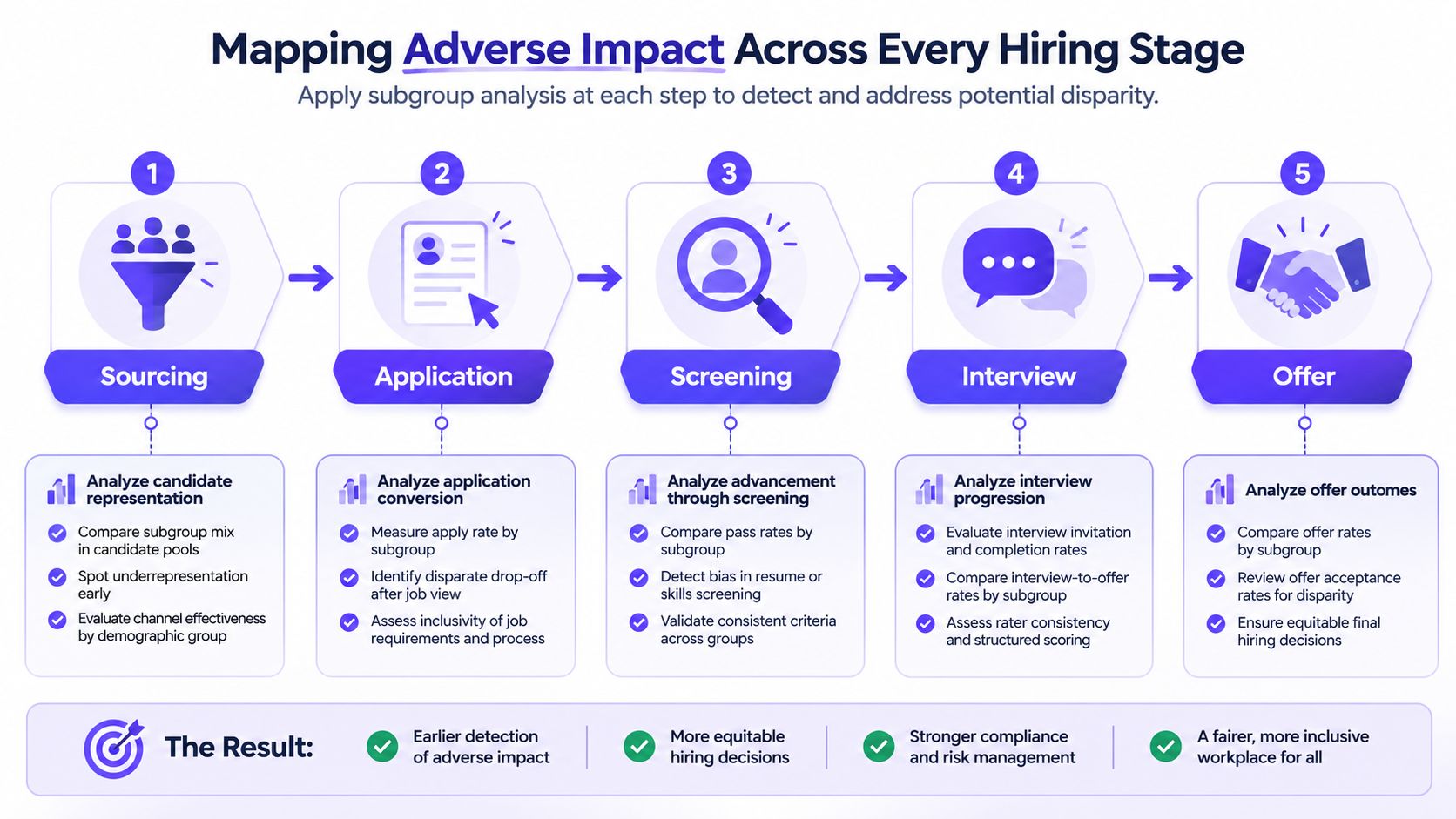
A sales hiring funnel should be reviewed as a chain of selection decisions, not one blended result. Start by naming each stage, defining which candidates were eligible to enter it, and comparing group advancement rates before the next decision occurs. In an automated funnel, this stage-by-stage view matters because a small early pool can conceal a meaningful shift in outcomes.
Start with the funnel map
A useful map may include sourcing, application, knockout questionnaire, automated sales assessment, structured interview, and offer. The labels can differ, but every stage should answer three questions: Who entered, who advanced, and what rule determined the outcome?
| Hiring stage | Decision to record | Risk to investigate |
|---|---|---|
| Application | Who completed and remained eligible | Requirements that discourage or exclude qualified applicants |
| Knockout questionnaire | Who passed each item | Questions unrelated to essential sales work |
| AI roleplay | Who met the score cutoff | Scenario, rubric, timing, or speech-related scoring effects |
| Structured interview | Who reached the next stage | Interviewer calibration and cutoff consistency |
| Offer | Who received an offer | Subjective overrides or undocumented exceptions |
The application stage can create a disparity before any assessment begins. A requirement for specific prior experience may narrow the pool without measuring the capabilities the sales role requires. The knockout questionnaire can add another barrier through availability, location, credential, or technology questions that lack a documented job connection.
Inspect the automated roleplay
The AI roleplay requires review at the criterion level. Separate the overall score from its components, then compare group performance on each criterion. Two groups may reach the total-score cutoff at similar rates while one group receives lower scores on a heavily weighted feature.
Scenario design also affects the result. A buyer persona using unfamiliar terminology, culturally narrow objections, or rigid response expectations may measure background familiarity rather than selling ability. Review whether the scoring engine evaluates observable behaviors, including identifying buyer pain, handling an objection, maintaining call control, and securing a clear next step.
The sales interview scorecard framework can help teams define consistent criteria before assessment begins. Its compliance value comes from the underlying discipline. Each criterion needs a behavioral definition, a scoring rule, and a documented reason it matters to the role.
Review stages separately
A funnel can appear neutral overall even when one stage creates the disparity. For example, suppose 60% of applicants pass screening, while only 30% of one group advances past the interview stage. A broad funnel ratio may hide the interview bottleneck because earlier and later decisions are blended together.
Later interviews may also make final hiring numbers look less different after an automated cutoff has already reduced the affected group's size. Stage-level records show where the odds changed, much like checking each gate in a series rather than inspecting only who reached the end.
Review the records after changing prompts, rubrics, vendors, cutoffs, or candidate instructions. A practical guide to steps for compliant hiring can support the review process, while counsel should assess the facts when a disparity appears. Keep the applicant counts, advancement decisions, scoring components, and reasons for exceptions together so analysts can distinguish a genuine stage effect from a small-sample fluctuation.
A funnel-wide ratio answers “what happened overall.” Stage analysis answers “where did the process change the odds?”
A Practical Checklist to Reduce Adverse Impact
A hiring manager can turn the legal framework into a repeatable operating routine. The goal is twofold: make candidates easier to compare and make each selection decision explainable.
-
Build scenarios from the actual ideal customer profile. Use the buyer role, customer pains, product context, competitors, and common objections. A scenario based on real sales work creates a clearer connection to the job than a generic conversation exercise.
-
Score observable behavior. Define what strong objection handling, call control, responsiveness, discovery, and next-step execution look like. Avoid criteria that let an automated system or interviewer reward personality, accent, confidence style, or familiarity with a particular script.
-
Set cut scores from job evidence. A cutoff should represent capabilities required for successful performance, not a convenient number chosen after reviewing a preferred candidate pool. Document who approved it, which job requirement it represents, and when the team will reassess it.
-
Analyze each funnel stage. Compare advancement at application, screening, assessment, interview, and offer stages. The EEOC's Selective Factor Initiative guidance supports examining the effect of each procedure rather than relying only on the final hiring outcome. In an automated funnel, this means reviewing the model or rule at the point where it changes candidate access.
-
Investigate disparities before scaling. A low selection ratio should prompt review of scenario wording, technical access, scoring components, interviewer behavior, and eligibility rules. A ratio above the four-fifths benchmark still requires documentation because that benchmark is not a complete legal test, especially when subgroup samples are small.
-
Retrain the process when evidence points to a problem. The correction may involve rewriting a scenario, removing an irrelevant question, recalibrating a rubric, changing a cutoff, or improving candidate instructions. Record the reason for the change, then monitor the revised process at the same stage and in later outcomes.
Documentation ties the checklist together. Keep the job analysis, assessment design, scoring rules, validation evidence, subgroup reviews, revisions, and decision owners in one record. That history helps the company distinguish a necessary job requirement from a habit that remained because nobody tested it.
Live simulated calls can produce clearer behavioral evidence than unstructured interviews or personality impressions. Simulation alone does not eliminate adverse impact. Employers still need consistent scenarios, job-related criteria, transparent scoring logic, and periodic subgroup analysis. Small samples may make ratios unstable, so review the underlying counts and repeat the analysis as additional candidates enter the funnel.
Turning Compliance Into a Competitive Hiring Advantage
Sales leaders who treat adverse-impact data as process intelligence can strengthen both compliance and hiring decisions. Three operating habits make that possible.
Measure every funnel stage. Review access at application screening, automated assessments, interviews, and final selection. An overall result may hide the point where one group loses access, like checking a pipeline only at the outlet instead of each valve.
Validate high-stakes tools against the work. A buyer scenario or scoring model should connect to observable sales behaviors and job performance. Tidy scores alone do not establish that connection.
Document continuously. Keep the criteria, cutoffs, subgroup analyses, validation evidence, and revisions together. This record helps decision-makers distinguish a genuine job requirement from a process habit that no one has tested.
The same standardized buyer scenarios can support onboarding and sales training after hiring. Candidates are assessed on observable work, managers receive comparable evidence, and new employees practice behaviors defined before the offer. Assessment and enablement then reinforce one another.
Operational checks also improve the candidate experience. Consistent instructions, clear scoring, and recurring subgroup reviews make the process easier to examine and revise when evidence points to an unnecessary barrier. Small samples can make ratios unstable, so review the underlying counts and continue monitoring later outcomes.
Overvue helps sales teams assess candidates through standardized AI buyer conversations, score observable behaviors such as objection handling and next-step execution, and reuse the same scenarios for sales training. Visit Overvue to see how a consistent assessment and practice workflow can support more defensible hiring.