A randomized field experiment found that badging increased sales by 21.5% and leaderboarding by 22.5% during the treatment period, while couponing produced a 31.7% lift in the study published through Information Systems Research. Those results reframe gamification in sales. The question isn't whether a leaderboard looks engaging. The question is whether the feedback loop changes a behavior that creates qualified pipeline, improves selling skill, or moves a deal forward.
That distinction matters in 2026. A market estimate places the global gamification market at $29.11 billion in 2025, with a projection of $112.32 billion by 2031, while another estimate values the global sales gamification platform market at $1.8 billion in 2025, projected to reach $5.3 billion by 2034 according to the cited industry reports. The category has moved beyond novelty, but many sales teams still use it to reward CRM activity rather than improve the decisions and conversations that produce revenue.
Table of Contents
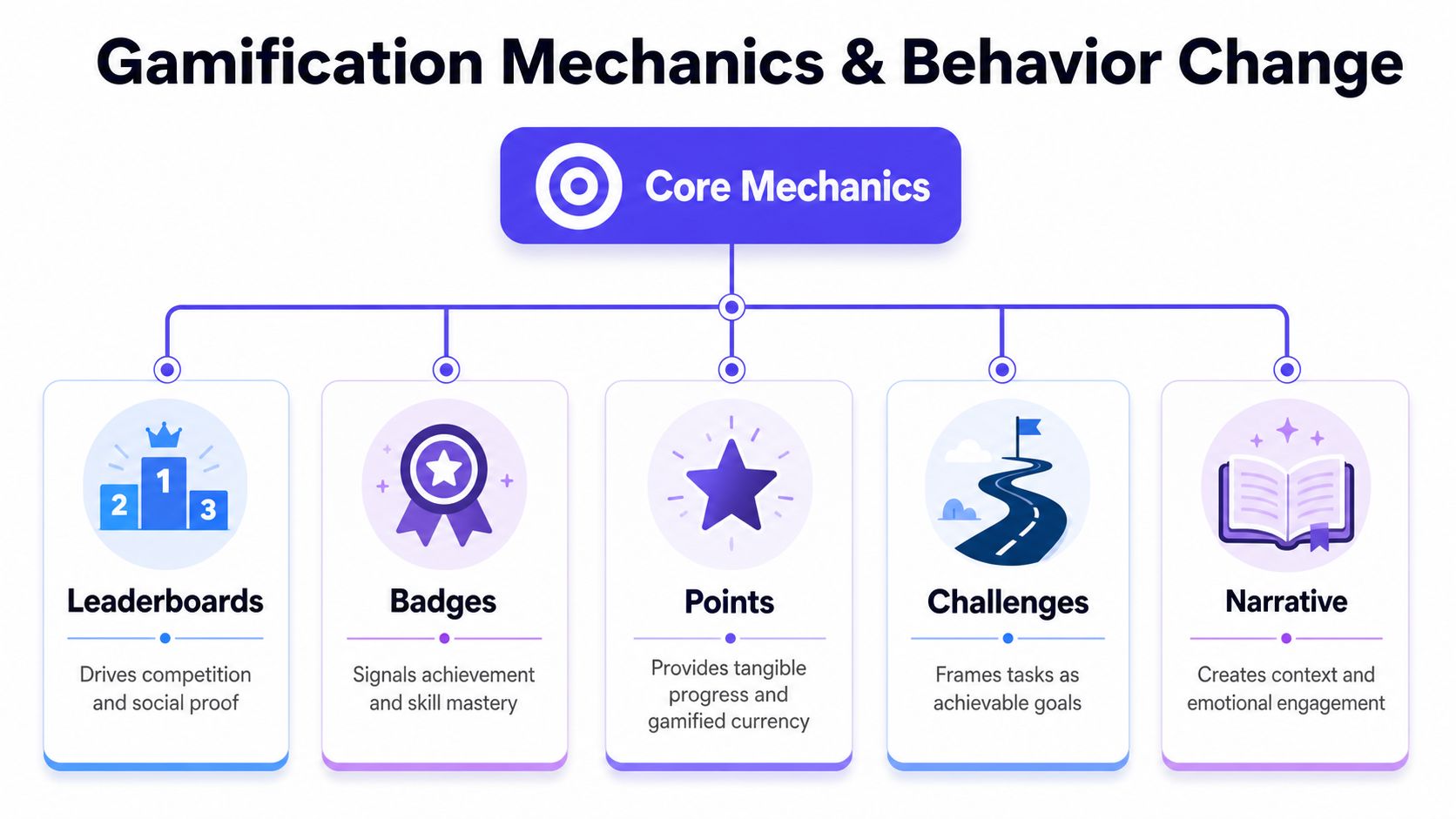
- Leaderboards create comparison
- Badges signal competence
- Points show movement
- Challenges narrow attention
- Narrative gives the work context
What Gamification in Sales Actually Means
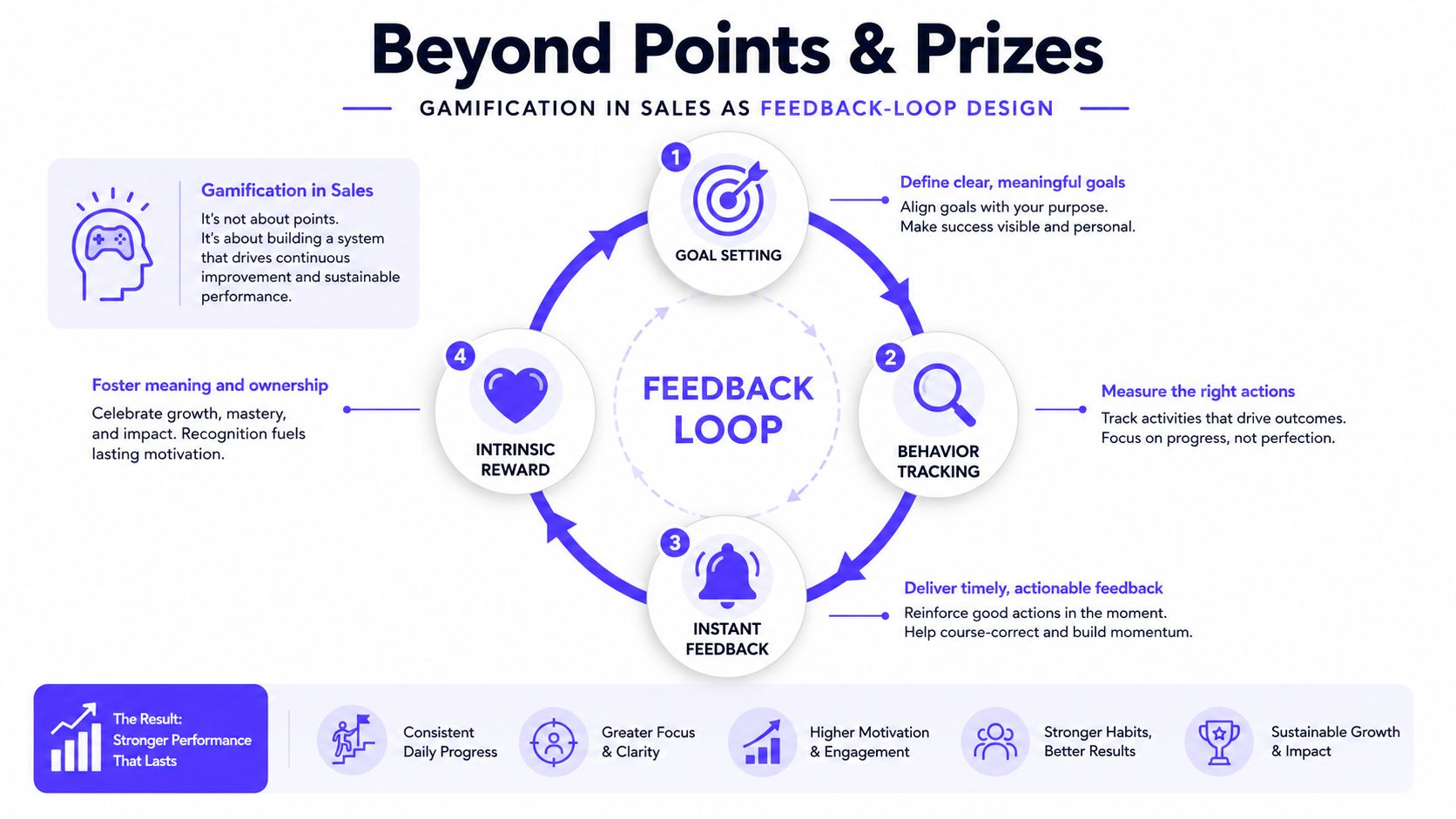
Gamification in sales is a feedback-loop design problem. A sales leader identifies a behavior, makes progress visible, delivers feedback close to the action, and gives the rep a reason to repeat the behavior. Points, badges, challenges, and leaderboards are optional interface elements. They aren't the system itself.
A useful working definition appears in AsanteBot's gamification definition, which frames gamification as the use of game elements in non-game contexts. For sales teams, that means adding structured motivational mechanics to prospecting, discovery, coaching, onboarding, or deal execution without turning the work into a literal game.
Four building blocks usually determine whether the design changes behavior:
- Clear goals: Reps need to know what action matters, such as completing a discovery simulation or recording a defensible next step.
- Immediate feedback: The system should show whether the action met the standard while the context remains fresh.
- Visible progress: A rep needs a view of movement toward a personal, team, or skill-based target.
- Voluntary participation: Reps should retain meaningful choice. Coercion may create compliance, but it can weaken ownership and learning.
Traditional incentive compensation operates on a different timescale. A commission plan usually influences decisions across a month, quarter, or year. A gamified feedback loop operates during the work itself, helping a rep decide whether to make another attempt, revise a talk track, or practice a weak skill.
That difference makes gamification closer to motivation engineering than to morale programming. A recognition moment after a well-executed objection response can reinforce a specific capability. A generic prize for the highest number of logged calls can reinforce data entry, regardless of call quality.
Practical rule: If a mechanic can't tell a rep what to repeat, stop doing, or practice next, it is decoration rather than enablement.
Sales gamification also belongs beside a structured sales training and enablement program, not apart from it. Training supplies the standard. The feedback loop makes that standard observable in daily work.
What the Research Shows About Sales Gamification
The evidence supports a narrower conclusion than “gamification boosts sales.” A mechanic can influence commercial outcomes, but its effect depends on the behavior it reinforces, the sales environment, and its effect on motivation. The practical distinction is between activity-volume gamification, which increases visible actions, and behavior-change gamification, which improves how those actions are performed.
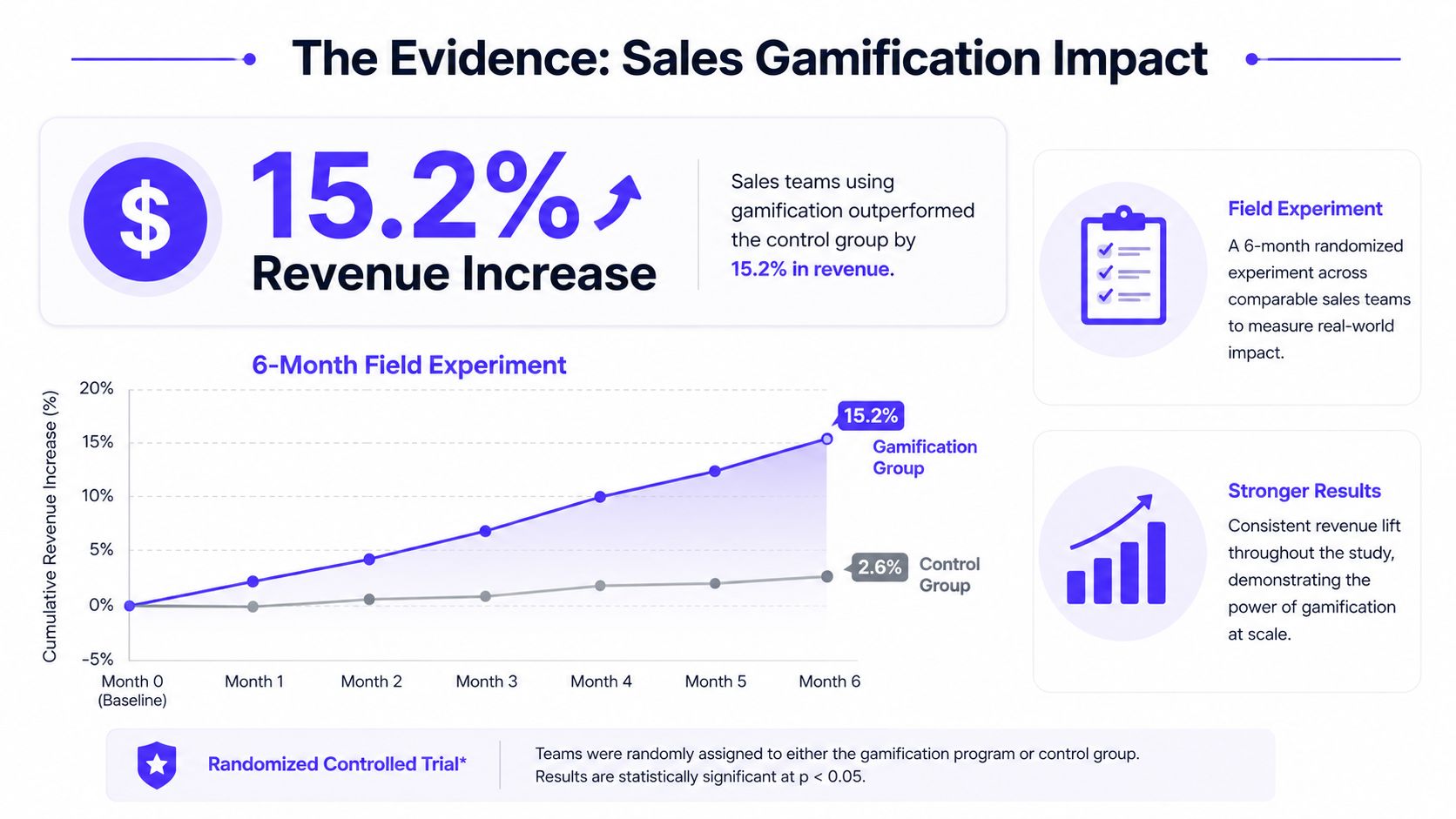
A randomized field experiment separated mechanics instead of treating gamification as one intervention. Badging produced a 21.5% sales increase, leaderboarding produced a 22.5% increase, and couponing produced a 31.7% lift during treatment in the reported study. These results do not establish a universal return for badges or leaderboards. They show that a game layer can affect sales when it connects to a meaningful commercial action.
A separate professional services field experiment reported 36% higher fees collected, 16% more new clients, and 22% more new business opportunities across 24 offices over 29 months. Those outcomes are more informative than participation totals because they connect the intervention with collection, acquisition, and opportunity creation. They also suggest that evaluation should continue past the activity dashboard and examine commercial movement.
A telecom-franchise field experiment used narrative gamification with 81 employees over two months and found that the gamified unit outperformed the comparison unit on sales-volume change in the reported study. The useful design clue is the combination of progress visibility and story framing. A narrative may help sustain attention, but it does not replace coaching, sound qualification, or practice.
Where the evidence becomes less comfortable
A sales-team case study examining points, leaderboards, rewards, and challenges found that competition and cooperation could create extrinsic motives. It also warned that prescription-heavy systems may trigger overjustification effects. External rewards can crowd out autonomy or perceived competence, weakening deeper engagement as discussed in the cited case study.
Three conclusions follow:
- Mechanics can change outcomes: The strongest evidence links selected mechanics to sales, fees, clients, opportunities, or sales volume.
- Context controls transfer: A result from one sales setting is not a universal benchmark for another.
- Motivation can reverse: A system that dictates every action and overemphasizes external rewards may produce compliance while damaging ownership.
The strongest use case is therefore operational coaching and skill practice, not a public contest by default. A program should reinforce better conversations, follow-up quality, or verified capability before it rewards more CRM entries. Leadership should approve gamification as a measurable behavior intervention, not as a promise of automatic revenue growth.
Core Mechanics and How Each One Changes Behavior
A mechanic is a delivery method. A metric is the behavior or outcome attached to it. Confusing those two creates bad programs, because the same leaderboard can reinforce excellent follow-up or meaningless activity depending on what it ranks.
Leaderboards create comparison
Leaderboards trigger social comparison and make relative progress visible. A team might rank reps on qualified next-step completion rather than raw CRM updates. That can create urgency around deal execution.
The failure mode is predictable. A public ranking based on closed revenue can make the contest unwinnable for reps with smaller territories, newer books, or lower starting performance. Team-only rankings, personal-best views, or tiered comparisons reduce the damage without removing accountability.
Badges signal competence
Badges work best as competence signals. A badge for verified objection handling communicates something different from a badge for completing a login streak. The first marks a skill. The second mostly marks participation.
Badge design should make the standard visible and defensible. Guidance on recognition badges, points, rewards, and leaderboards from HubEngage offers useful context for distinguishing recognition from indiscriminate reward. A badge loses meaning when the team can't explain what capability earned it.
Points show movement
Points provide a progress currency. They can combine actions that matter across a workflow, such as completing practice, applying feedback, and executing a documented next step. They help reps see movement before a deal closes.
Points become dangerous when values are arbitrary or disconnected from quality. If a low-value activity earns more recognition than a difficult selling behavior, reps will rationally optimize the score.
Challenges narrow attention
Challenges frame work as an achievable target and can support autonomy when reps choose among relevant paths. A manager might offer a discovery challenge, an objection-handling challenge, and a follow-up challenge, then let each rep select the skill requiring the most improvement.
Short challenges can focus attention, but constant contests create fatigue. The design should preserve a stable learning path rather than forcing reps to chase a new reward every day.
Narrative gives the work context
Narrative framing connects a task to identity and meaning. A new-hire program might position each simulated buyer conversation as a stage in earning the right to manage a more complex sales scenario. The story helps a repetitive practice session feel connected to professional growth.
Narrative fails when the theme overwhelms the selling standard. Reps need to understand the buyer, the business problem, and the required behavior. A story cannot compensate for vague scoring.
For leaders building practice into the operating rhythm, role-playing for sales simulations provides a useful way to connect mechanics with observable behavior.
Choosing Metrics That Drive Revenue Instead of Vanity
The most common failure in gamification is not a weak interface. It's a weak metric.
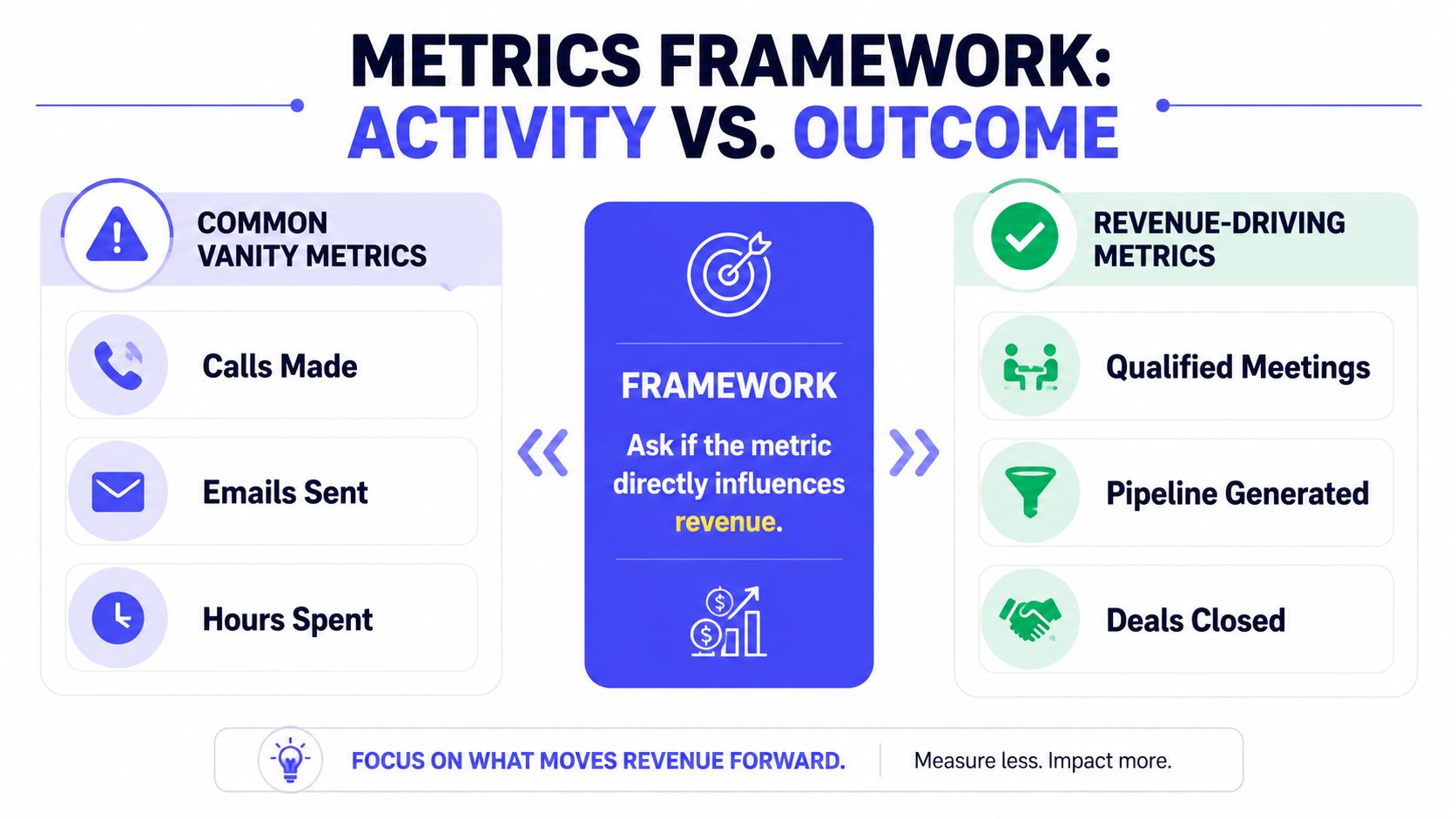
Calls logged, emails sent, and hours spent are easy to count. They can also be easy to inflate without improving buyer relevance, qualification, or deal progression. A leaderboard that rewards those figures may make the CRM look busy while teaching reps that volume matters more than judgment.
A better audit asks one question: Does this metric represent a behavior that can plausibly move a buyer toward a valuable next step?
| Metric type | What it reveals | Main risk |
|---|---|---|
| Calls made | Attempted activity | Reps can maximize volume without improving conversations |
| Emails sent | Outreach output | Message quality and buyer fit remain hidden |
| Meetings booked | Initial conversion | Poorly qualified meetings can create downstream waste |
| Qualified pipeline generated | Commercial relevance | Requires consistent qualification standards |
| Objection-handling score | Selling skill | Needs a repeatable assessment method |
| Next-step execution | Deal discipline | Requires clear definitions and timely observation |
The table exposes a useful distinction. Activity metrics can be leading indicators, but they aren't automatically good gamification targets. A call matters more when it produces a relevant conversation, advances qualification, or creates a defensible next step.
Measure skills managers usually can't see
Managers rarely observe every objection, interruption, concession, or follow-up decision. Gamified practice can make those behaviors visible before a live deal exposes a weakness. A simulated call can score whether a rep clarified the objection, maintained call control, responded to buyer context, and secured a specific next action.
That approach aligns with the broader question of how gamification can support learner retention, but sales leaders should still judge retention by transfer. A rep remembering a product fact isn't enough. The relevant test is whether the rep can apply the knowledge during a realistic buyer exchange.
The KPI stack should therefore combine three layers:
- Input behavior: Is the rep completing the relevant work?
- Skill behavior: Can the rep execute the behavior to the required standard?
- Commercial outcome: Does the behavior contribute to qualified pipeline or deal movement?
The sales enablement KPI framework for 2026 can help leaders place gamified measures inside a wider operating model. The central safeguard remains simple: never reward a number that the team can improve while making the customer experience worse.
From Public Contests to Daily Skill Practice
Public contests optimize attention. Private skill practice optimizes capability. Sales leaders need to know which problem the program is solving before selecting the format.
A public leaderboard can make effort visible and create social energy, especially when the metric is fair and the contest has a clear endpoint. It becomes noisy when reps compete on raw activity, when low-ranked participants see no realistic path to progress, or when the public ranking turns coaching into status management.
A private practice loop starts somewhere else. It gives the rep a buyer scenario, a defined objective, a chance to respond, and feedback against explicit criteria. The rep can repeat the scenario, test a revised response, and observe whether the score improves. That sequence targets behavior change, not merely activity volume.
Why simulated buyers fit the model
An AI buyer simulator built from a company's ideal customer profile can present the context that makes practice useful:
- Buyer conditions: Role, business situation, pains, and priorities.
- Conversation friction: Common objections, competitor references, and constraints.
- Evaluation criteria: Objection handling, call control, responsiveness, and next-step execution.
- Repeatability: The same scenario can assess different reps against a consistent standard.
Automatic criteria-based scoring closes the loop quickly. Instead of waiting for a manager to review a recording or hear a live call, the rep receives an indication of what happened and what requires another attempt. The system can then attach progress to a skill, not to a superficial activity count.
A team leaderboard can still play a role, but it should compare skill ratings or improvement, not the number of times a rep touches the CRM. That distinction protects lower performers from a permanent public ranking while giving high performers a reason to refine difficult behaviors.
Overvue is one example of this model. Its platform uses AI buyers modeled on a company's ICP, standardized sales scenarios, automatic scoring against criteria such as objection handling and next-step execution, daily challenges, progress tracking, and team-only leaderboards. The relevant design choice isn't the presence of XP or achievements. It's the connection between repeated simulation, observable behavior, and feedback.
Design test: A rep should be able to answer, “What did the system help improve today?” If the answer is only a higher activity count, the loop is incomplete.
This model also changes the manager's role. Managers still define the selling standard and coach exceptions, but they don't need to personally create every practice scenario or score every attempt. Gamification becomes an operating layer for enablement, with competition used selectively after the learning signal is trustworthy.
Common Misconceptions That Undermine Sales Gamification
Badges motivate everyone
Badges appeal to reps who value visible mastery, but no mechanic motivates every role or personality in the same way. A badge supports competence when it marks a real capability. It feels childish or patronizing when it rewards routine compliance.
Give reps more than one route to progress. Options can include skill mastery, personal improvement, team contribution, or consistent execution. Keep the criteria concrete, and show how each achievement relates to selling work.
Leaderboards are neutral
A leaderboard changes the social environment around performance. Public comparison may motivate some reps while discouraging others, especially when rankings reflect territory, tenure, account mix, or timing as much as selling skill.
Choose the comparison with care. Personal-best views, team rankings, role-specific cohorts, and skill-based progress preserve visibility without turning the lowest position into an identity. The ranking should help a rep decide what to practice next, rather than imply where that person belongs.
More mechanics produce better results
Points, badges, levels, streaks, narratives, notifications, and rewards do not automatically form a stronger program. Each mechanic creates another choice for the rep and another maintenance task for the manager. A crowded design can hide the behavior the team needs to improve.
The practical lesson from the research is narrower than “add more motivation.” External rewards can interfere with engagement when they reduce autonomy or make competence feel externally controlled. In a sales program, remove any mechanic that does not improve feedback, make progress visible, support skill practice, or provide meaningful recognition.
A sound program starts with one behavior and one feedback loop. After the team shows better execution without reduced trust, other mechanics can earn a place. The strongest game layer is often barely noticeable, because the rep experiences it as useful coaching rather than management theater.
A 90-Day Implementation Plan for Sales Leaders
A sales leader doesn't need a dedicated gamification engineer to run a disciplined pilot. The pilot needs a narrow behavior, a fair comparison, a reliable scoring method, and a decision rule.
Days 1 to 30
Start with a baseline of the existing activity, skill, and commercial measures. Select one behavior that managers can observe or assess, such as objection handling or next-step execution. Choose a pilot cohort that represents the team, define the scoring standard, and document what won't count.
The first checkpoint should ask whether the metric is reliable before asking whether it is motivating. If reps interpret the score differently, the mechanic will create arguments instead of learning.
Days 31 to 60
Launch the feedback loop with a predictable cadence. Give reps immediate progress visibility, add coaching prompts, and use private or team-only comparison where public ranking would create avoidable pressure. Managers should review patterns, not just winners, and connect practice results to live-call coaching.
Collect qualitative feedback during the pilot. Reps can identify whether the scenario feels realistic, whether the score explains the result, and whether the challenge encourages better selling or faster clicking.
Days 61 to 90
Compare pilot performance with the pre-pilot baseline and examine all three measurement layers. Activity may rise while skill quality stays flat. Skill scores may improve before commercial outcomes move. The expansion decision should account for both signal and sustainability.
| Phase | Focus | Key outputs | Success signal |
|---|---|---|---|
| First 30 days | Baseline and design | Target behavior, scoring standard, pilot cohort | Reps understand the target and managers trust the measure |
| Days 31 to 60 | Feedback and coaching | Practice cadence, progress visibility, coaching notes | Reps repeat the behavior and can explain their feedback |
| Days 61 to 90 | Evaluation and decision | Baseline comparison, rep feedback, expansion recommendation | Skill or commercial indicators improve without harmful metric gaming |
A CRO-ready review should include:
- Activity checkpoint: Whether the targeted work is occurring more consistently.
- Skill checkpoint: Whether reps perform better against the defined criteria.
- Outcome checkpoint: Whether qualified pipeline or deal execution shows a meaningful improvement.
- Fairness checkpoint: Whether role, tenure, territory, and access to opportunity distort the contest.
- Sustainability checkpoint: Whether reps still participate when novelty and prizes lose their initial pull.
If the pilot produces more CRM noise, the right decision is to kill or redesign it. If it produces clearer coaching data and better execution, expansion should preserve the narrow mechanic that worked rather than add complexity for its own sake.
Overvue gives sales hiring and enablement teams a way to run repeatable AI buyer simulations, score objection handling, call control, responsiveness, and next-step execution, and structure practice with progress tracking and team-only leaderboards. Sales leaders can visit Overvue to evaluate whether an evidence-based skill-practice loop fits their hiring or training program.