
A sales hiring manager builds a roleplay for a target company using only industry, company size, and technology stack. The candidate recognizes the account type, but then struggles when the simulated VP of Operations challenges implementation effort, questions the business case, and asks whether the team can switch from an incumbent system. The manager has tested account familiarity, not selling behavior.
That mistake sits at the center of ICP vs buyer persona confusion. An ideal customer profile identifies the companies a revenue team should pursue. A buyer persona describes the people inside those companies and the way they evaluate a purchase. Hiring assessments and training programs need both, because a rep can understand the right account and still mishandle the conversation.
| Criteria | Ideal customer profile | Buyer persona |
|---|---|---|
| Target level | Company or account | Individual stakeholder |
| Core inputs | Industry, revenue, headcount, geography, business model, technology stack, buying triggers | Role, seniority, goals, pains, objections, success metrics, information habits |
| Primary decision | Which accounts deserve attention | How to communicate with each stakeholder |
| Sales application | Qualification, account prioritization, territory design | Messaging, discovery, objection handling, coaching |
| Hiring application | Scenario context and account fit | Roleplay behavior and scoring criteria |
Why Teams Confuse ICP and Buyer Persona in Hiring
The confusion usually starts with a reasonable shortcut. A hiring manager gives a candidate a target account description, adds a prospect title, and assumes the resulting exercise represents a buyer persona. It doesn't. Company size and industry tell the candidate what kind of organization exists on the other side of the call, but they don't explain what the stakeholder wants, fears, measures, or needs to believe before agreeing to a next step.
That gap affects the quality of the assessment. A candidate might describe the target market accurately while failing to ask a VP of Operations how the current process affects the team, what prompted a review, or who else must approve a change. If the evaluator scores only preparation and product knowledge, the exercise rewards memorization instead of observable sales capability.
Practical rule: If the prompt tells a candidate which company to call but not how the stakeholder thinks, the prompt contains an ICP, not a complete persona.
A clean self-check asks what decision the exercise is testing:
- Account fit: Can the candidate identify why this company belongs in the territory or target list?
- Conversation fit: Can the candidate adapt discovery, value framing, and objection handling to the person in front of them?
- Buying-group awareness: Can the candidate recognize that another stakeholder may influence the decision?
The correct mental model is simple: ICP selects the account, persona shapes the conversation inside it. That distinction gives sales leaders a practical way to separate recruiting criteria from roleplay criteria. The account context should remain consistent across candidates, while the stakeholder's priorities and objections should expose how each candidate sells.
ICP and Buyer Persona Definitions at Two Levels
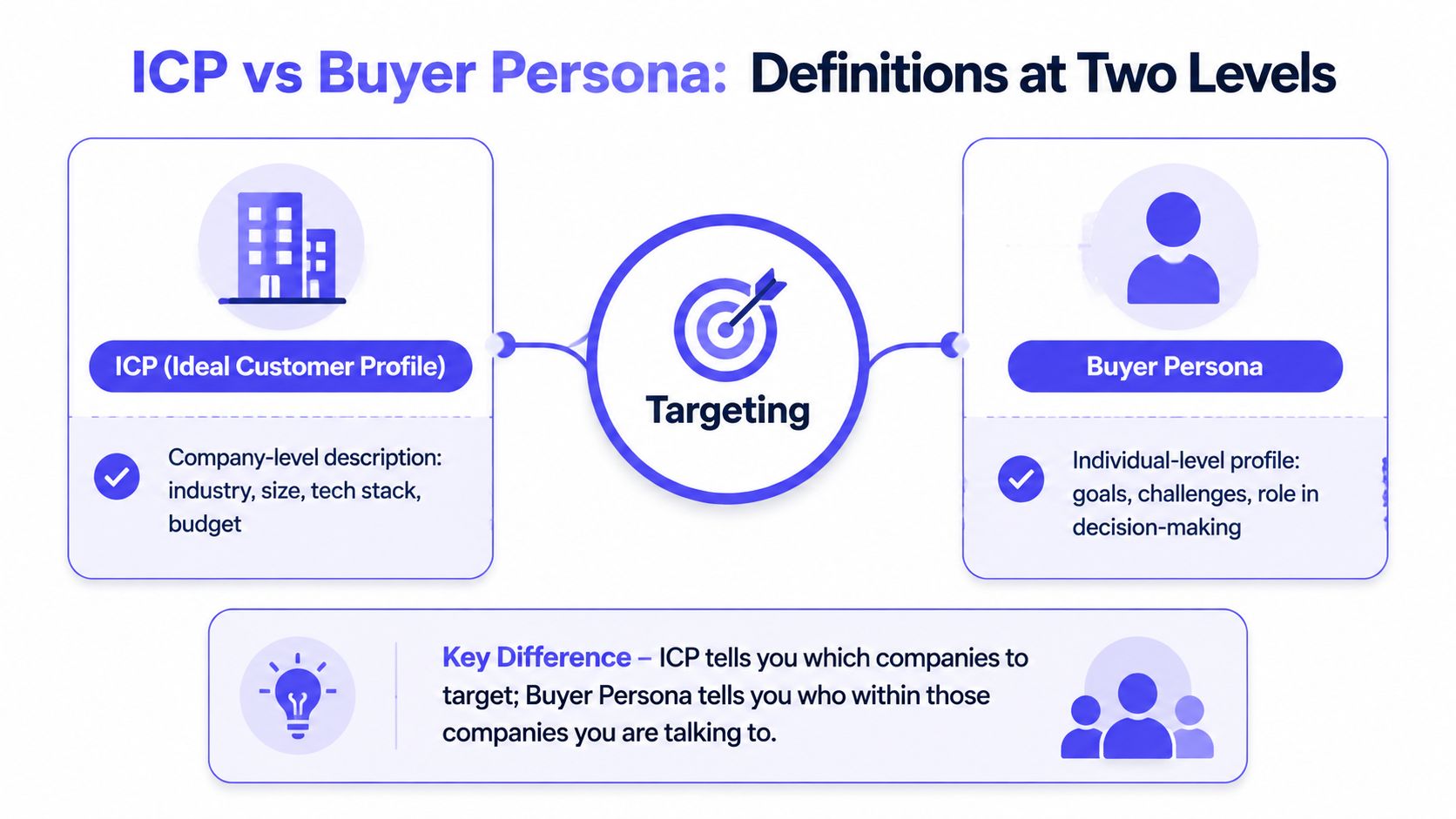
An ideal customer profile, or ICP, defines the type of company that fits a product or service. Salesforce describes it as a company-level assessment of fit. A buyer persona represents an individual stakeholder, based on research and data, as explained in its guide to ideal customer profiles.
The ICP helps sales teams decide whether an account belongs in the target market:
- What industry does the company serve?
- Does its business model support the problem being solved?
- Is its technology environment compatible with the product?
- What buying trigger signals an active need?
- Which company characteristics indicate commercial fit?
The persona guides the conversation with a person inside that account:
- What role does the stakeholder play in the decision?
- Which outcomes and metrics shape their priorities?
- What operational pain makes the issue urgent?
- Which objections could delay a purchase?
- How do they gather information and build internal support?
The distinction matters because B2B purchases usually involve several stakeholders. The Salesforce benchmark describes an average enterprise B2B buying committee of 11 stakeholders, rising to 14 to 23 stakeholders for deals above $100K ACV. It also reports that buyers complete about 70% of the decision process before contacting sales. A single-contact targeting model cannot account for that buying group.
An ICP sets the account context. Personas turn that context into role-specific selling situations. Finance may assess commercial risk, operations may focus on workflow disruption, and an executive sponsor may look for strategic impact. The account remains constant, while the discovery questions, proof points, objections, and AI roleplay prompts change by stakeholder.
For recruiting and training, convert the ICP's firmographics into a scenario first. Keep the company, industry, trigger, and business problem fixed, then assign a stakeholder with defined goals, metrics, concerns, and approval influence. That setup lets an AI simulation test whether a candidate can move from account selection to persona-led discovery.
A useful hiring-debrief definition is: the ICP tells the team which companies to pursue, and buyer personas tell the team how the people inside those companies decide. If a candidate can explain the first but cannot demonstrate the second, the assessment measures only part of the role.
ICP vs Buyer Persona Across Key Criteria
The practical difference becomes clearer when both frameworks are evaluated by their inputs and operational consequences. An ICP is a measurable account-selection tool. A persona is a behavioral and communication tool used after the account has qualified.
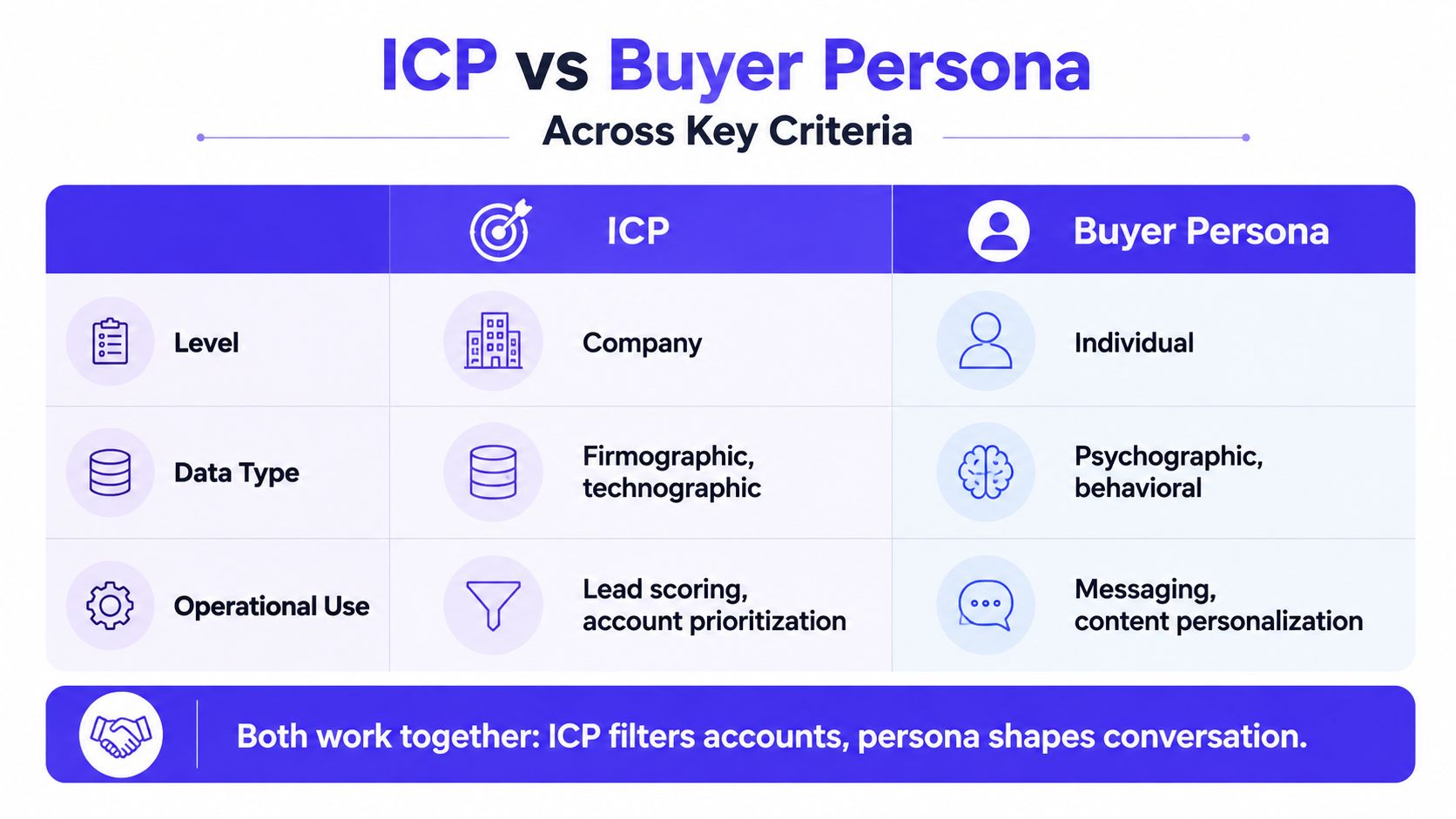
The ICP uses firmographic and technographic inputs, such as industry, revenue, headcount, geography, business model, technology stack, and buying triggers. Those fields support territory planning, account scoring, qualification rules, and account-based marketing. The ICP and buyer persona comparison from Puetto describes the ICP as the first filter for narrowing the account universe.
The persona uses role and behavior inputs, including seniority, responsibilities, goals, pains, objections, success metrics, and information habits. These details shape email language, discovery questions, demo emphasis, objection responses, and coaching prompts. A persona isn't a more detailed ICP. It answers a different operational question.
The data types also differ. Segmentation teams can analyze account characteristics quantitatively, while persona work generally requires qualitative understanding of how people make decisions. In sales hiring, that means an ICP can establish the scenario's commercial context, but the persona must establish the human tension that makes the call meaningful.
A candidate should not receive credit for repeating firmographic details during a simulated conversation. The relevant question is whether the candidate converts those details into useful behavior. If the account is running a particular technology stack and has a relevant buying trigger, can the candidate ask why the change matters now? If the stakeholder owns implementation, can the candidate address adoption risk rather than defaulting to a generic product pitch?
ICP scoring evaluates account judgment. Persona scoring evaluates conversational judgment. Strong assessments keep those dimensions visible instead of blending them into an impressionistic overall score.
Performance Gaps from Documented ICP and Personas
Documentation gives revenue teams a shared standard for deciding which accounts deserve attention and how reps should engage the people inside them. Without that standard, hiring assessments often reward generic selling behavior instead of judgment tied to the company's target market.
A 2019 SiriusDecisions and Forrester benchmark reported that 65% of high-growth B2B companies with 40% or more year-over-year revenue growth had a documented ICP, compared with 14% of no-growth firms, as summarized in this B2B ICP and buyer persona benchmark. The comparison does not show that documentation alone produces growth. It does show that disciplined account definition appears more often in organizations operating successfully at scale.
Persona adoption reveals a separate execution gap. A 2016 Cintell benchmark found that only 44% of B2B marketers used formal buyer personas. Later analyses of that data reported 73% higher conversion rates and 2.2x more effective lead generation for teams with well-defined personas. Another benchmark reported that companies with documented personas were 2.3x more likely to exceed revenue goals. These findings support a practical conclusion: persona documentation matters when it changes messaging, discovery, and coaching behavior.
What the numbers mean for sales leaders
The response should not be another library of templates. ICP and persona documents support different management decisions:
- ICP documentation: Defines the target account universe, territory priorities, and qualification standards.
- Persona documentation: Sets expectations for discovery, objection handling, messaging, and coaching.
- Shared operating model: Gives hiring managers a consistent way to test the behaviors new hires will practice after joining.
High-performing B2B teams typically maintain 3 to 5 personas per product line and refresh them every 6 to 12 months. Persona accuracy can decay by about 20% within 18 months without updates, according to the documented ICP and persona benchmark cited above.
Outdated documentation creates an assessment problem. A hiring exercise built around old objections can reject candidates who handle current buying concerns well. Onboarding content built around obsolete priorities can train reps to solve yesterday's problem.
Sales leaders can turn firmographic ICP details into persona-driven AI simulations through role-playing for sales design, execution, and scoring. The ICP supplies the account context, while the persona supplies the stakeholder's priorities, objections, and behavioral test conditions. The result is a hiring and training exercise that evaluates whether a rep can convert account facts into relevant conversation choices.
Where ICP and Persona Overlap in Account-Based Selling
A qualified account can still produce a poor sales conversation. The ICP confirms that the company fits the commercial model. Buyer personas show how its stakeholders sponsor, influence, block, implement, or approve the purchase.
That division keeps account-based selling focused. The team builds one account strategy, then creates role-specific paths for the people involved. Reps can use the same firmographic facts while changing the message, discovery questions, objections, and requested next step.
The research behind each framework also serves a different purpose. Buyer-persona research is generally qualitative, while segmentation examines quantitative account data. The B2B buyer persona research guidance from Adience describes ICP work as a way to define measurable account criteria and persona work as a way to understand decision-maker behavior and message fit.
One account, several conversations
Take a qualified account with an operations leader, a finance stakeholder, and an executive sponsor. The ICP may confirm the industry profile, technology environment, and buying trigger. The personas determine how the rep handles each discussion:
- Operations leader: Explore process friction, implementation effort, and adoption requirements.
- Finance stakeholder: Clarify commercial risk, resource needs, and the basis for value.
- Executive sponsor: Connect the initiative to strategic priorities and organizational outcomes.
Every conversation should reflect the same account facts, but each stakeholder needs a different reason to engage. In an AI hiring or training simulation, the ICP can remain fixed while the stakeholder role, objection pattern, and success criteria change. That setup tests whether a rep can turn account information into relevant conversation choices, rather than repeat a generic pitch.
The main operational risk is maintaining only one side of the model. A new segment can make the ICP inaccurate. A changed buying committee or product position can leave personas incomplete. Sales operations should review both assets together, then update the account filter and stakeholder scenarios as connected but separate parts of the selling system.
Mapping ICP Details into Persona Roleplay Scenarios
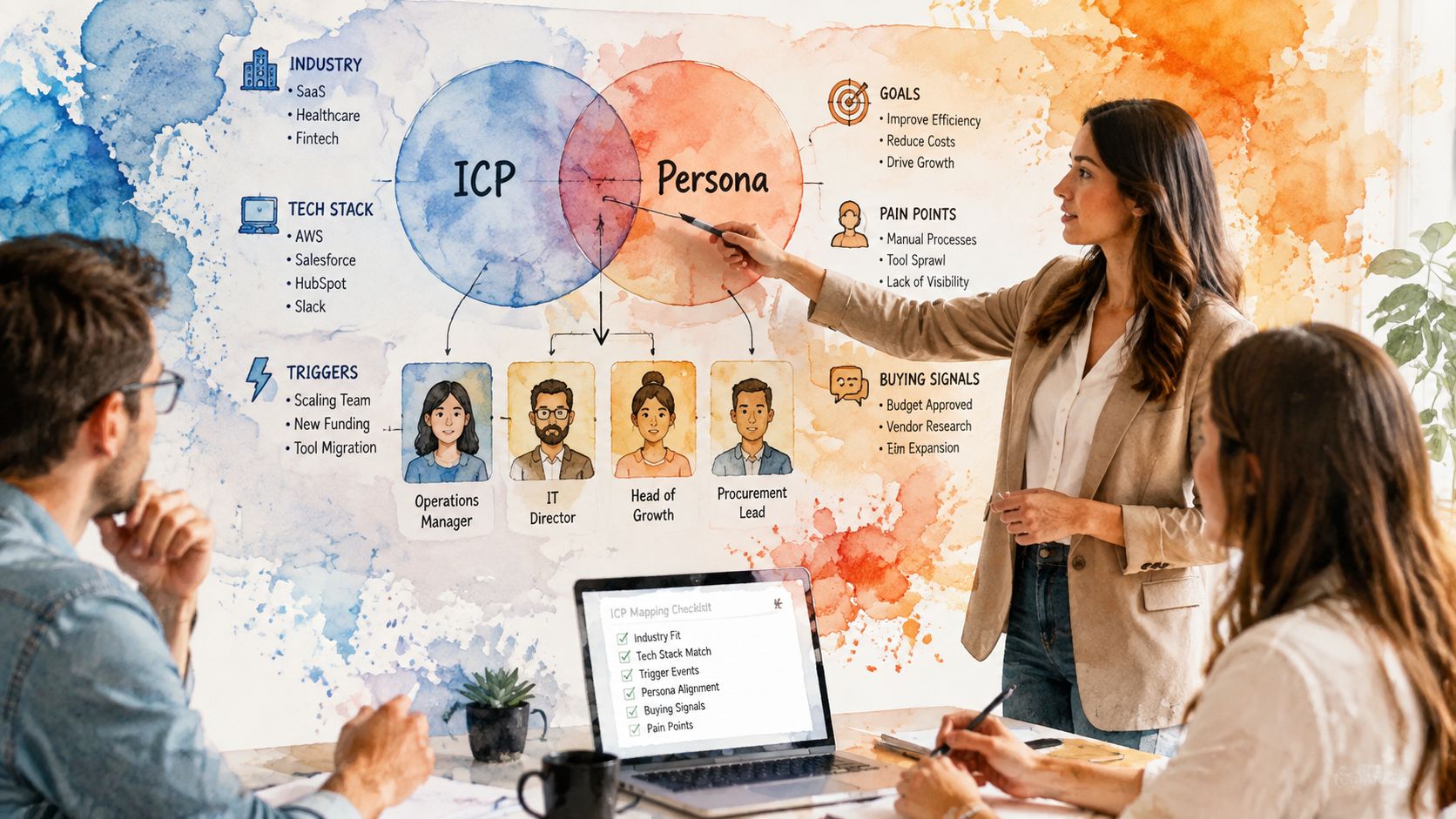
A hiring simulation becomes useful when account data creates the conditions a candidate must handle in real time. An ICP should not sit in a spreadsheet used only for lead scoring. Its fields can define the buyer's setting, business stakes, technical constraints, and reason for taking a call.
Start with the account context
Select the ICP details that will change the conversation:
- Industry and business model: Establish the operating environment and likely pressures.
- Technology stack: Surface integration concerns, incumbent tools, and technical dependencies.
- Buying trigger: Give the discussion urgency through a process change, new priority, or operational problem.
- Company profile: Set the account's scale and complexity without turning the prompt into a data quiz.
- Qualification boundaries: Define conditions that could make the account a poor fit.
Then assign a stakeholder to that account. Persona documentation should cover the role, relevant goals, pains, objections, success measures, and likely influence on the decision. Keep the account facts fixed while changing the person who must be persuaded.
Turn each persona into behavior
A persona earns its place in roleplay by creating a problem the candidate must solve. An operations leader may worry about disruption and request proof that employees can adopt the change. A finance stakeholder may challenge the commercial case and ask what happens if the expected value does not appear. Score the candidate's response, questioning, judgment, and next step, rather than whether they guess a hidden answer.
Overvue can generate AI roleplay scenarios from ICP details such as company context, buyer role, pains, common objections, competitors, and technology stack. Its simulations can score criteria including objection handling, call control, responsiveness, and next-step execution. Secure links also support remote, asynchronous candidate assessments. The same scenario structure can support new-hire practice by changing the persona, objection set, or deal stage. For hiring teams connecting simulations to selection decisions, this pre-hire assessment guide for 2026 provides relevant process guidance.
A practical setup uses the ICP to set the account and the persona to control behavior. That separation makes it easier to identify whether a candidate misunderstood the market, failed to adapt to the stakeholder, or lost control of the conversation.
Teams selecting the upstream system should compare segmentation tools before configuring the workflow. Segmentation can identify account groups, while a roleplay platform turns those groups into repeatable hiring and enablement conversations. The result is a direct path from firmographic criteria to observable sales behavior.
When to Use ICP Alone or Pair with Personas
The right framework depends on the decision in front of the team.
Use the ICP alone when the task is account targeting or qualification. Marketing operations can use it to build lists, revenue operations can apply it to scoring logic, and sales leaders can use it to prioritize territories. At that stage, adding detailed stakeholder psychology may slow the process without improving account selection.
Use a persona alone when the account is already qualified and the immediate task is message tuning. A content team refining a campaign for operations leaders may not need to rebuild the entire ICP. An enablement manager preparing an objection workshop may need only the stakeholder's role, priorities, concerns, and decision influence.
Pair both whenever the team is testing whether a rep can sell into a real market. That includes recruiting roleplays, onboarding simulations, account-based plays, discovery coaching, and deal reviews. The ICP keeps the scenario commercially relevant. The persona makes the conversation demanding enough to reveal judgment.
Assign ownership and refresh triggers
Recent neutral guidance distinguishes the owners and maintenance rhythms. It describes ICP reviews as quarterly and persona reviews as semi-annually, while noting that ICP work is more data-led and persona work is more qualitative, as outlined in this guide to ICP, personas, segmentation, and revenue operations.
A practical ownership model looks like this:
- Revenue operations: Owns ICP fields, fit rules, account scoring, and market or revenue-triggered revisions.
- Sales enablement: Owns persona behaviors, objection libraries, roleplay prompts, and coaching standards.
- Marketing and sales leaders: Validate whether the frameworks still match positioning and field reality.
- Hiring managers: Use both when evaluating candidates against actual selling conditions.
For interview design, an on-demand video interview guide for sales hiring can complement live simulation, but recorded responses shouldn't replace evidence from a realistic buyer conversation.
FAQ on ICP and Buyer Persona for Sales Teams
Who should own the ICP in a sales organization?
Revenue operations should usually maintain the ICP because the work depends on account data, qualification logic, territory decisions, and alignment between sales and marketing. Sales leadership and customer-facing teams still need to validate it, since CRM patterns alone may not explain why certain accounts progress, stall, or churn.
The owner should document both positive-fit signals and disqualifiers. A profile that lists only desirable characteristics gives reps no protection against attractive but unsuitable accounts.
Who should own buyer personas?
Sales enablement is a natural owner for personas because the output directly affects messaging, discovery, objection handling, and coaching. Product marketing and customer-facing managers should contribute evidence from positioning work, calls, support interactions, and lost opportunities.
A persona shouldn't become a marketing-only document. If reps can't use it to change a question, response, or next-step recommendation, it hasn't reached operational quality.
How can a team detect persona decay?
Teams can look for repeated signs in field behavior:
- Objection mismatch: Reps encounter concerns that the persona doesn't include.
- Buying-group gaps: New stakeholder roles appear in deals without clear messaging or enablement support.
- Positioning drift: Prospects describe the problem differently from the language in the persona.
- Coaching repetition: Managers repeatedly correct the same assumptions about priorities or decision criteria.
- Simulation failure: Roleplays produce unrealistic buyer responses because the prompt reflects an outdated conversation.
The benchmark cited earlier reports that persona accuracy can decay by about 20% within 18 months without updates, so teams shouldn't wait for a major campaign failure before reviewing the document. A new objection, committee pattern, or product position can justify an earlier revision.
How should assessment scores align with persona traits?
Each persona should map to observable behaviors, not personality labels. An operations persona might require the candidate to uncover process impact, acknowledge implementation concerns, and secure a next step with the right stakeholder. A finance persona might require clear value framing, disciplined assumptions, and responsiveness to risk questions.
A scoring rubric can assess discovery quality, objection handling, call control, responsiveness, and next-step execution. Those criteria allow hiring managers to compare behavior consistently across candidates and give new hires a direct practice target. The rubric should score what the candidate did in the conversation, not whether the evaluator personally liked the candidate's style.
Should every account have a separate persona?
No. Personas should represent recurring stakeholder patterns, not every individual contact. Teams can maintain a manageable set of role-based profiles and adapt them when account context changes the stakes.
The useful test is reuse. If a persona appears across qualified accounts and produces distinct messaging, objections, or coaching requirements, it earns a place in the program. If it contains details that never change a sales action, it belongs in the archive, not the roleplay.
What should a hiring manager do this week?
The fastest operational fix is to select one target account type and write one corresponding stakeholder scenario. Include the account's relevant ICP facts, the buyer's role, a realistic objection, and a clearly defined next step. Then score every candidate against the same behaviors and use the scenario again during onboarding.
That process exposes whether the team has a genuine ICP, a usable persona, or only a collection of vague descriptions. It also creates a direct connection between recruiting standards and the conversations reps must handle after they join.
Overvue turns real ICP details into AI buyer simulations for candidate assessment and sales-team practice, with standardized scoring for behaviors such as objection handling, call control, responsiveness, and next-step execution. Sales hiring and enablement leaders can use the shared scenario model to evaluate candidates consistently and train new hires safely. Visit Overvue to see how ICP-based roleplay can fit into the sales hiring and training workflow.